Sunbrella vs Stamoid vs Marine Polyester: Which Fabric Holds Up on a Superyacht in South Florida?
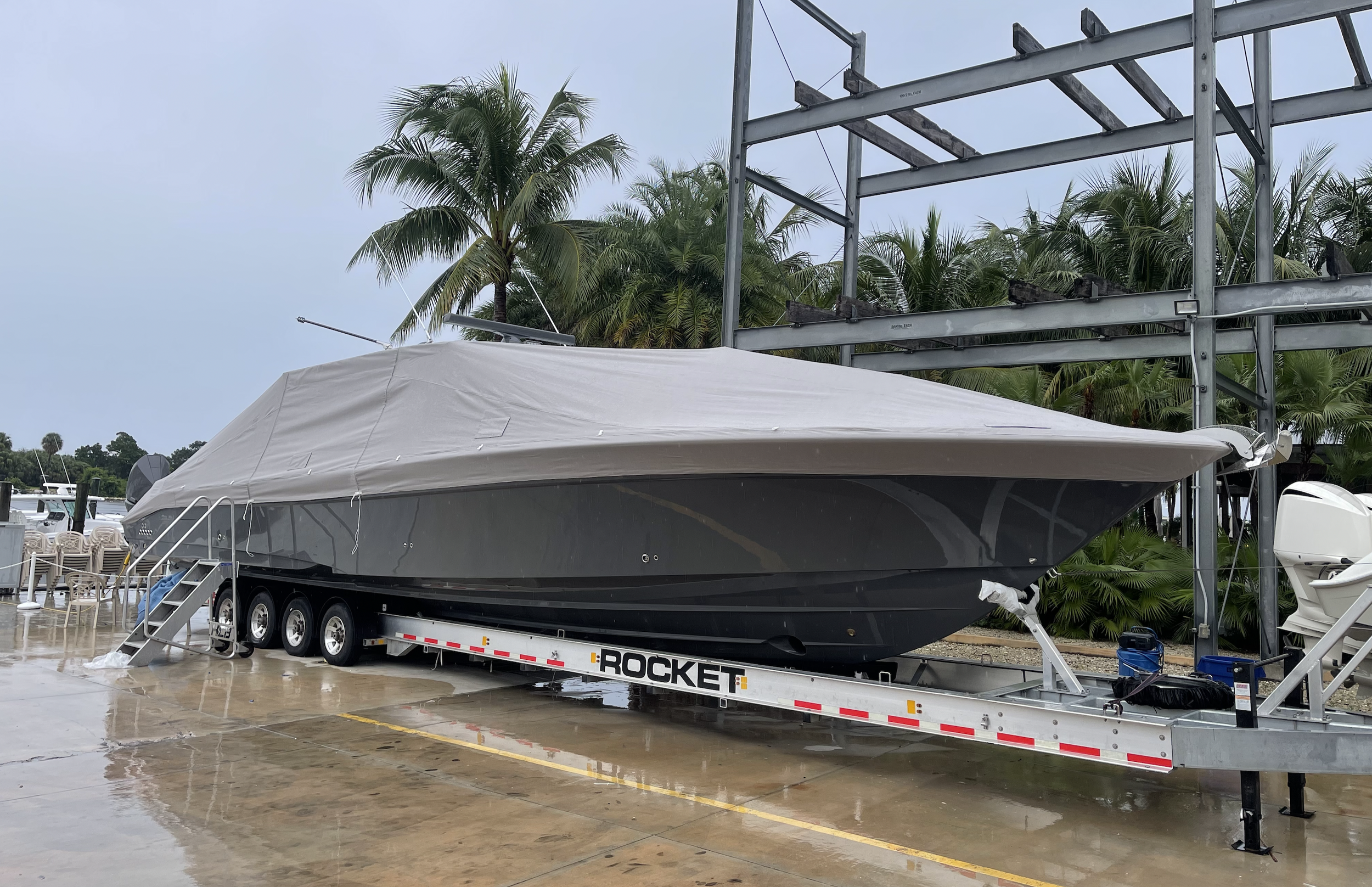
South Florida is one of the harshest environments a marine fabric can face — sustained UV intensity, high ambient humidity, salt air, and summer storms that don't follow a schedule. For captains and vessel managers responsible for protecting a motor yacht or superyacht, fabric selection is a technical decision with real consequences. Choose wrong and you're dealing with delaminated coatings, mildew on a $50,000 upholstery package, or covers that fail structurally mid-season. This guide compares Sunbrella, Stamoid, and marine polyester as cover materials for vessels 40ft and above — with a focus on UV resistance, moisture management, and longevity in the South Florida marine environment.
What South Florida's marine environment actually does to yacht covers
In salt air and high sun, the fabric usually isn’t the first thing to fail. More often, the failures come from:
Heat + UV weakening fibers, fading color, and degrading coatings.
Condensation under the cover (especially on larger yachts with more trapped air volume).
Mildew feeding on dirt and residue, not necessarily the fabric itself.
Abrasion and flexing at corners, rails, windshield frames, and tie-down points.
A cover that’s “waterproof” on paper can still create problems if it traps humidity, while a breathable cover can still leak at seams if it’s not patterned and supported correctly.
For harsh environments, the fabric choice matters, but patterning, ventilation, support poles, seam design, and thread often decide whether a cover lasts 3 years or 10+.
Sunbrella: Breathability-first protection (strong for heat, sun, and condensation control)
What it is: Sunbrella marine tops and covers fabric is a solution-dyed acrylic designed to prioritize UV stability, color retention, and breathability. Sunbrella backs many shade and marine fabrics with a 10-year limited warranty. (sunbrella.com)
Where Sunbrella shines in harsh conditions
Breathability is the headline advantage. In hot, humid, or high-condensation climates, airflow through the fabric helps reduce the “greenhouse” effect that drives mildew and corrosion on hardware below.
Sunbrella also has a long track record for UV stability, and marine performance documentation often references lab fade testing methods (commonly AATCC standards) and high-hour exposure results for solution-dyed acrylic categories.
The tradeoff: Not “true waterproof” like coated fabrics
Sunbrella is typically water resistant, not the same as a PVC-coated, seam-weldable fabric. In extended downpours or snow-load conditions, you may see seepage (often at seams or low points) unless the cover has strong pitch and support.
Also note a common misunderstanding: Sunbrella doesn’t “grow mildew,” but mildew can grow on dirt and organic residue left on the fabric, so cleaning still matters. (sunbrella.dickson-constant.com)
Best use cases
Sunbrella is often the right call when:
The boat sits outside in high UV regions.
You need condensation control (large cockpit areas, enclosed spaces, coastal humidity).
You want long-term color and fabric stability with a strong warranty baseline. (sunbrella.com)
Stamoid: Waterproofing-first protection (strong for rain, spray, and maximum water exclusion)
What it is: Stamoid is generally a PVC-coated polyester marine fabric family built to be waterproof and highly cleanable, with product listings describing mold/mildew resistance and waterproof performance. (trivantage.com)
Many Stamoid marine coated fabrics are covered by a 5-year limited warranty (varies by product line and terms). (trivantage.com)
Where Stamoid wins in harsh conditions
If your priority is keeping water out—period—Stamoid is hard to beat.
Because it’s coated, it’s also typically easier to wipe down (bird droppings, salt film, grime) than woven breathable canvases, which can be a practical advantage for yacht owners who want the cover to look sharp with less frequent deep cleaning. (trivantage.com)
The tradeoff: Waterproof can mean trapped moisture
The same characteristic that blocks rain can also trap humidity under the cover if you don’t build in ventilation. In warm coastal climates, that can accelerate mildew on surfaces beneath the cover and create that persistent “damp boat” smell.
This is why Stamoid projects often benefit from intentional venting, good cover pitch, and avoiding long-term “sealed up tight” storage.
Best use cases
Stamoid is often the right call when:
You’re in heavy rain, frequent spray, or storm-prone areas.
The cover must be fully waterproof (or as close as possible) for equipment protection.
You can design for ventilation and good airflow under the cover. (trivantage.com)
Polyester: The affordability option (good short-term value, but know the limits)
What it is: In yacht covers, “polyester” can mean everything from lower-cost mass-market fabrics to higher-end solution-dyed polyesters. As a category, polyester is often chosen for lower upfront cost, with performance depending heavily on denier, coating, and construction.
In practical buyer guidance, polyester options are frequently positioned as more budget-friendly than premium solution-dyed acrylics and coated marine fabrics, with shorter expected service life in punishing sun.
Where polyester makes sense
Polyester can be a smart pick when:
The boat is stored under cover part of the year.
You need a cover now and plan to upgrade later.
The cover is for seasonal use, trailering, or interim protection.
Higher-grade solution-dyed polyesters can narrow the gap, but if you’re comparing “average polyester cover” to premium marine fabrics, UV and long-term durability are typically where polyester gives up ground first.
Head-to-head comparison table (what matters most for yacht covers)
Factor that affects real-world lifespan
Sunbrella (solution-dyed acrylic)
Stamoid (PVC-coated polyester)
Polyester (varies by grade)
Water protection
Water resistant (depends on design and pitch)
Often water resistant; coatings vary
Breathability (condensation control)
High (key strength) (sunbrella.com)
Low; needs vents
Moderate to low (varies)
UV / color longevity signals
Strong; backed by 10-year limited warranty (sunbrella.com)
Strong UV resistance claims; warranty often 5 years
Mixed; depends on solution-dyed vs piece-dyed and coating
Mildew management
Often treated; still needs ventilation to avoid trapped humidity
Highly dependent on finish and maintenance
Best fit for harsh climates
Hot/humid, high UV, condensation-prone
Wet, stormy, spray-heavy
Mild climates, seasonal use, budget-driven
Typical buyer motivation
Long-term protection + airflow
Maximum water exclusion
Lowest upfront cost
Some boat cover builds (especially yacht enclosures, dodgers, and cockpit protection systems) mix canvas with vinyl components—think clear panels, reinforcement bands, and wipe-clean sections. In those cases you may see marine upholstery/covering options like yachtsman marine vinyl, majestic sea marine vinyl, or atlantis marine vinyl used for sections where cleanability and water exclusion matter more than breathability.
If your cover design includes clear “windows,” your choice is often between smoke clear and regular clear depending on glare, visibility, and heat management.
Also, avoid accidentally cross-shopping automotive patterns for marine exposure: items like ford g-grain, gm monticello, daytona, autobahn, or “automotive vinyl dodge chrysler jeep caprice ford g” are useful search terms in automotive upholstery, but marine UV + salt + wet-dry cycling usually demands marine-rated materials and specs. The same goes for novelty categories like specialty vinyl animal skins—they can look great in the right interior project, but they’re not automatically the right choice for exterior marine weathering.
If you’re pulling specs, color cards, or ordering guidance, many suppliers centralize these in a resource center catalog (for example, if you’re already shopping at Trivantage, check their Trivantage resources alongside the product listing you’re using).
1) Choose by climate first (because moisture behaves differently in each region)
Hot + humid + high UV (many coastal areas):
Favor breathability to reduce condensation.
Sunbrella is often a top fit because it helps the boat “dry out” under the cover. (sunbrella.com)
Rainy + cool + frequent storms:
Favor waterproofing and high-quality seam design.
Stamoid is often a strong match, but add vents to avoid damp trapping.
Mixed seasons (hot summers + winter storage):
If the cover stays on for long periods, breathability usually pays off.
If winter is wet and the boat can’t be checked often, waterproofing can reduce water intrusion risk (as long as ventilation is engineered in).
2) Then choose by usage (how the cover lives day-to-day)
Daily/weekly use (you take it on/off often):
Weight, foldability, and ease of handling matter.
Breathable fabrics often feel easier to live with, while coated fabrics can be bulkier but wipe clean faster.
Long-term mooring or storage:
Prioritize: UV stability + seam integrity + ventilation + abrasion reinforcements.
The longer the cover stays on continuously, the more condensation control becomes a deciding factor.
High-chafe layouts (rails, hardtops, tall windshields):
Regardless of fabric, plan for chafe patches and smart tie-down geometry.
Fabric choice can’t “outperform” bad abrasion points.
3) Finally choose by vessel size (bigger boats amplify condensation and stress)
Center consoles and smaller boats:
Polyester can be acceptable if you’re upgrading later or storing indoors part-time.
Sunbrella is a common premium upgrade for longer lifespan and UV stability. (sunbrella.com)
Mid-size cruisers:
Condensation becomes more noticeable under large spans.
Sunbrella often performs well here; Stamoid works if venting and pitch are engineered.
Large yachts:
The cover is a system, not a sheet of fabric.
Waterproof fabrics can protect aggressively, but ventilation planning becomes non-negotiable to avoid moisture damage under the cover.
If you’re investing in a premium fabric, make sure your shop also specifies UV-resistant thread and builds in venting/support. Great fabric with failing thread or pooling water still fails early.
A practical selection checklist (quick decision filter)
Use these questions to narrow your choice fast:
Do you fight condensation and mildew more than rain intrusion?
Yes → lean Sunbrella (breathability). (sunbrella.com)
No → consider Stamoid (waterproofing).
Will the cover stay on for weeks at a time without removal?
Yes → prioritize breathability + vents + high UV stability. (sunbrella.com)
Is this a short-term cover or a long-term protection plan?
Short-term → polyester can make sense.
Long-term → Sunbrella or Stamoid typically offer better durability signals and warranty support. (sunbrella.com)
Is your biggest risk “water getting in” or “moisture getting trapped”?
Water getting in → Stamoid.
Moisture trapped → Sunbrella. (sunbrella.com)
Bottom line: The best fabric depends on the problem you’re solving
Choose Sunbrella when your harsh condition is UV + heat + humidity, and you want a breathable cover with long warranty backing. (sunbrella.com)
Choose Stamoid when your harsh condition is rain + spray + maximum waterproofing, and you can engineer ventilation into the cover design.
Choose polyester when your harsh condition is mostly budget pressure, or the cover is temporary/seasonal—just be realistic about lifespan in full sun.
Working on a cover or enclosure project for a vessel in Fort Lauderdale, West Palm Beach, or Miami? American Marine fabricates custom canvas systems for motor yachts and superyachts 40ft and above — dockside, with 3D digital patterning and cloud-stored templates for future reorders. Schedule a dockside assessment.