
How Custom Vessel Covers Are Fabricated for Large Yachts and Superyachts in South Florida
Why Precision-Fabricated Vessel Covers Matter on Large Yachts
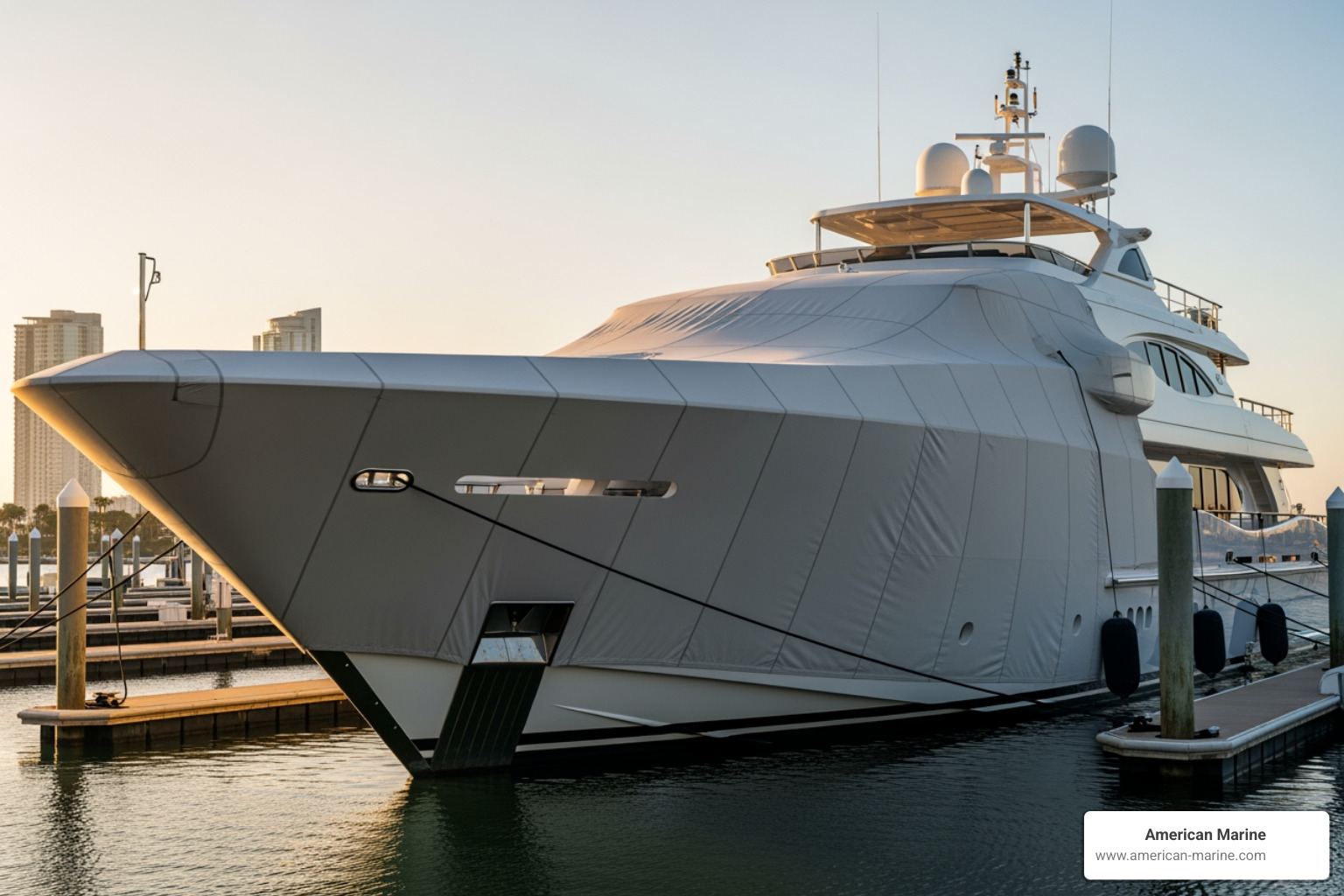
A precision-fabricated vessel cover protects a large yacht through exact fit, marine-grade materials, and vessel-specific engineering. For motor yachts and superyachts operating in South Florida, key specification criteria include:
- Fit Precision — 3D digital measurement for exact contours across complex superstructure geometry
- Material Grade — Solution-dyed acrylics (Sunbrella) or coated polyesters (WeatherMAX) for UV and water resistance rated for South Florida conditions
- Fabrication Quality — CNC cutting, reinforced seams, PTFE thread, and engineered chafe protection
- Functional Design — Integrated ventilation, secure tie-down systems, and zippered crew access
- Expected Service Life — 7–15 years with consistent maintenance in South Florida's marine environment
Generic and semi-custom covers fail on large yachts — producing water pooling, abrasion, wind flap, and an appearance inconsistent with the vessel's standard. For vessels 40ft and above with complex deck geometry and custom superstructures, an ill-fitting cover accelerates surface deterioration and creates maintenance problems that exceed the cost of correct specification from the outset.
I'm Jeremy Bottau, owner of American Marine. We specialize in precision vessel cover fabrication for luxury yachts and superyachts using 3D digital patterning and CNC cutting technology. Our process delivers the exact fit and material durability that builders, captains, and refit managers require for vessels in South Florida's demanding marine conditions.
Why Custom-Fit Covers Are Essential for Professional Marine Operations
For large yachts and superyachts, a custom-fabricated vessel cover is a critical component of asset preservation and operational readiness. Unlike universal alternatives, a custom-fit solution is engineered to the precise contours of a specific vessel — accommodating its exact deck profile, hardware configuration, and superstructure geometry. This precision extends the vessel's service life and protects the interior surfaces and finishes that represent a significant investment.
The Failure Modes of Generic Covers on Large Vessels
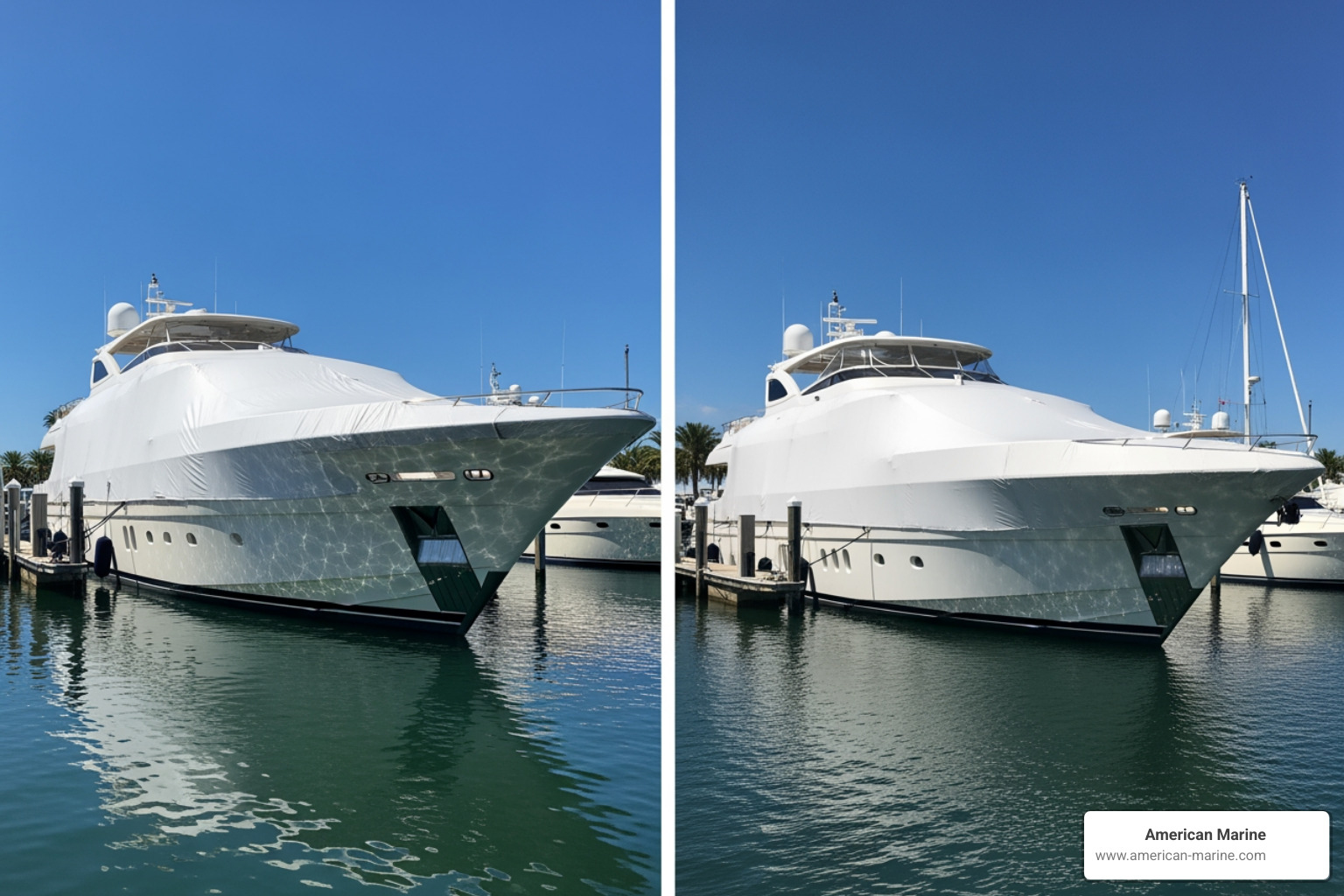
Generic and semi-custom covers for large yachts produce consistent, predictable failure modes that compound over time:
- Water Pooling: Excess material sags and collects rainwater — promoting mildew growth on the cover, deck, and upholstery beneath it, while the added weight stresses fabric and stitching and accelerates seam failure.
- Abrasion at Contact Points: An ill-fitting cover chafes against hardware, gelcoat, and railings — particularly in South Florida's wind conditions. Constant rubbing produces scratches and wear marks that require cosmetic remediation.
- Reduced Service Life: Wind flap, water pooling, and poor tensioning shorten service life from 7–15 years to 2–4 years — converting an apparent cost saving into repeated replacement expense.
- Inadequate Attachment: Generic tie-down systems are insufficient for the wind loads on large vessels, producing billowing or complete cover loss in South Florida's afternoon storm conditions.
For a detailed analysis of the cost dynamics, see our article The Hidden Costs of Generic Covers: Why Custom-Fit Saves Money Long-Term.
The Value of Professional Custom Fabrication
For professional marine operations, a custom-fabricated vessel cover is an investment in the vessel's longevity and operational readiness. Exact fit — produced through 3D digital measurement — eliminates water pooling, chafing, and wind flap. Elite marine-grade materials — Sunbrella, WeatherMAX, Stamoid — perform correctly through South Florida's UV intensity and storm season. Reinforced stitching, chafe protection, and vessel-specific attachment systems produce a cover that performs for its full rated service life. To understand more about why precision fabrication is the correct standard for large vessel work, see our article Why Yacht Builders and Designers Partner with American Marine.
Selecting Marine-Grade Fabrics: Technical Specification for South Florida
Choosing the correct fabric for a large vessel cover requires a technical assessment of material properties against environmental and operational demands. South Florida's UV intensity, humidity, and frequent rain require fabrics with documented performance credentials — not generic "marine-grade" claims.
- UV and Mildew Resistance: Materials must be engineered specifically for the UV degradation and mildew growth rates of South Florida's tropical environment.
- Water Repellency and Breathability: A cover must shed water effectively while allowing trapped moisture to escape — preventing the condensation and mold buildup that occurs beneath fully waterproof covers without integrated ventilation.
- Fabric Weight and Construction: Weight is one indicator of durability, but construction quality, coating type, and thread specification are equally determinative of service life.
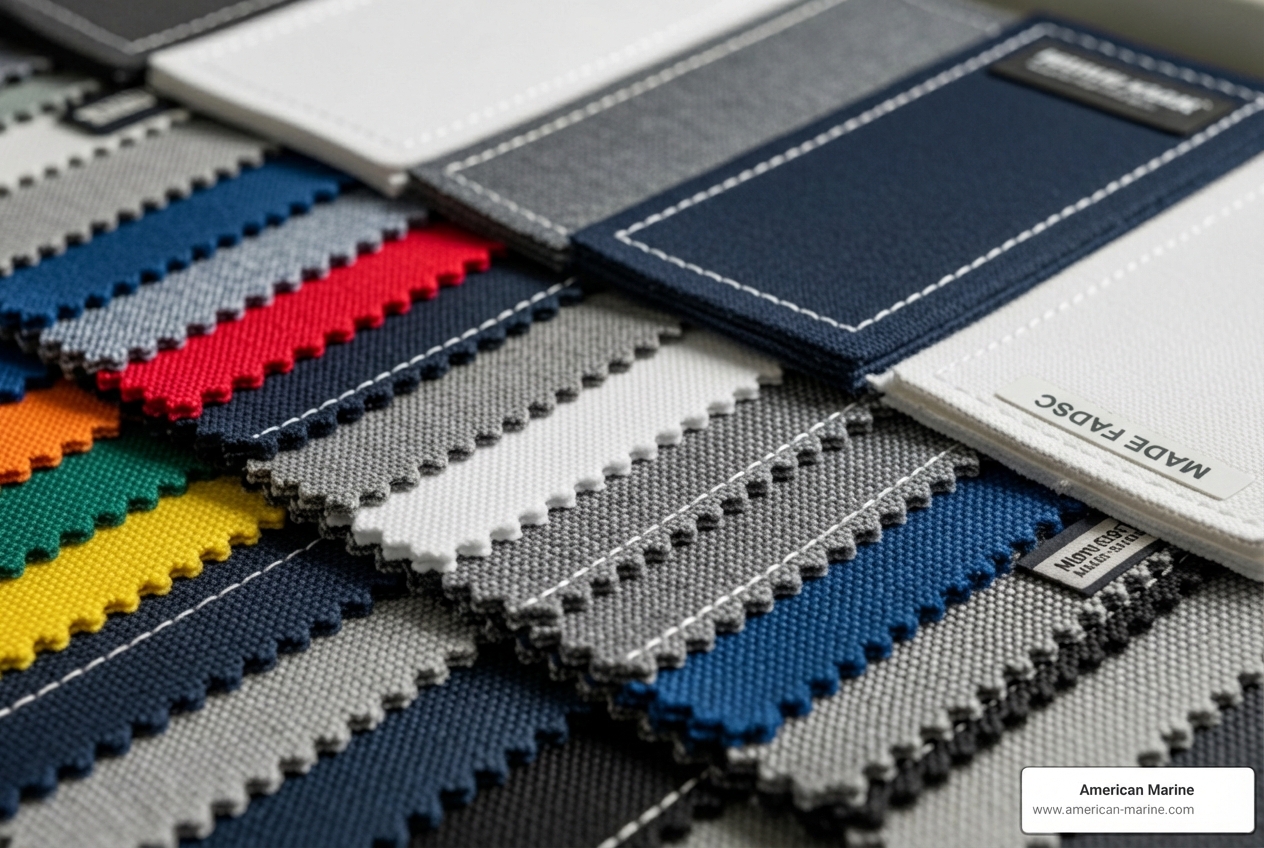
Solution-Dyed Acrylics
Solution-dyed acrylics — Sunbrella being the industry standard — are the professional specification for sun-exposed vessel cover applications. Color is embedded in the fiber before weaving, not applied to the surface — delivering UV resistance and colorfastness that holds through multiple South Florida seasons without retreatment.
- Colorfastness: Intrinsic color resists fading from sustained UV radiation — the cover maintains its appearance through years of South Florida sun exposure.
- UV Resistance: Blocks a high percentage of UV rays, protecting the vessel's surfaces, upholstery, and electronics from degradation beneath the cover.
- Breathability: Solution-dyed acrylic breathes — water vapor escapes from beneath the cover, preventing condensation and mildew on enclosed interior surfaces.
- Manufacturer Warranty: Premium solution-dyed acrylics carry 10-year limited fabric warranties, reflecting their documented service life in marine applications.
For a detailed comparison of solution-dyed acrylic vs. vinyl-coated polyester for superyacht cover applications, see our article Sunbrella vs Stamoid: Which Marine Fabric Reigns Supreme for Superyacht Covers?
High-Performance Coated Polyesters
High-performance coated polyesters — WeatherMAX being the most widely specified — offer an alternative where extreme durability and water resistance are the primary requirements.
- Hydrostatic Resistance: Coated polyesters resist water penetration under pressure — the correct specification for applications where complete waterproofing is required.
- Strength-to-Weight Ratio: Strong and tear-resistant while remaining relatively lightweight — manageable for crew handling on large vessel applications.
- Dimensional Stability: The polyester base resists abrasion and retains its shape without stretching or sagging — maintaining the cover's precise fit through sustained use.
- Manufacturer Warranty: Premium coated polyesters carry 7-year limited fabric warranties.
The Fabrication Process: Digital Measurement to Precision Assembly
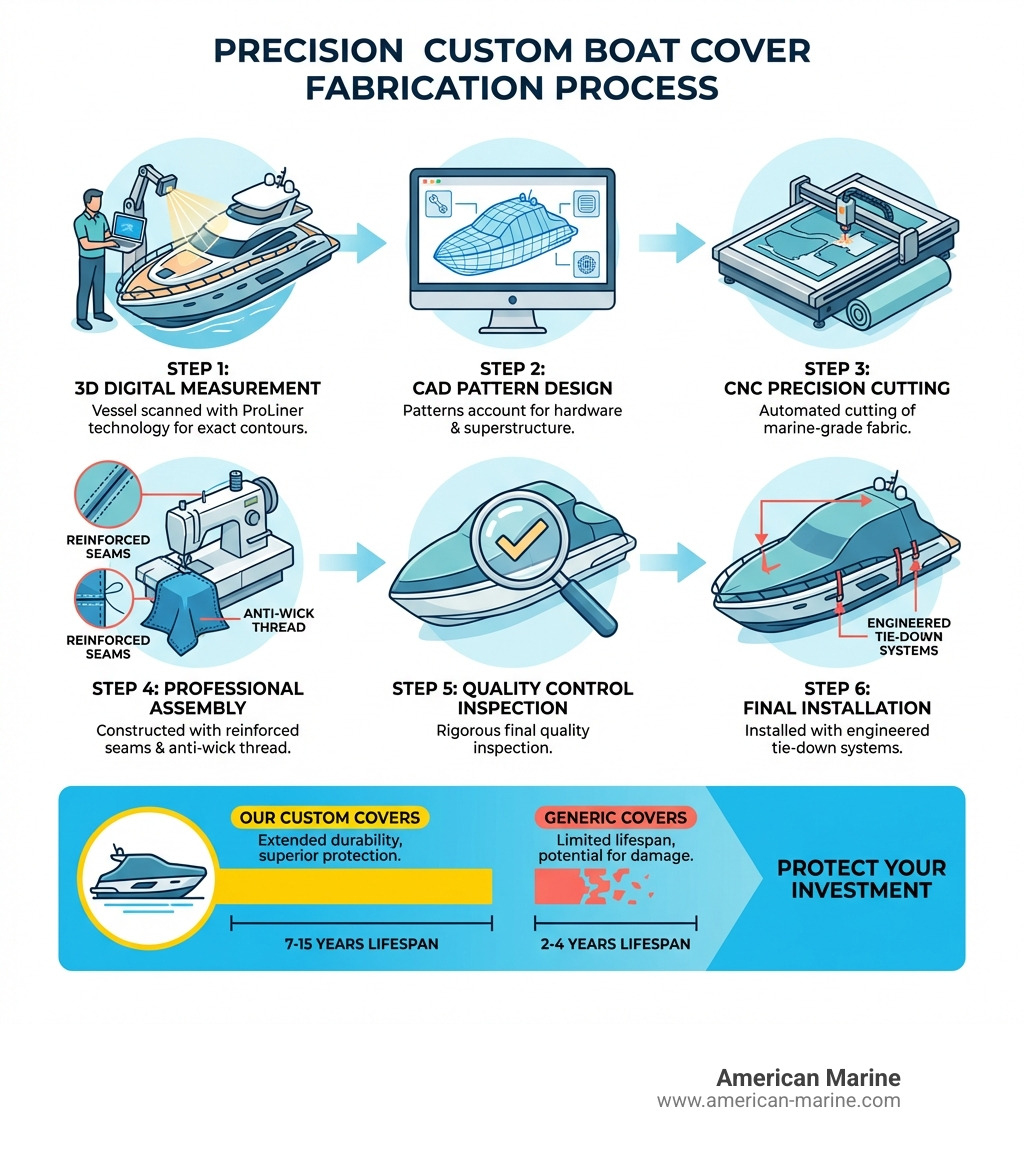
The creation of a correctly fitted vessel cover for a large yacht combines digital technology with expert fabrication at every stage. Unlike traditional manual patterning, our process eliminates the measurement inconsistencies that produce fit problems on complex vessel geometry — and produces results that are repeatable across replacement cycles without remeasuring the vessel.
Step 1: 3D Digital Measurement and CAD Design
Every American Marine vessel cover project begins with on-site 3D scanning using ProLiner technology — capturing the exact dimensions and contours of the vessel's deck, superstructure, and hardware with millimeter precision. This creates a digital blueprint that accounts for every detail: curved windshields, antenna bases, radar arch configurations, stanchion positions, and hardware attachment points that manual measurement cannot consistently replicate.
Our design team processes the scan data through CAD software to:
- Model Complex Geometry: Translate the vessel's exact shape into a digital pattern accounting for all curves and compound surfaces
- Integrate Hardware: Design precise cutouts and reinforcements around deck equipment to ensure seamless fit and prevent chafe
- Engineer Water Shedding: Profile every panel for correct water drainage without pooling — the primary functional requirement of a correctly designed large vessel cover
Digital templates are archived in cloud storage — enabling identical replacement covers to be fabricated from any location without remeasuring the vessel.
Step 2: CNC Cutting and Professional Assembly
Digital patterns from CAD are sent directly to CNC cutting equipment — each fabric panel cut to exact specification, eliminating the human error that produces misaligned seams and fit problems in manually cut covers. CNC cutting also optimizes fabric layout, reducing material waste on large vessel projects where fabric costs are significant.
Assembly is performed by experienced marine canvas fabricators in our South Florida facility. Key construction standards:
- Four-Ply Folded Seams: No raw edges — maximum seam strength and resistance to fraying under sustained stress
- PTFE Thread (Anti-Wick): UV-stable and impervious to salt and chemicals — prevents water wicking through stitch lines and ensures seams outlast the fabric
- Double Stitching: Critical stress points and hems are double-stitched for increased tensile strength under wind load
- Chafe Protection: Integrated at all hardware contact points — antennas, radar domes, cleats, stanchion bases — preventing the abrasion that produces premature cover failure
Key Features in Professional Vessel Cover Specification
A correctly specified vessel cover for a large motor yacht integrates functional features that distinguish professional fabrication from generic alternatives:
- Engineered Tie-Down Systems: Heavy-duty adjustable strap systems and 1/4" draw rope in the hem distribute tension evenly and secure the cover against South Florida wind loads — not the elastic cord systems that fail within a season
- Reinforcements at Stress Points: Robust vinyl or webbing reinforcements around windshields, cleats, and stanchions prevent tearing at the locations where generic covers consistently fail
- Integrated Ventilation: Strategically placed vents allow continuous airflow beneath the cover — preventing the condensation and mildew buildup that fully sealed covers produce on enclosed spaces
- Zippered Access Doors: Crew access to specific areas without removing the entire cover — a practical operational feature on large vessels where full cover removal is a significant operation
- Support Pole Compatibility: Sewn-in pads for internal support poles maintain a peaked profile over wide deck areas — preventing the water pooling that flat-lying covers produce during South Florida's tropical rain events
Structural Reinforcement Standards
Structural integrity at every critical point determines how long a vessel cover performs at specification:
- Four-Ply Seams: Maximum bond strength and no raw edges — the professional standard for large vessel cover fabrication
- Hardware Reinforcement: Durable vinyl or webbing at cleats, stanchions, and grab rails prevents the abrasion and tearing that generic covers experience at these contact points within their first season
- Chafe Guards: Specialized guards integrated at antenna, radar dome, and winch contact points protect both the cover and the vessel's gelcoat surfaces
- Bow and Stern Reinforcement: Additional material at these high-load zones improves resilience against the elevated wind loads at vessel extremities
Maintenance and Service Life of Custom Vessel Covers
A correctly specified and professionally fabricated vessel cover delivers 7–15 years of service life in South Florida's marine environment. Maintenance consistency is the primary variable that determines where in that range a cover lands. For detailed canvas care guidance, see our article More Than a Cover: The Role of Custom Canvas in Yacht Preservation.
Maintenance Protocol for Captains and Crew
- Routine Cleaning: Clean with mild soap and lukewarm water or marine-approved fabric cleaners — removes salt, dirt, and biological contamination before it degrades fabric coatings. Never use harsh detergents, solvents, or pressure washers.
- Complete Drying Before Storage: The cover must be fully dry before folding — mildew develops rapidly in stored damp canvas and requires remediation that exceeds the cost of prevention.
- Regular Inspection: Seams, stitching, tie-downs, and reinforcements should be inspected on a consistent schedule — minor issues addressed early prevent progression to panel-level failure.
- Water Repellency Maintenance: If water no longer beads on the surface, re-treat with marine-grade fabric guard according to the manufacturer's specification — restores water shedding performance as the fabric ages.
Service Life and Warranty Coverage
Two distinct warranty types apply to a professional vessel cover:
- Fabric Warranty: Provided by the material manufacturer — Sunbrella carries a 10-year limited fabric warranty, WeatherMAX carries a 7-year limited warranty. These cover material defects and significant loss of color or strength, not normal wear or improper maintenance.
- Fabrication Warranty: Provided by American Marine — covers craftsmanship including stitching quality, seam strength, and hardware specification.
Combined correctly specified materials with consistent maintenance produces covers that reliably reach the upper end of the 7–15 year service life range in Fort Lauderdale, West Palm Beach, and Miami.
Conclusion
For builders, captains, and refit managers of large motor yachts and superyachts, a correctly specified and professionally fabricated vessel cover is a fundamental component of asset protection and operational readiness. The complex geometry of these vessels demands precision and material standards that generic solutions cannot deliver — particularly in South Florida's demanding marine environment.
American Marine fabricates custom vessel covers for motor yachts and superyachts across Fort Lauderdale, West Palm Beach, and Miami. If you're planning a cover project for a vessel 40ft or above, schedule a dockside assessment and we'll evaluate your vessel's specific requirements and recommend the correct specification.