
Waterproof Yacht Cushions for Motor Yachts and Superyachts: Materials, Foam, and Care
Why Waterproof Yacht Cushions Matter on Motor Yachts and Superyachts
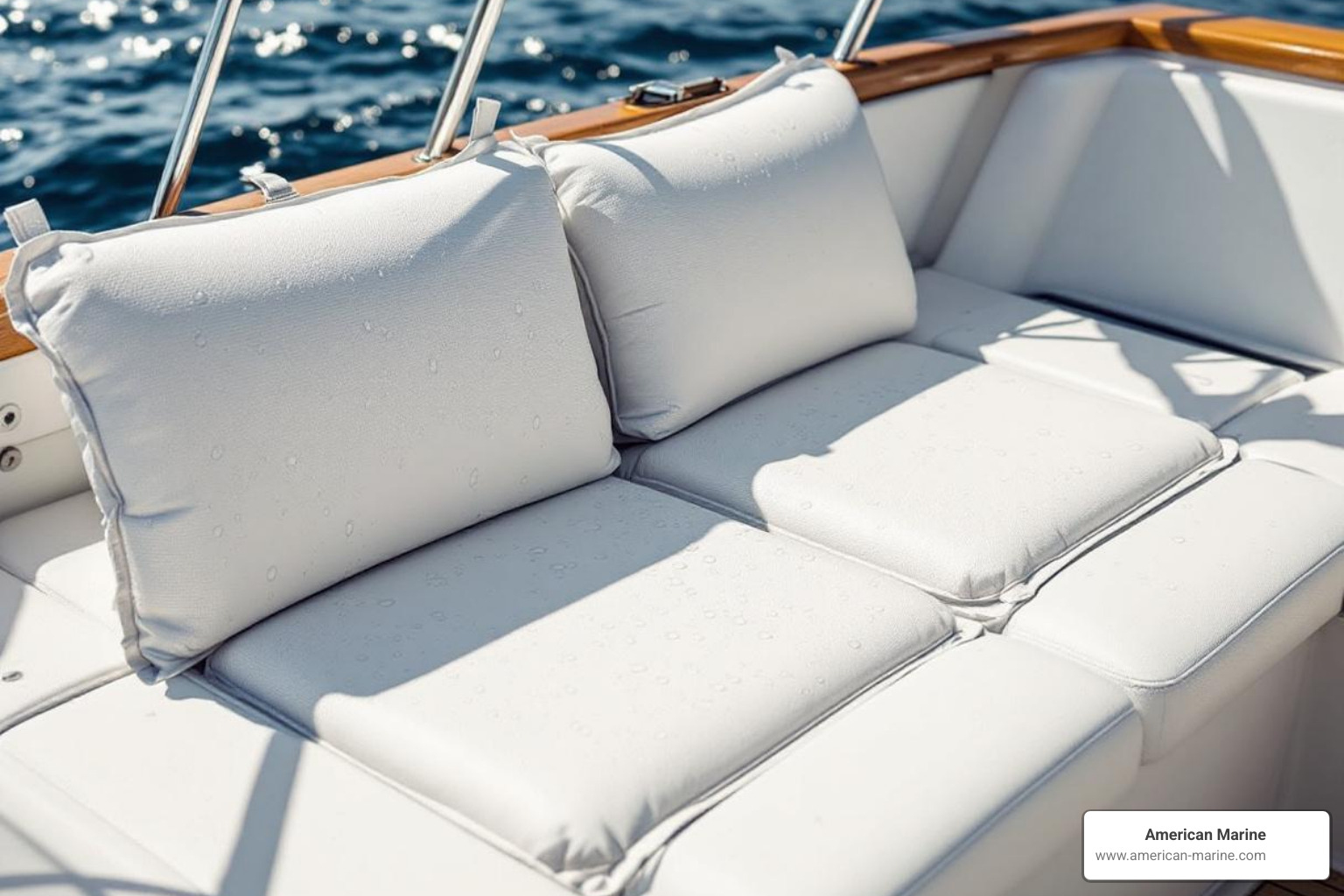
Waterproof cushions on a motor yacht or superyacht are a functional specification decision — not just a comfort upgrade. In South Florida's high-UV, high-humidity environment, the wrong foam absorbs water and becomes a mildew source within a season. The wrong fabric fades, cracks, or loses structural integrity before it reaches end of design life. This guide covers how professional-grade waterproof cushions are specified for large vessels — foam selection, fabric options, and the maintenance protocol that determines service life in South Florida's marine conditions.
Key Specification Criteria:
- Foam Type: Closed-cell foam (water-repellent) or reticulated open-cell foam (quick-draining) — selected by application zone
- Fabric: Marine-grade vinyl or solution-dyed acrylic for UV resistance and mildew resistance in South Florida conditions
- Density: 1.8–4.5 lbs/ft³ depending on application zone and use intensity
- Essential Features: Antimicrobial treatment, UPF 50+ UV resistance, marine-grade zippers, and drainage-optimized backing
- Construction: Minimal-seam or seamless designs to prevent water intrusion at exposed seam points
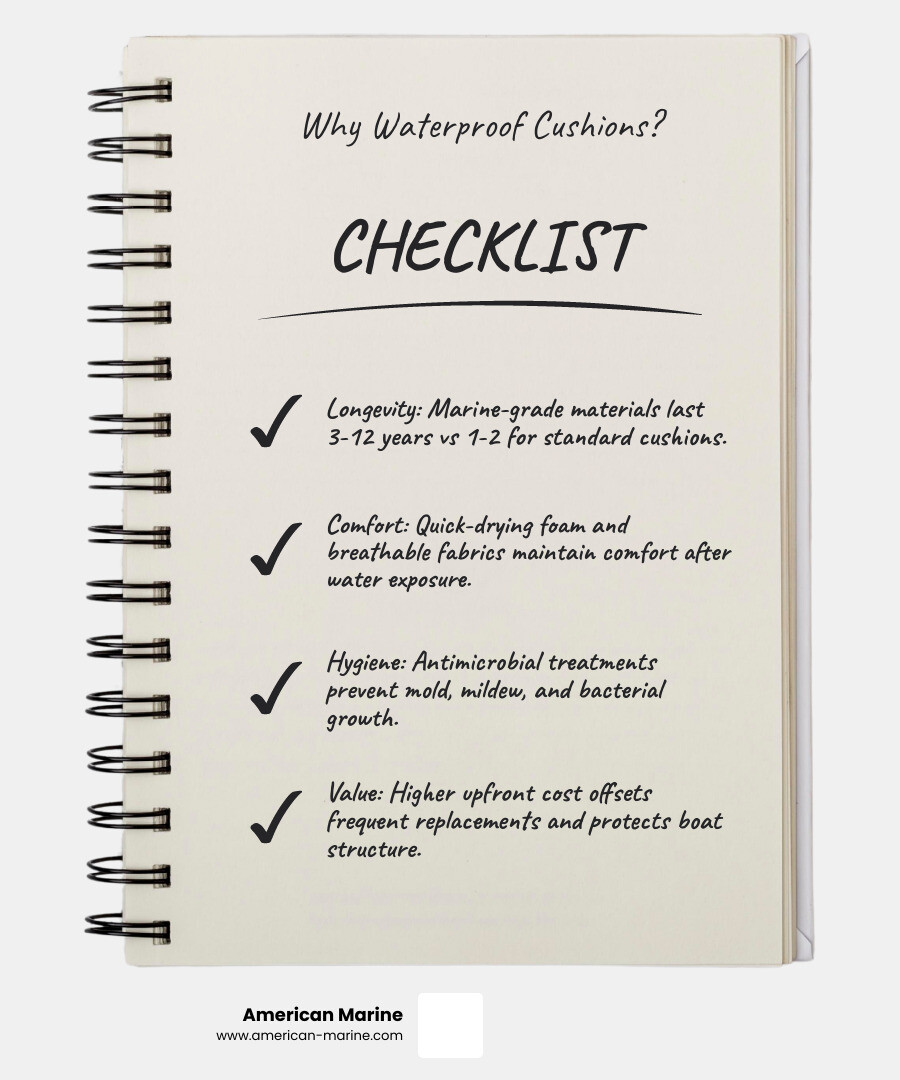
Correctly specified waterproof cushions combine engineered foam and marine-grade fabrics to create a moisture management system that drains and dries quickly — eliminating the mold, odor, and structural breakdown that standard foam produces in a single South Florida season. A quality marine cushion specification delivers 5–12 years of service life depending on foam density, fabric specification, and maintenance consistency.
I'm Jeremy Bottau, owner of American Marine. We specialize in custom marine upholstery for motor yachts and superyachts in South Florida, and our experience consistently shows that foam specification and fabric selection are the primary variables that determine how long waterproof cushions perform in demanding marine environments.
The Anatomy of a Professional-Grade Waterproof Yacht Cushion
A correctly specified waterproof marine cushion is an engineered system — not simply foam in a waterproof cover. From the foam core to the outer fabric and stitching, every component works to manage moisture, prevent absorption, and withstand South Florida's marine environment. The foam core is specified to either repel water entirely or drain and dry rapidly. It is wrapped in a marine-grade fabric that resists UV radiation and saltwater, often with a mesh backing to allow drainage and promote airflow beneath the cushion. This layered approach is what produces a cushion that performs correctly through an active South Florida season.
Foam Specification for Marine Applications
The foam core is the most consequential specification decision. The choice is between closed-cell and reticulated open-cell foam, each suited to different application zones on a motor yacht or superyacht.
Closed-cell foam is inherently waterproof because its cellular structure consists of sealed air pockets that do not absorb water. It is firm and resilient, with densities from 3–4.5 lbs/ft³. The correct specification for application zones with heavy water exposure — cockpit seating on vessels without enclosures, exposed aft deck cushions, and applications where flotation is a safety consideration.
Reticulated open-cell foam (Dryfast) manages water differently — its large interconnected cells allow water to flow directly through, enabling rapid drying. This rapid drainage inhibits mold and mildew growth. While not waterproof in the way closed-cell foam is, it is the correct specification for plush interior and semi-exposed cushions on motor yachts and superyachts where comfort is the priority and drainage is the moisture management strategy. Typical density of 1.8 lbs/ft³.
High-density polyurethane foam (1.8–2.8 lbs/ft³) with antimicrobial treatment is a common specification for salon and interior seating applications. When paired with a marine-grade vinyl or acrylic cover, it provides reliable support with service life from 5–12 years depending on density and maintenance.
Densified fibre padding — heat-bonded polyester — is a water-impervious alternative that dries in 3–4 hours and is increasingly specified for exterior applications where weight is a consideration.
| Feature | Closed-Cell Foam | Reticulated Open-Cell Foam (Dryfast) |
|---|---|---|
| Water Absorption | None — water-repellent | Allows water to flow through |
| Drying Speed | N/A — no absorption | Very fast |
| Firmness | Very firm — 3–4.5 lbs/ft³ | Variable, can be plush — 1.8 lbs/ft³ |
| Buoyancy | Excellent — 100% flotation | Low — water flows through |
| Best Application | Exposed cockpit seating, safety pads, flotation applications | Plush exterior seating, sun pads, semi-exposed areas |
| Mold/Mildew | Highly resistant | Highly resistant due to rapid drainage |
Fabric Specification for Waterproof Cushion Applications
The outer fabric is the cushion's primary defense against South Florida's UV intensity and saltwater exposure. Three professional-grade options:
- Marine-Grade Vinyl: The correct specification for applications requiring complete waterproofing and maximum durability — high-traffic exterior seating, helm chairs, and cushions in direct spray zones. Easy to clean and resistant to saltwater and UV when correctly specified.
- Solution-Dyed Acrylics (Sunbrella): Color embedded in the fiber — not applied to the surface — delivering UV resistance and colorfastness that holds through multiple South Florida seasons. Highly water-resistant rather than fully waterproof. The correct specification for exterior cushions where breathability and appearance are priorities alongside water resistance.
- Marine-Grade Polyester: Engineered for high performance with water column ratings ≥ 1,500 mm, UPF 50+ UV protection, and high tensile strength. A practical specification for applications where vinyl's weight or appearance is not suitable.
Construction details are equally important: PVC mesh backing for drainage, corrosion-resistant marine-grade zippers positioned away from direct water exposure, and minimal top-surface seaming to reduce water intrusion points.
Specifying Waterproof Cushions by Application Zone
Correct cushion specification matches the foam and fabric to the vessel's specific application zones — exposure level, traffic intensity, moisture contact, and maintenance availability. The correct specification differs by zone.
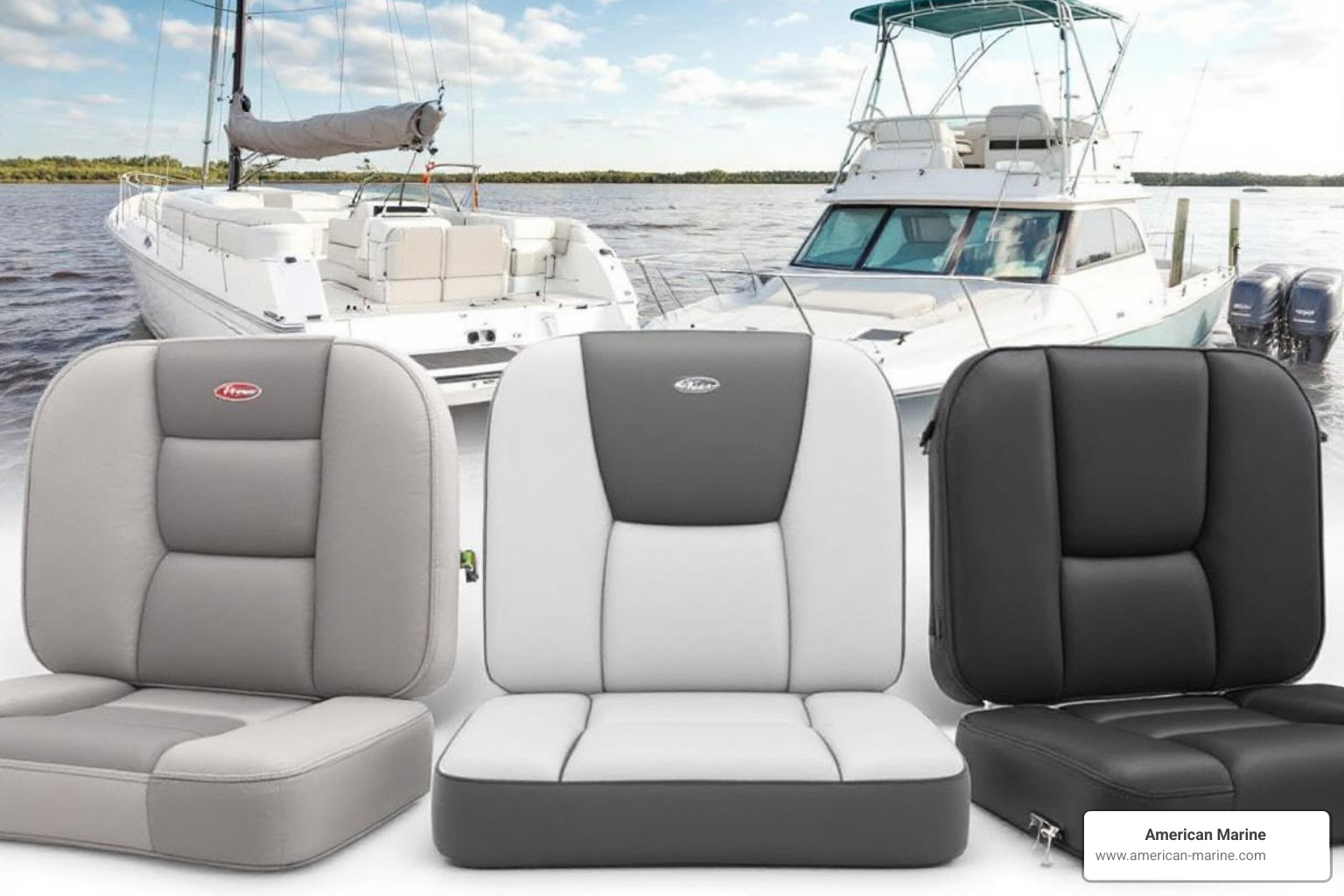
Application Zone Specification for Motor Yachts and Superyachts
- Exterior Deck and Sun Pad Areas: High UV exposure, direct rain contact. Correct specification: closed-cell or Dryfast foam with marine-grade vinyl or solution-dyed acrylic cover. Drainage-optimized backing required. Minimal top-surface seaming.
- Cockpit Seating (Enclosed): Moderate UV and moisture exposure depending on enclosure system. Correct specification: high-density polyurethane foam with marine-grade vinyl or acrylic cover. Antimicrobial treatment recommended for enclosed spaces.
- Interior Salon Seating: Controlled moisture environment. Correct specification: open-cell foam appropriate — prioritize comfort and aesthetic alongside moisture resistance. Fabric selection can include a wider range of solution-dyed acrylics and upholstery vinyls.
- Custom Superyacht Applications: For vessels in Miami, Fort Lauderdale, and West Palm Beach where cushions must integrate with a broader interior design system, custom solutions are the only approach that delivers precision fit and design coordination. For context on how upholstery specification connects to the broader interior, see our article Custom Yacht Upholstery for Motor Yachts and Superyachts.
Performance Features That Define Specification Quality
- Mold and Mildew Resistance: Antimicrobial-treated foams or rapid-drying reticulated foams prevent fungal growth in South Florida's high-humidity conditions.
- UV Protection: UPF 50+ fabric rating with high lightfastness (Grade 6–7) to prevent fading and fiber degradation under sustained UV exposure.
- Colorfastness: Solution-dyed fabrics maintain color integrity through years of sun exposure and cleaning — surface-dyed alternatives fade significantly faster.
- Seam Construction: Minimal or seamless top surfaces reduce water intrusion points. Marine-grade zippers placed away from direct exposure prevent corrosion and seam failure.
- Drainage Performance: Mesh backing or open-cell foam structure allows water to drain and air to circulate — preventing the waterlogging that degrades foam structure and produces mildew.
Maintenance and Long-Term Value
Correctly specified waterproof cushions require consistent maintenance to reach their rated service life. South Florida's saltwater environment accelerates surface degradation on any material not actively maintained.
Maintenance Protocol
Routine Cleaning:
- Wipe down with fresh water after each use to remove salt residue before it crystallizes and abrades the fabric surface.
- For deeper cleaning, use mild soap and a soft brush. Rinse thoroughly. Never use harsh detergents or bleach-based products that damage protective coatings.
- Air dry completely in a ventilated area before storing — mildew develops rapidly in stored damp cushions and requires remediation that exceeds the cost of prevention.
Seasonal Care:
- Use marine-specific fabric cleaners for persistent stains. Even antimicrobial foam requires surface cleaning to prevent organic buildup that hosts mildew growth.
- Store cushions in a dry, ventilated space during extended lay-up periods. Elevate cushions to allow airflow underneath during storage.
Service Life and Lifecycle Value
Correctly specified waterproof cushions deliver 5–12 years of service life depending on foam density, fabric specification, and maintenance consistency. The lifecycle cost advantage over repeatedly replacing lower-grade cushions that fail within one or two South Florida seasons is significant — compounded by the vessel damage costs that moisture from failed cushions produces in the surfaces and spaces beneath them.
- Reduced replacement frequency: A quality specification outlasts three or four standard cushion cycles.
- Vessel protection: Preventing moisture from reaching the vessel's structure protects against rot, corrosion, and electronics damage — costs that far exceed the investment in correct cushion specification.
- Maintained vessel presentation: UV-resistant and stain-resistant fabrics preserve the vessel's appearance through an active charter or cruising season.
Custom-Fit Cushions for Motor Yachts and Superyachts
Off-the-shelf cushions are unsuitable for motor yachts and superyachts where precision fit, design coordination, and material specification to the vessel's specific application zones are required. At American Marine, we fabricate custom waterproof cushions for large vessels throughout South Florida using 3D digital measurement and professional-grade materials.
Why Custom Fit Matters on Large Vessels
- 3D Precision Measurement: We capture your vessel's exact contours using advanced 3D measuring — producing a fit with no gaps, no movement underway, and correct drainage geometry across every cushion surface.
- Design Coordination: Complete control over fabric, color, and stitching allows specification that integrates with the vessel's interior design system — not just the immediate seating zone. For context on how cushion specification connects to the broader upholstery system, see our article The Art of Marine Upholstery: Where Form Meets Function on the Water.
- Application-Zone Material Optimization: Each zone on the vessel is specified independently — foam density, fabric type, and construction details matched to the specific exposure and use pattern of that area.
- Functional Integration: Custom designs accommodate hinged sections for storage access, shaped profiles for hull-contoured berths, and configurations that use available space without compromise.
When Custom Specification is Required
- Non-standard layouts: Motor yachts and superyachts with custom deck configurations where no standard cushion pattern fits correctly.
- Design system integration: Vessels where the cushion specification is part of a broader interior design project requiring material and color coordination across all soft goods.
- Long-term value: The extended service life and superior performance of a correctly specified custom cushion system delivers greater total value than repeated replacement of ill-fitting, commodity alternatives.
Conclusion
Correctly specified waterproof cushions are one of the most practical maintenance investments on a motor yacht or superyacht operating in South Florida. The right foam, the right fabric, and precision fit to the vessel's geometry produces a cushion system that performs through an active season without mold, moisture breakthrough, or premature material failure.
American Marine fabricates custom waterproof cushions for motor yachts and superyachts across Fort Lauderdale, West Palm Beach, and Miami. If you're planning a cushion replacement or upholstery project on a vessel 40ft or above, schedule a dockside assessment and we'll evaluate your vessel's specific requirements and recommend the correct specification for each application zone.