Custom Yacht Upholstery for Motor Yachts and Superyachts: Materials, Process, and Care
Custom yacht upholstery on a motor yacht or superyacht is a technical fabrication project — not an off-the-shelf purchase. Every cushion, panel, and seating system is designed to fit the specific geometry of your vessel, specified in marine-grade materials engineered for South Florida's UV intensity and saltwater exposure, and fabricated to a standard that holds up through an active charter or cruising season. This guide covers what separates professional custom upholstery from generic alternatives, how to specify materials correctly, what the fabrication process involves, and how to maintain the result through South Florida's demanding marine conditions.
Understanding Custom Yacht Upholstery: What Sets It Apart?
Custom yacht upholstery is distinguished from off-the-shelf alternatives by three factors: precision fit to the vessel's specific geometry, marine-grade material specification, and fabrication quality that holds up under sustained marine use. Each of these factors has measurable consequences for how long the upholstery performs and what it costs to maintain over its service life.
What Defines Custom Yacht Upholstery
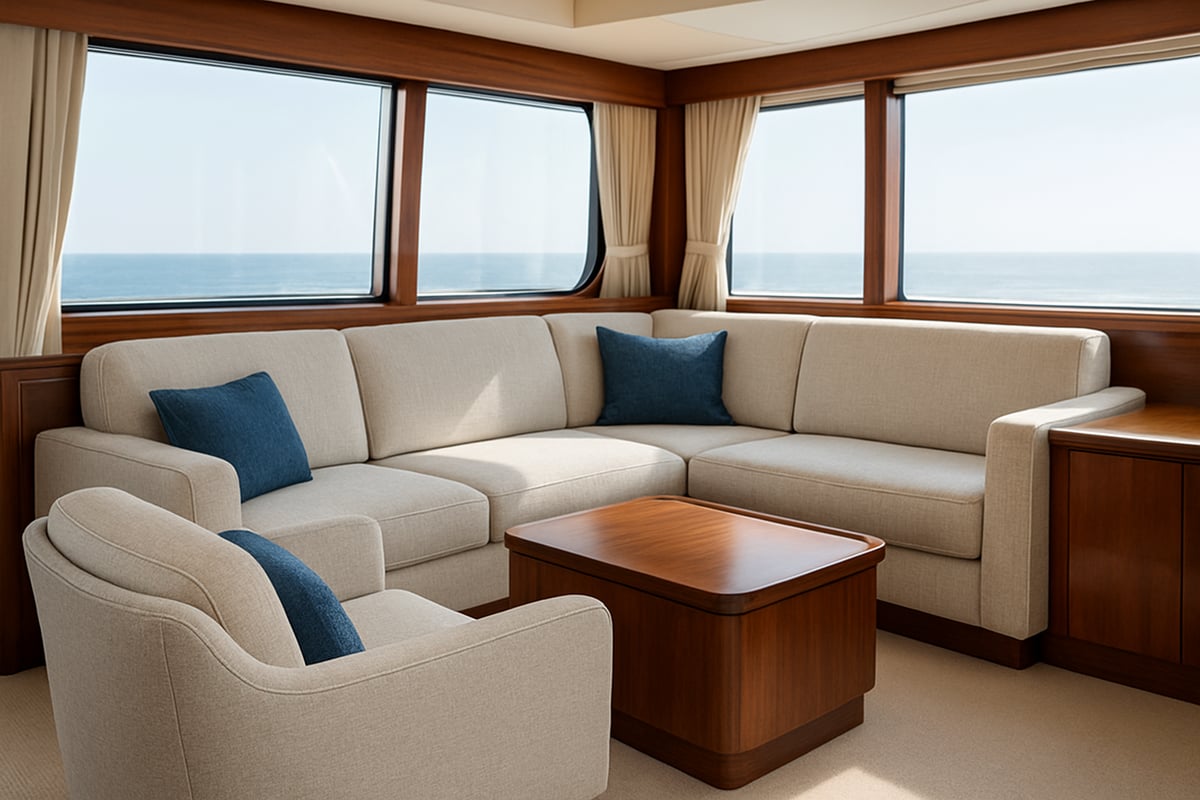
Custom upholstery means every piece is patterned, cut, and fabricated to fit the exact contours of your vessel — from the sunpad geometry on the aft deck to the salon sofa profiles below. There is no bunching, no awkward gaps, and no visible compromise between the piece and the surface it covers. The fit is engineered, not approximated.
Marine-grade materials are the performance foundation. Fabrics like Sunbrella and Stamoid are engineered for sustained UV exposure, salt spray, and humid conditions — the failure modes that destroy residential or automotive upholstery within a single season in South Florida. Their UV stabilization ratings, mildew resistance, and colorfastness are not marketing claims — they are documented performance specifications that determine service life in real operating conditions. For further context on what this craftsmanship involves, see our article The Art of Marine Upholstery: Where Form Meets Function on the Water.
The return on a correctly specified and fabricated custom upholstery project is measurable: longer service life, lower maintenance cost, and preserved vessel value compared to generic alternatives that require more frequent replacement.
Operational Benefits for Captains and Vessel Managers
For captains and vessel managers overseeing a motor yacht or superyacht, custom upholstery has direct operational implications. Correctly specified marine-grade materials reduce crew maintenance time — fabrics with proper protective topcoats clean effectively with standard products rather than requiring specialized treatments or frequent professional intervention. Precision-fit cushions and panels stay in position through sea conditions and don't require constant repositioning. Digital template archiving means replacement panels can be fabricated without remeasuring the vessel — an important operational advantage for vessels that move between ports and yards.
The 3D Digital Patterning Advantage
3D digital patterning has changed the precision standard for custom yacht upholstery fabrication. Digital templates capture exact vessel geometry — curves, compound angles, hardware attachment points — producing a fit that hand-measured templates cannot consistently replicate. Clients review digital renderings before fabrication begins, confirming design decisions before material is cut. This reduces waste, eliminates surprises, and produces a result that matches the design intent precisely. Industry data indicates 3D patterning reduces material waste by up to 20% compared to traditional templating — a meaningful efficiency gain on superyacht-scale projects where material costs are significant.
Choosing the Right Materials: Fabrics, Foams, and Finishes
Material specification is where most custom yacht upholstery projects succeed or fail. The correct specification matches the material's performance profile to the specific application zone — UV exposure level, moisture contact, traffic intensity, and maintenance availability.
Marine-Grade Fabrics: Specification by Application
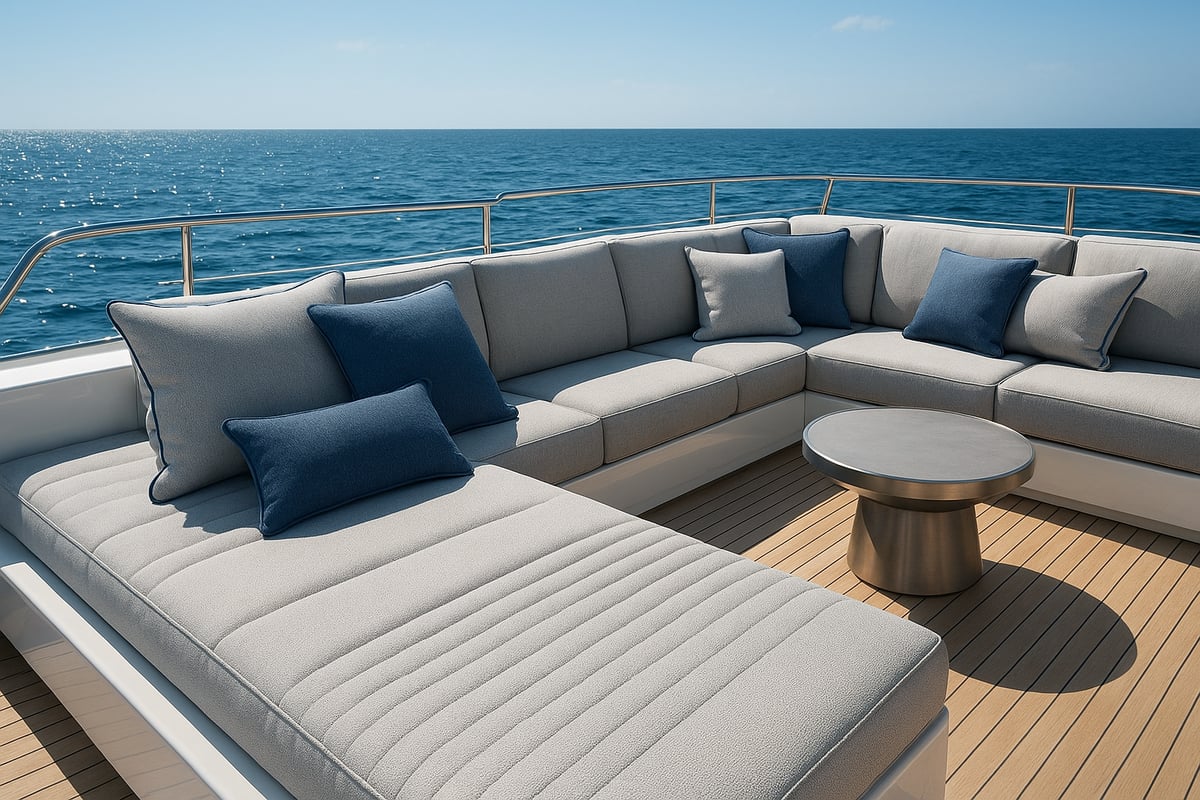
The professional fabric category for yacht upholstery is defined by UV stabilization ratings, mildew resistance treatments, abrasion resistance ratings, and waterproofing performance. The industry's established specifications — Sunbrella solution-dyed acrylic and Stamoid vinyl-coated polyester — remain the correct choices for the majority of applications on motor yachts and superyachts. Newer entrants with recycled fiber content and reduced chemical treatments are expanding the specification options for owners with sustainability priorities.
| Attribute | Standard Vinyl | High-End Woven Vinyl |
|---|---|---|
| Texture | Smooth | Textured, premium appearance |
| UV Resistance | Good | Excellent |
| Breathability | Low | Higher |
| Eco-Friendly Options | Limited | Increasingly available |
Color selection on large vessels involves more than aesthetic preference — colorfastness under South Florida's UV intensity determines how long the specified color holds before fading. Solution-dyed fabrics, where pigment is embedded in the fiber rather than applied as a surface treatment, deliver significantly better long-term colorfastness. For context on how material selection affects comfort and appearance across different application zones, see our article From Deck Chairs to Sun Lounges: Elevating Comfort with Marine Upholstery.
Foam and Cushioning Specification
Foam specification is as consequential as fabric selection — it determines both comfort performance and how the cushion holds up through sustained moisture exposure in South Florida's marine environment.
Closed-cell foam is the correct specification for any exterior cushion application. It does not absorb water, maintains shape and support through rain events and spray exposure, and does not develop the mold and odor problems that open-cell foam creates in exterior marine applications. Open-cell foam — softer and more comfortable — is appropriate for interior applications in protected areas where moisture exposure is managed.
Quick-dry foam systems (EZ-Dri and similar products) are increasingly specified on active motor yachts and charter vessels where cushions need to recover quickly after rain or spray without extended drying time. Anti-microbial foam treatments are a worthwhile specification on any vessel operating in South Florida's high-humidity conditions.
Foam specification considerations by application zone:
- Exterior sun pads and deck seating: closed-cell, UV-stable cover material required
- Cockpit seating: closed-cell or quick-dry — depending on enclosure level and exposure
- Interior salon seating: open-cell appropriate where moisture exposure is controlled
- Crew quarters: durable, easy-clean specification — antimicrobial treatment recommended
Finishing Details That Determine Quality
The finishing standard separates professional custom yacht upholstery from commodity work. Reinforced double-stitched seams with UV-stable thread — not standard polyester thread — are the correct specification for any marine upholstery application. Marine-grade zippers, properly lubricated and protected, prevent the corrosion failures that strand owners with non-functional cushion covers in the middle of a season. Custom piping, embroidery, and monogramming are available options that add vessel identity without compromising the material's performance profile. Protective topcoats for stain and mildew resistance extend cleaning intervals and reduce the crew maintenance burden over the upholstery's service life.
The Professional Fabrication Process
A professional custom upholstery project on a motor yacht or superyacht follows a structured process designed to eliminate the errors that produce poor fit, material waste, and rework.
Step 1: On-Vessel Consultation and Assessment
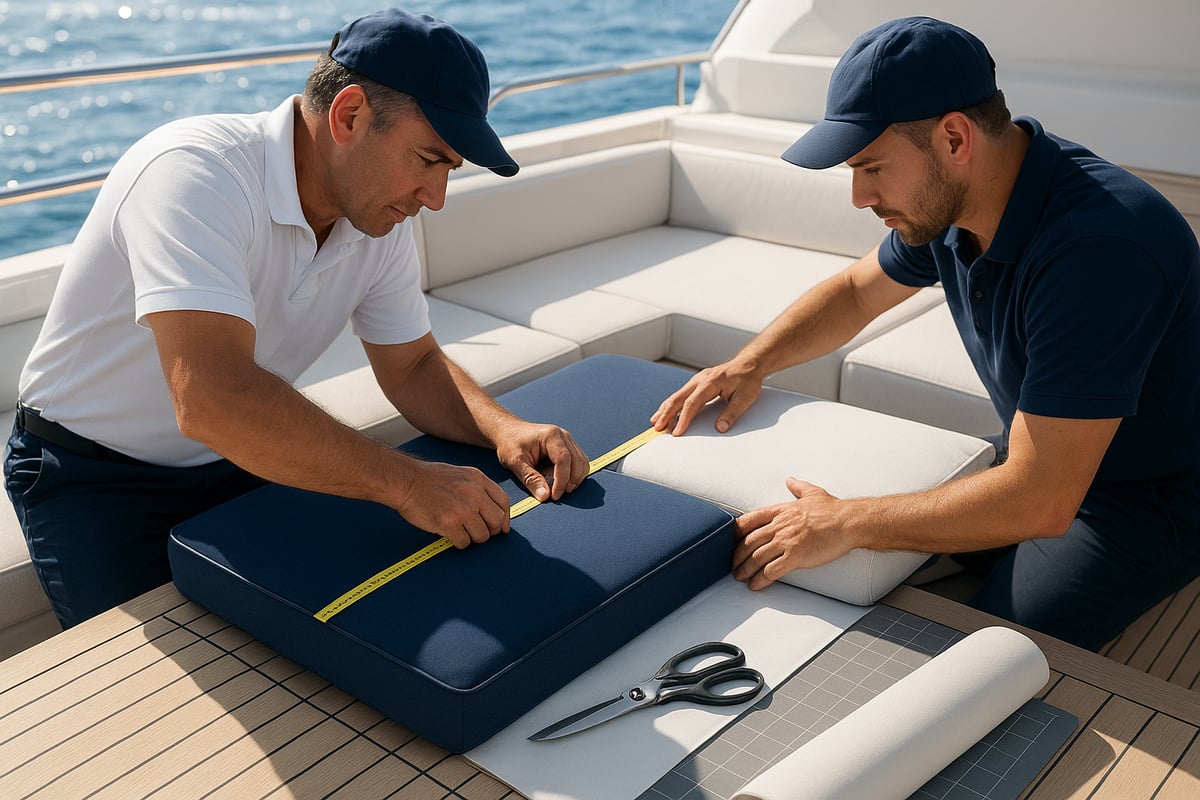
The process begins with an on-vessel assessment — not a showroom consultation. A specialist walks through every area of the vessel, evaluating current upholstery condition, identifying UV damage and material failure, assessing foam compression and structural integrity, and documenting the specific geometry of each seating and cushion zone. The assessment covers:
- UV damage and material failure patterns indicating end-of-life condition
- Comfort issues from foam compression loss in high-use seating
- Design alignment with the vessel's current interior scheme
- Application zone requirements — exposure level, traffic intensity, moisture contact
For context on what a professional vessel assessment and transformation looks like in practice, see our article Inside a Yacht Makeover: Transformations with Custom Canvas and Upholstery.
Step 2: Design Confirmation and Material Selection
With the assessment complete, design and material decisions are finalized. Digital renderings allow captains and owners to review color, fabric, and layout decisions before any material is cut or fabricated. Physical samples — fabric swatches, foam density comparisons, hardware finishes — confirm tactile and visual decisions that digital renderings cannot fully represent. 3D digital patterning captures exact vessel geometry, producing templates that account for compound curves, hardware attachment points, and the specific dimensional constraints of each application zone. Material waste is minimized because cutting is done from precise digital templates rather than hand-measured approximations.
Step 3: Fabrication
Fabrication is executed in our South Florida facility against the digital templates produced from the vessel assessment. Each piece is cut with precision-cutting technology, assembled by experienced marine upholstery fabricators, and inspected at multiple quality control points before leaving the facility. Seams are double-stitched with UV-stable thread. Hardware is specified for marine corrosion resistance. Zippers are marine-grade and properly protected. Every detail that determines how the finished piece performs in service is verified before installation.
Step 4: Dockside Installation and Adjustment
Installation is performed at your vessel. Each cushion, panel, and seating section is fitted on-site, with our team making final adjustments to ensure fit, function, and appearance match the design intent. On-site installation allows immediate correction of any fit issues that arise from vessel-specific conditions not captured in the template — and ensures the final result matches what was agreed at the design confirmation stage. Fire resistance, material safety certifications, and marine compliance are verified before handover.
Step 5: Care Handover
At project completion, the captain or vessel manager receives a complete care brief — cleaning protocols for each material specified, maintenance schedules, product recommendations, and guidance on end-of-life indicators for each application zone. Digital templates are archived in our cloud system, enabling replacement panels to be fabricated to the original specification without remeasuring the vessel — an operational advantage for vessels that require component replacement during an active season or from a remote location.
Design Considerations for Motor Yachts and Superyachts
Color and Colorfastness
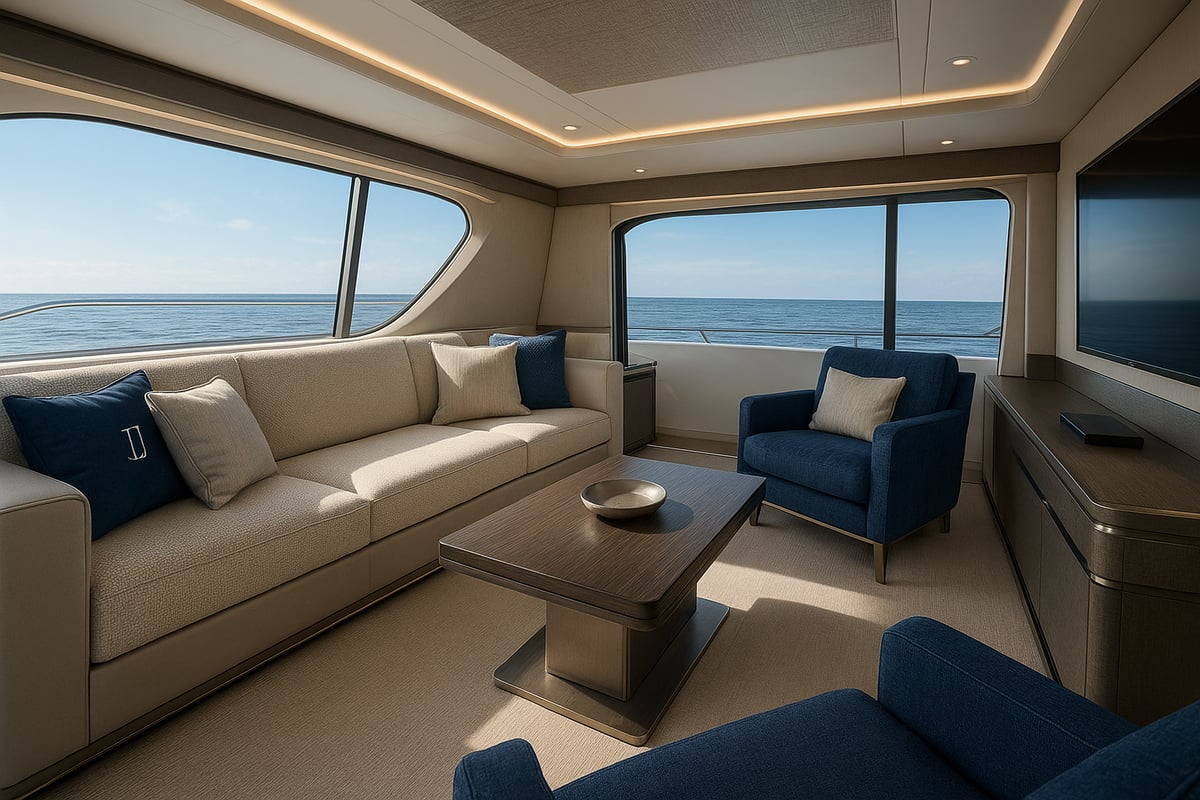
Color selection on large vessels is a technical decision as much as an aesthetic one. Solution-dyed fabrics — where pigment is embedded in the fiber structure rather than applied as a surface treatment — deliver the best long-term colorfastness under South Florida's UV intensity. Coastal neutrals, warm whites, and tonal greys hold their appearance well through sustained sun exposure and are forgiving of the minor soiling that accumulates during active use. Bolder colors and custom prints are available in professional marine-grade specifications — the key is confirming the colorfastness rating before specifying for exterior or high-UV applications.
Texture and Material Layering
Mixing materials across a vessel's interior — smooth PU vinyl in owner's areas, textured woven vinyl in salon seating, performance fabric on exterior cushions — creates visual depth and allows each zone to be specified for its actual performance requirements rather than applying a single material across all applications. Textured finishes provide practical grip benefits in sea conditions alongside their aesthetic value. The material layering approach requires coordination between the fabricator and the interior designer or naval architect to ensure the specifications are consistent with the overall interior design system.
Vessel Identity and Custom Details
Custom embroidery, monograms, vessel name integration, and tone-on-tone branding are standard options on motor yachts and superyachts where the interior reflects the vessel's identity. These details add a level of exclusivity and personalization that clearly signals the quality of the overall interior without competing with the material's performance profile. Smart textile options — temperature-regulating materials, integrated LED systems in upholstered panels — are available for vessels where technology integration is a design priority.
Maintenance: Keeping Custom Upholstery in Condition
Daily and Seasonal Maintenance Protocol
Consistent maintenance is the primary determinant of how long custom yacht upholstery performs at specification in South Florida's saltwater environment. After each use, brush off debris and rinse seating surfaces with fresh water to remove salt residue before it crystallizes and abrades the fabric surface. Use marine-approved, pH-neutral cleaning products — harsh chemicals damage protective topcoats and accelerate UV degradation. Address spills immediately — blotting rather than rubbing prevents contaminant penetration into the fabric structure. Maintenance checklist for active vessels:
- Rinse and wipe down upholstery after each use
- Deep clean and condition at the beginning and end of each season
- Inspect seams, zippers, and hardware fasteners regularly for early failure indicators
- Store cushions protected from direct UV exposure and moisture when the vessel is not in active use
End-of-Life Indicators and Replacement Planning
Proactive replacement planning — rather than waiting for material failure — allows captains and vessel managers to schedule reupholstery as a planned maintenance event rather than an unplanned disruption. End-of-life indicators for marine upholstery:
| Indicator | Recommended Response |
|---|---|
| Persistent fading or discoloration | Plan replacement — UV breakdown is irreversible |
| Surface cracking or peeling | Replace — structural integrity compromised |
| Foam compression loss | Re-cushion or replace — comfort and support affected |
| Persistent mildew despite cleaning | Assess for deep cleaning or replacement |
High-quality marine upholstery with consistent maintenance delivers 6–10 years of service life in South Florida conditions. When these indicators appear, the correct response is to plan the replacement project on your timeline — not to defer until the material fails at an operationally inconvenient moment.
Professional Support
Annual professional inspection — assessing material condition, seam integrity, foam compression, and hardware function — identifies issues before they develop into material failure. Professionals have access to marine-grade cleaning and treatment products not available through standard retail channels, and can address emerging issues with repairs that extend service life and defer full replacement. American Marine provides ongoing maintenance support for upholstery projects we've fabricated — including dockside inspections, targeted repairs, and replacement panel fabrication from archived digital templates.
American Marine fabricates custom yacht upholstery for motor yachts and superyachts across Fort Lauderdale, West Palm Beach, and Miami. If you're planning an upholstery project or refit on a vessel 40ft or above, schedule a dockside assessment and we'll evaluate your vessel's specific requirements and recommend the correct material specification for each application zone.