How to Assess and Specify Marine Upholstery Repair on Motor Yachts in South Florida
Identifying Marine Upholstery Damage on Large Vessels
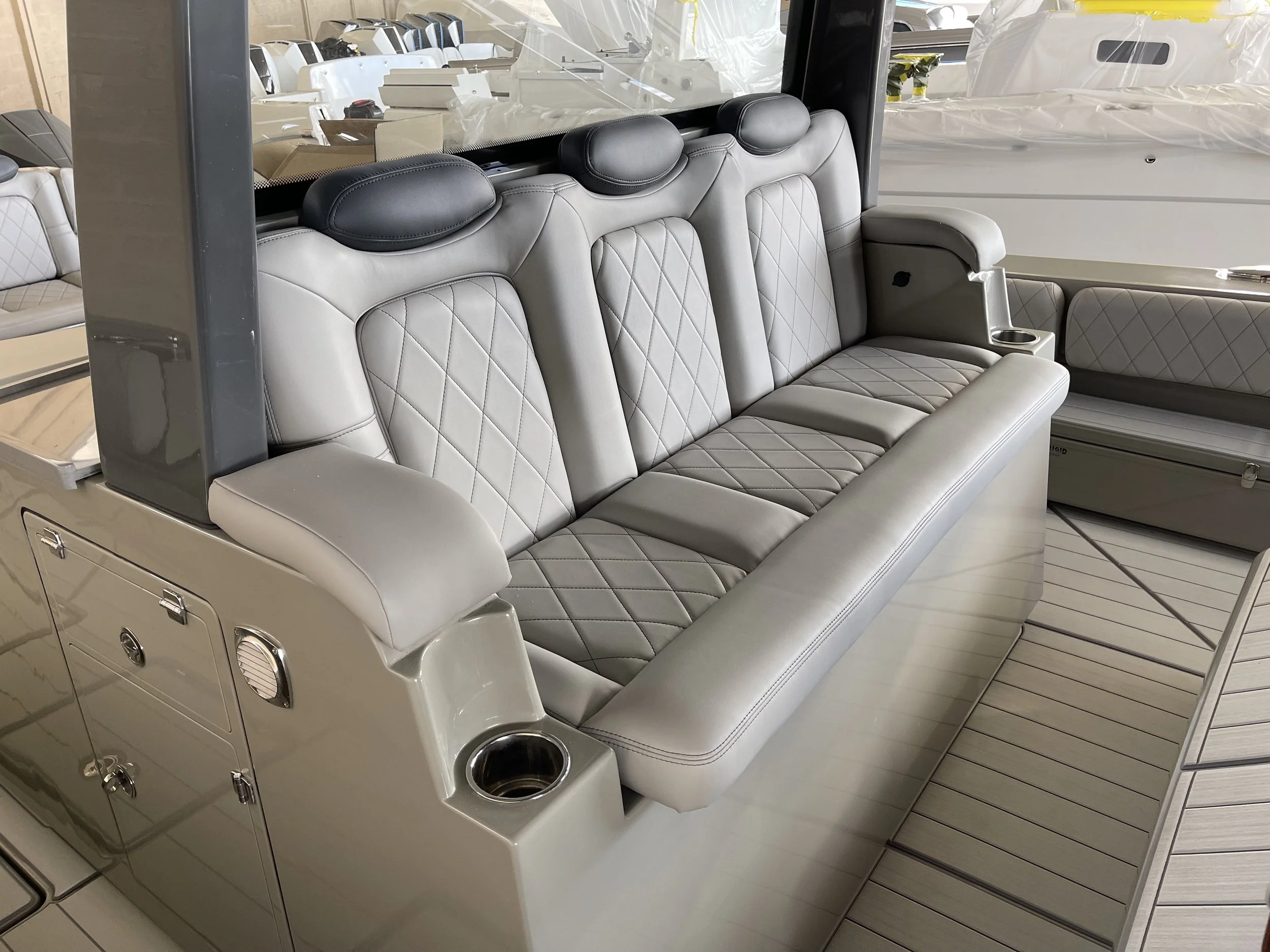
Marine upholstery on a motor yacht or superyacht in South Florida degrades faster than in almost any other operating environment. UV intensity, salt air, humidity, and constant moisture exposure accelerate every failure mode — fading, cracking, foam compression, seam failure, and mildew. For captains and vessel managers, identifying the correct intervention point — repair vs. replacement — and specifying the right materials for each application zone determines the service life of the next upholstery cycle. This guide covers the damage indicators that matter, the repair and replacement process at the professional level, and the material standards that produce results in South Florida's conditions.
Common Damage Types on Motor Yachts and Superyachts
The most common upholstery failure modes on large vessels in South Florida:
- UV degradation: Plasticizer leaching from vinyl produces surface chalking, brittleness, and micro-cracking — the primary failure mode on any sun-exposed exterior seating that isn't rotated or covered consistently.
- Foam compression: High-density foam loses cell memory under sustained use — producing a bottoming-out effect where occupants feel the substrate beneath. On large vessels with active use patterns, this typically manifests within 7–10 years on high-traffic seating.
- Mold and mildew colonization: Pink mold (Serratia marcescens) and black mildew develop inside foam cores that trap moisture. Once established internally, surface cleaning does not resolve the problem — foam replacement is required.
- Seam and hardware failure: Salt crystallization inside seams acts as an abrasive against thread. Standard polyester thread degrades under South Florida's UV exposure well before the fabric reaches end of life. Zipper corrosion and snap seizure are the most common and most preventable hardware failure modes.
- Substrate deterioration: Plywood and inferior plastic backing plates rot and warp in South Florida's humidity. On correctly specified vessels, HDPE (High-Density Polyethylene) substrates eliminate this failure mode entirely.
For context on waterproof cushion specification that prevents these failure modes, see our article Waterproof Yacht Cushions for Motor Yachts and Superyachts.
Early Indicators Requiring Professional Assessment
These indicators signal that a professional assessment is the correct next step — not a cleaning or DIY repair:
- Persistent musty odor despite surface cleaning — indicates internal mold colonization
- Chalky residue or brittleness on vinyl — indicates plasticizer loss from UV breakdown
- Visible foam sagging or bottoming-out under normal use — indicates foam compression past service life
- Seam separation or thread fraying at stress points — indicates thread degradation
- Rust staining around snaps, zippers, or fasteners — indicates hardware corrosion requiring replacement
- Backing plate warping or fastener pull-out — indicates substrate failure requiring structural repair
Repair vs. Replacement: The Correct Decision Framework
The decision between repair and replacement is a lifecycle cost decision — not a visual one. Isolated damage — a single torn panel, a failed zipper, a localized seam separation — is correctly addressed with targeted repair when the surrounding material and foam are structurally sound. Widespread UV degradation, internal mold colonization, foam compression across multiple zones, or substrate failure indicate that replacement is the lower total cost decision — continued repair investment on end-of-life materials produces diminishing returns and escalating costs. For context on the replacement process and material specification, see our article Marine Cushion Replacement for Motor Yachts and Superyachts.
Choosing a Marine Upholstery Repair Service in South Florida
For motor yachts and superyachts, the selection criteria for a marine upholstery repair service are different from those for smaller vessel work. The complexity of large vessel geometry, the material standards required for sustained performance in South Florida's conditions, and the coordination requirements of refit schedules demand a different level of capability than a general marine canvas shop provides.
Credentials and Large Vessel Experience
Key evaluation criteria for a marine upholstery repair service on large vessels:
- Demonstrable large vessel experience: A portfolio of completed projects on motor yachts and superyachts of comparable scale is the most reliable indicator of capability. References from captains and yard project managers carry more weight than general client testimonials.
- Professional certifications: Marine Fabricators Association (MFA) certification and Industrial Fabrics Association International (IFAI) credentials confirm adherence to professional standards in material specification and fabrication.
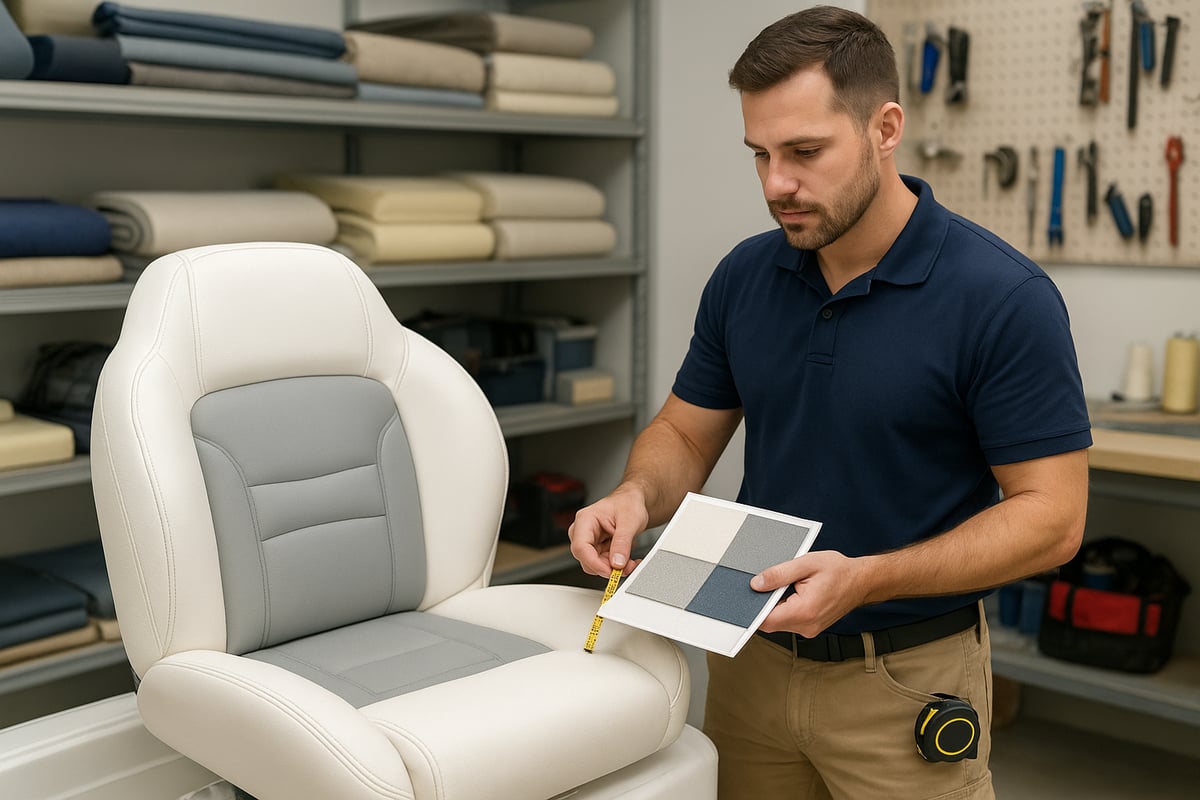
- Material transparency: A professional fabricator specifies materials by brand and grade — Sunbrella Marine, Stamoid, GORE TENARA thread — and explains why each is the correct specification for each application zone. Vague references to "marine-grade materials" without specific product information are a warning indicator.
- Technology and process: 3D digital patterning, CNC precision cutting, and cloud-archived templates are the professional standard for large vessel work. Manual measurement and hand-cutting cannot deliver consistent fit on complex large vessel geometry.
- Refit coordination capability: On a large vessel refit, upholstery work must coordinate with other trades on a compressed timeline. A fabricator with experience in South Florida's major yards — Rybovich, Lauderdale Marine Center, Derecktor — understands how to work within yard schedules without extending overall project timelines.
Comparing Service Levels and Material Standards
| Feature | Professional Marine Fabricator | General Upholstery Shop |
|---|---|---|
| Fabric specification | Sunbrella, Stamoid — by grade and application | Generic marine vinyl |
| Thread specification | GORE TENARA PTFE — UV-stable, 10+ year lifespan | Standard polyester |
| Foam specification | Dry-fast, closed-cell, HDPE substrate — by zone | Standard foam |
| Measurement process | 3D digital patterning — precision fit | Manual measurement |
| Large vessel experience | Documented portfolio — 60ft+ | Variable |
American Marine: Marine Upholstery Repair for Large Vessels in South Florida
American Marine specializes in marine upholstery repair and fabrication for motor yachts and superyachts throughout Fort Lauderdale, West Palm Beach, and Miami. We work exclusively with professional-grade materials — Sunbrella, Stamoid, GORE TENARA thread — and use 3D digital patterning to ensure precision fit on complex large vessel geometry. Our team coordinates with captains, vessel managers, and yard project managers at Rybovich, Lauderdale Marine Center, and Derecktor to deliver on refit schedules without disrupting other trades. For an overview of our upholstery services, see our Marine Upholstery page.
The Professional Repair and Replacement Process
A professional marine upholstery repair or replacement project on a motor yacht or superyacht follows a structured process designed to eliminate the fit errors, material failures, and scheduling disruptions that characterize lower-grade work.
Step 1: On-Vessel Assessment
The process begins with an on-vessel assessment at your slip or yard — not a showroom consultation. A specialist inspects every application zone, documents damage patterns, assesses foam condition and substrate integrity, and identifies any hidden mold or moisture damage that surface inspection alone would miss. Accurate measurement is taken at this stage — on large vessels, 3D digital scanning captures the exact geometry of each surface, including compound curves and hardware attachment points that manual measurement cannot consistently replicate.
Step 2: Material Specification and Design Confirmation
Based on the assessment, materials are specified for each application zone — fabric type, foam density, substrate specification, and hardware. Digital renderings allow captains and vessel managers to review design decisions before any material is cut. Physical samples — fabric swatches, foam density comparisons — confirm tactile and visual decisions that renderings cannot fully represent. This stage prevents the costly specification changes that occur mid-project when decisions are deferred.
Step 3: Fabrication
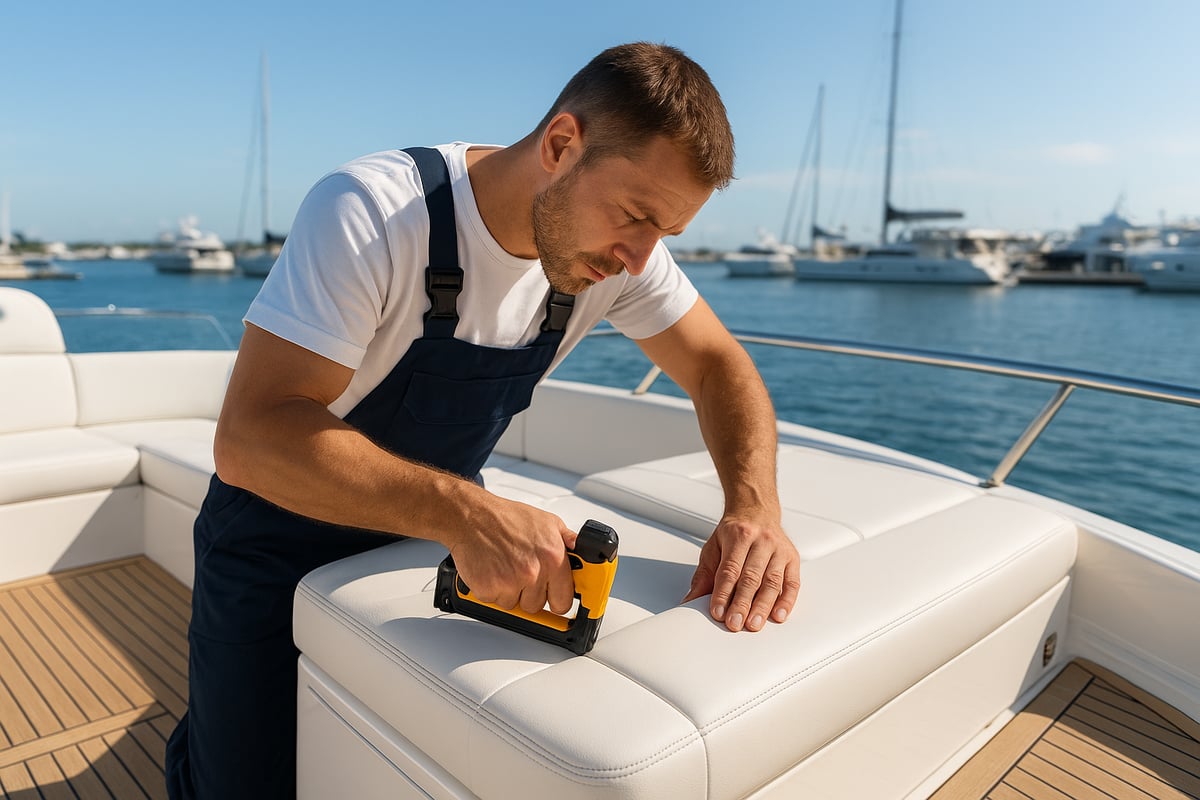
Fabrication is executed against the digital templates from the vessel assessment. Panels are precision-cut with CNC equipment — eliminating the fit errors that manual cutting produces on complex vessel geometry. Seams are double-stitched with GORE TENARA PTFE thread. Hardware is specified in marine-grade stainless steel throughout. Quality checks at multiple fabrication stages ensure every component meets specification before installation.
Step 4: Dockside Installation
Installation is performed at your vessel — at your slip, marina, or yard. Each component is fitted on-site with final adjustments made on-vessel to ensure fit, function, and appearance match the design intent. Digital templates are archived in cloud storage, enabling identical replacement components to be fabricated from any location without remeasuring the vessel — an operational advantage for vessels that require component replacement during an active season or from a remote port.
Step 5: Care Handover
At project completion, the captain or vessel manager receives a complete care brief — cleaning protocols for each material specified, maintenance schedules, product recommendations, and end-of-life indicators for each application zone. Warranty documentation is provided. Ongoing maintenance support — including dockside inspections, targeted repairs, and replacement panel fabrication from archived templates — is available for all projects we complete.
Material Standards and Current Innovations
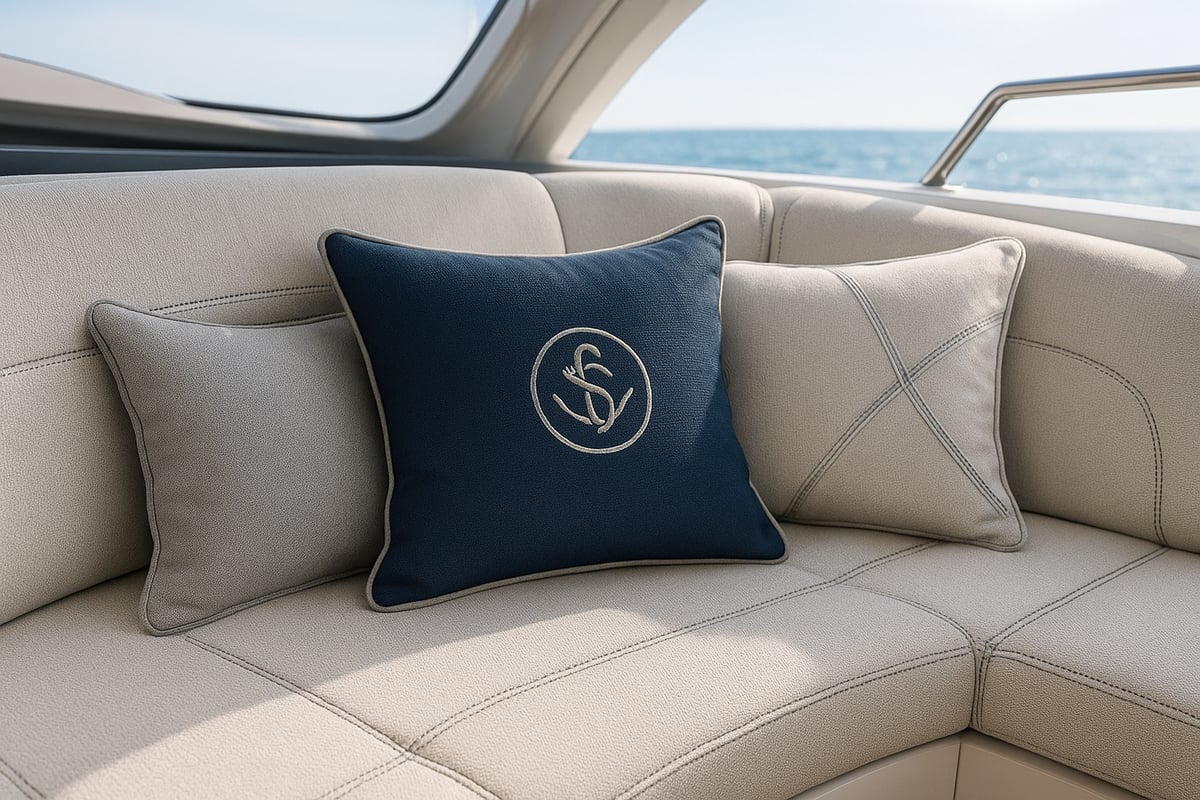
Professional-Grade Materials for South Florida Conditions
- Solution-dyed acrylics (Sunbrella): Color embedded in the fiber — not surface-applied — delivering UV resistance and colorfastness that holds through multiple South Florida seasons. The professional standard for exterior upholstery applications where UV stability and breathability are the primary requirements.
- Marine-grade vinyl (Stamoid and equivalent): 30 oz specification with antimicrobial and UV-stable coatings. The correct specification for high-traffic exterior seating, helm chairs, and applications where complete waterproofing and maximum durability are required.
- GORE TENARA PTFE thread: Impervious to UV degradation, saltwater, and chemical cleaners — ensures seams outlast the fabric rather than failing prematurely. The professional standard for any marine upholstery work where service life matters.
- Dry-fast reticulated foam: Open-cell structure allows water to pass through and drain immediately — the correct exterior foam specification for South Florida's rain-intensive summer season.
- HDPE substrate plates: 100% rot-proof and dimensionally stable — eliminates the backing plate warping and fastener pull-out that plywood substrates produce in South Florida's humidity.
Current Innovations Worth Specifying
- Eco-friendly and recycled marine vinyls: Increasing availability of recycled content options with documented marine-grade performance credentials — relevant for vessels where environmental credentials are an owner priority.
- Advanced waterproofing and stain resistance: New coating systems extending cleanability and UV resistance beyond baseline fabric specifications — reducing crew maintenance burden on active vessels.
- Custom design integration: Contrasting stitching, embroidered vessel identity elements, and color-matched specifications that coordinate with the vessel's broader interior design system without compromising material performance.
Maintenance Protocols for Extended Upholstery Service Life
Correctly specified and professionally fabricated marine upholstery delivers 7–10 years of service life in South Florida conditions. Maintenance consistency is the primary variable that determines where in that range a particular installation lands. For broader context on canvas and upholstery care, see our article From Deck Chairs to Sun Lounges: Elevating Comfort with Marine Upholstery.
Routine Cleaning Protocol
- Rinse upholstery with fresh water after each use — removes salt before it crystallizes and abrades the fabric surface
- Use pH-neutral marine cleaning products — harsh chemicals and bleach damage protective coatings and accelerate UV degradation
- Blot spills immediately — rubbing drives contaminants into the fabric structure
- Air dry completely before storing or closing the vessel — mildew develops rapidly in enclosed damp spaces
Seasonal and Long-Term Maintenance
- Deep clean at the beginning and end of each season — removes embedded salt, organic residue, and contaminants that routine cleaning doesn't reach
- Apply UV protectant and fabric conditioner on a schedule appropriate to the material specification — restores water repellency and plasticizer content
- Inspect seams, zippers, and hardware fasteners regularly for early failure indicators — early repair of minor issues prevents progression to panel-level failure
- Store cushions vertically when the vessel is not in active use — allows moisture to drain and prevents compression set in foam
When Professional Repair is the Correct Response
Professional repair — rather than DIY intervention — is the correct response when:
- Damage involves the foam core or substrate — not just the surface material
- Mold or mildew has colonized internally — surface treatment will not resolve the problem
- Seam failure extends across a significant portion of a panel — re-stitching is a temporary fix on degraded thread and fabric
- Hardware failure is widespread — isolated zipper replacement is practical, but systemic hardware corrosion indicates a material specification issue requiring professional assessment
Annual professional inspection — assessing material condition, seam integrity, foam compression, and hardware function — identifies issues before they develop into material failure and allows planned remediation on your schedule rather than reactive repair under operational pressure.
American Marine provides marine upholstery repair and fabrication services for motor yachts and superyachts across Fort Lauderdale, West Palm Beach, and Miami. If you're assessing upholstery condition on a vessel 40ft or above, schedule a dockside assessment and we'll evaluate each application zone and recommend the correct repair or replacement specification.