Why precision fit custom boat covers protect luxury yachts from hidden damage
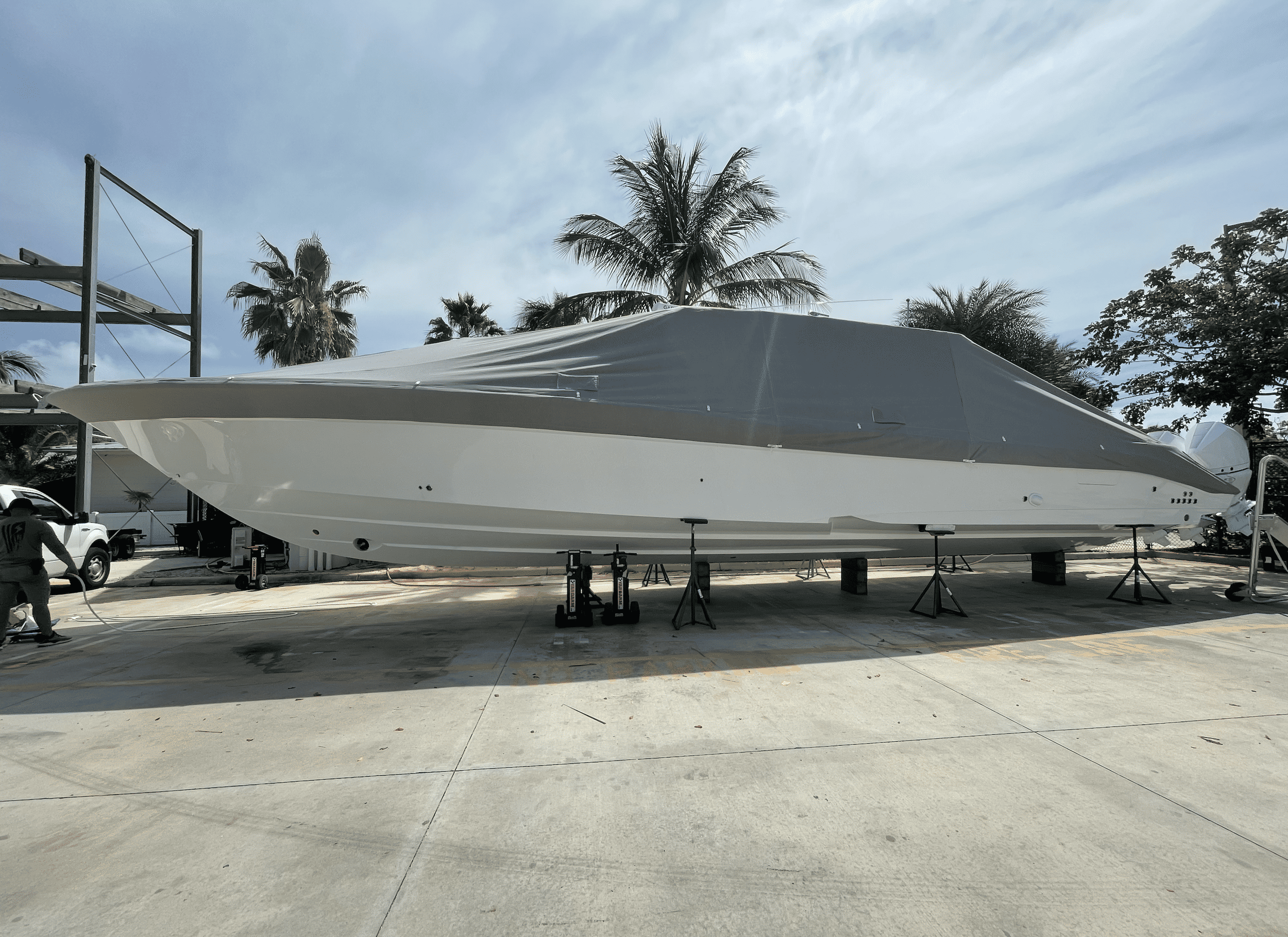
Luxury yachts don’t usually fail in obvious ways. The real damage often starts quietly, while the vessel is “protected” under a boat cover that doesn’t actually fit.
An ill-fitting cover can trap moisture, grind grit into gelcoat, and let UV reach the very surfaces owners are trying to preserve. A precision fit custom boat cover does the opposite: it seals out sunlight and debris, sheds water correctly, and stays tensioned so it can’t flap, pool, or chafe—because “close enough” is never a perfect fit.
At American Marine, we see the same pattern again and again: the most expensive mistakes are rarely the dramatic ones. They’re the slow, hidden ones.
The hidden damage most yacht owners don’t see until it’s too late
A luxury yacht’s finish is unforgiving. High-gloss gelcoat, painted surfaces, stainless hardware, and premium upholstery look incredible, but they also reveal every scratch, fade line, and water mark—especially on complex profiles like a motor yacht boat, trawler boat, and even super yachts with multiple elevations (including bluewater yachts built for offshore passages).
When a cover is “close enough,” owners often don’t notice the problems until months later—when the cover comes off and the damage is already set.
Moisture buildup that creates mold, corrosion, and odors
Moisture problems usually come from two cover issues:
Loose areas that sag and create water pockets
Poor airflow that traps humid air under the cover
Once damp air gets sealed in, you create a mini greenhouse. Condensation forms overnight, then lingers. Soft goods absorb it, stitching stays wet, and metal fittings sit in humid air.
Over time, that can lead to mildew on cushions, musty odors in compartments, and corrosion on hardware that should have stayed pristine.
UV fading and uneven weathering
UV damage isn’t always uniform. A cover that shifts, stretches, or gaps at the edges can leave “hot spots” where sunlight hits the same area repeatedly.
That’s how you end up with:
Patchy oxidation on gelcoat
Faded upholstery seams
Dull, uneven shine along rails and corners
Luxury yachts are valued on condition and appearance. Uneven fading is one of the fastest ways to make a premium vessel look older than it is.
Gelcoat scratches from cover movement and trapped grit
The most common surprise: a cover can scratch your yacht even when it never “falls off.”
When the wind picks up, a loose cover flaps. That movement creates friction. If any dust, sand, or salt crystals are trapped between the cover and the hull, the cover becomes sandpaper.
This often shows up as:
Scuffing along the sheer line
Micro-scratches on high-gloss gelcoat
Chafe marks near cleats, windshield frames, and sharp transitions
Why precision fit matters more on high-end yachts
A premium yacht has more complex geometry than most boats: multiple levels, hardtops, electronics, rails, and custom hardware. “Generic” patterns don’t account for those details, and that’s where the damage starts—especially around the rear deck, the bridge area, and hardtop transitions.
A precision fit cover is engineered to match the yacht’s exact fit boat geometry so water can run off and the fabric can stay stable. Stability is what prevents hidden wear, and it’s the difference between a cover that’s merely on the boat and a truly accurate cover that protects it.
The difference between “covered” and “protected”
A cover that simply sits on top of the yacht may block leaves and bird droppings, but it can still:
Hold water in low points
Rub on corners
Expose high-wear zones to UV
Stretch over time and lose shape
A precision fit cover is built to maintain its shape and tension, so it protects consistently in real conditions, not just on calm days—delivering a perfect cover experience instead of a cover that “mostly works.”
How American Marine measures for an exact custom fit
Custom fit isn’t a guess. It’s a process—and for many owners, it’s the only reliable way to get an exact fit boat cover that behaves like a structured, engineered component (what some owners casually call a “kustom” fit).
For luxury yachts, accuracy depends on capturing not just length and beam, but the 3D structure: height changes, protrusions, and any zones where a cover could chafe or pool. This is especially true for yachts with an extended hardtop, radar arches, or complex rail layouts.
Measurement techniques that reduce risk
A proper measuring approach typically includes:
Mapping the yacht’s profile (key heights, transitions, and slopes)
Identifying contact points (where fabric must be reinforced or lifted off the surface)
Accounting for hardware and add-ons (rails, antennas, solar, outriggers, radar arches)
Building in drainage strategy (avoiding flat zones where water could collect)
On high-end yachts, even a small measurement error can shift the load path of the fabric. That’s when you see tension in the wrong places and looseness where you need structure.
Designing around real-world storage conditions
Storage environment matters. A yacht kept on a lift, in a marina slip, or on a trailer experiences different wind exposure and spray.
That’s why a tailored cover should be planned for:
Prevailing wind direction at the storage location
Tie-down access and safe attachment points
How often the owner will remove and reinstall it
Clearance needs for mooring lines, fenders, and dock access
For some owners, adding or integrating biminis or bimini tops (or planning around a seasonal bimini top) also changes the measurement and tension strategy—another reason generic patterns fail on premium hulls.
Fabric tension: the underrated feature that prevents most cover-caused damage
A luxury yacht cover should act more like a fitted structure than a loose sheet. Tension is what keeps the fabric from becoming a moving abrasive surface.
What correct tension actually does
When a cover is tensioned correctly, it:
Reduces flapping, which reduces chafe and abrasion
Encourages water runoff, reducing puddles and mildew risk
Maintains consistent UV blocking, avoiding shifted gaps
Holds shape over time, rather than stretching into problem areas
Why loose covers fail faster (and cost more)
Loose covers tend to fail in a predictable sequence:
Wind movement increases stress at seams and corners
Fabric stretches and the fit gets worse
Water pooling starts
Mildew and surface scratching appear
The cover tears or the yacht finish deteriorates
A precision fit cover costs more upfront, but it usually costs far less than gelcoat correction, upholstery replacement, or detailing needed to reverse preventable wear—especially when owners compare the long-term cost against repeat replacements and avoidable restoration work (and the overall maintenance budget).
Common storage errors a custom canvas shop helps you avoid
Many owners invest in the yacht and overlook the storage setup. Marine canvas expertise is valuable because it anticipates failure points before they happen—this is where experienced marine fabric experts make a measurable difference and help ensure high quality outcomes.
Mistake 1: covering a yacht that isn’t fully clean and dry
Covering over salt spray, dust, or moisture creates the perfect environment for scratches and mildew. A good cover can’t compensate for a dirty surface underneath it—even the best products won’t perform if the surface prep is ignored.
Mistake 2: relying on bungee cords or improvised tie-downs
Improvised tie-downs often pull in the wrong direction, which causes:
Distorted fit
Stress on seams
Loose panels that flap
A tailored system uses secure attachment points and tension paths that are designed into the pattern.
Mistake 3: ignoring abrasion zones
Luxury yachts have more “edge geometry”: rails, corners, and hardware. Without reinforcement or strategic stand-offs, those spots can wear through fabric and mark the finish.
Real-world outcomes: how tailored covers can extend vessel life by years
The biggest benefits are not always dramatic. They show up as what doesn’t happen.
Owners who upgrade from an off-the-shelf cover (including “select fit” options and affordable select fit covers) to a precision fit custom cover often report:
Less oxidation and fewer detailing sessions per season
Cleaner interiors and fewer mildew episodes
Reduced gelcoat correction and polishing needs
Better resale presentation year after year
A tailored cover doesn’t just keep a yacht looking good for a weekend. It supports the long, slow work of keeping a premium vessel in premium condition—whether it’s a custom boat build, a well-known production model from top boat manufacturers, or a one-off layout with many configurations across the product line.
(And while this article focuses on yachts, the same “fit vs friction” principle applies across the boating world—from deck boats and center consoles to a double cabin cruiser.)
Quick comparison: off-the-shelf vs precision fit custom covers
Feature
Off-the-shelf cover
Precision fit custom cover
Fit consistency
Approximate, shifts with wind
Patterned to the yacht’s geometry for a perfect fit
Water runoff
More pooling risk
Designed to shed water
Chafe control
Higher rubbing and abrasion
Tensioned, reinforced at contact zones
UV protection
Gaps and movement create exposure
Stable coverage across surfaces
Long-term value
Often replaced sooner
Built to reduce boat wear and cover wear
How they measure and verify fit (so you get a true exact fit boat result and, ideally, the best fitting exact fit covers for your specific profile)
Where they reinforce and why
How they handle ventilation and moisture management
How tension is built into the pattern (not just added with extra straps)
What accessories (vents, reinforcements, anti-chafe patches) are appropriate for your storage environment
How they provide an accurate price quote tied to your yacht’s geometry, not a rough guess based on length alone
What specialty covers they can produce for unique hardware, seasonal setups, or transport needs
How they support you after delivery (including responsiveness and best customer service expectations in this part of the world)
If you’re comparing vendors, it’s also a good idea to ask how they handle unusual requests and edge cases (for example: “double cabin boat covers - fisher canvas burlington nj”, “cover wizard(tm”, “bags optimist hull”, or “blades optimist” requests that may appear in search results). The key is making sure you’re getting a patterning and build process that matches your yacht—not just a keyword match.
At American Marine, our goal is simple: deliver a precision fit cover that protects the yacht from the damage you can’t see yet—and helps you avoid paying for it later.
Next step: protect the finish you already paid for
A luxury yacht’s surfaces are part of its value. A precision fit custom cover is one of the most practical ways to preserve that value through seasons of sun, moisture, and storage time.
If you want help evaluating your current cover or planning a tailored cover built around your yacht and storage conditions (including rear deck access, bridge clearances, and extended hardtop geometry), American Marine can guide you through the options and the details that matter—so you can make a high-confidence decision that fits your needs, timeline, and budget.