Yacht Carpet and Marine Flooring: The Complete South Florida Guide
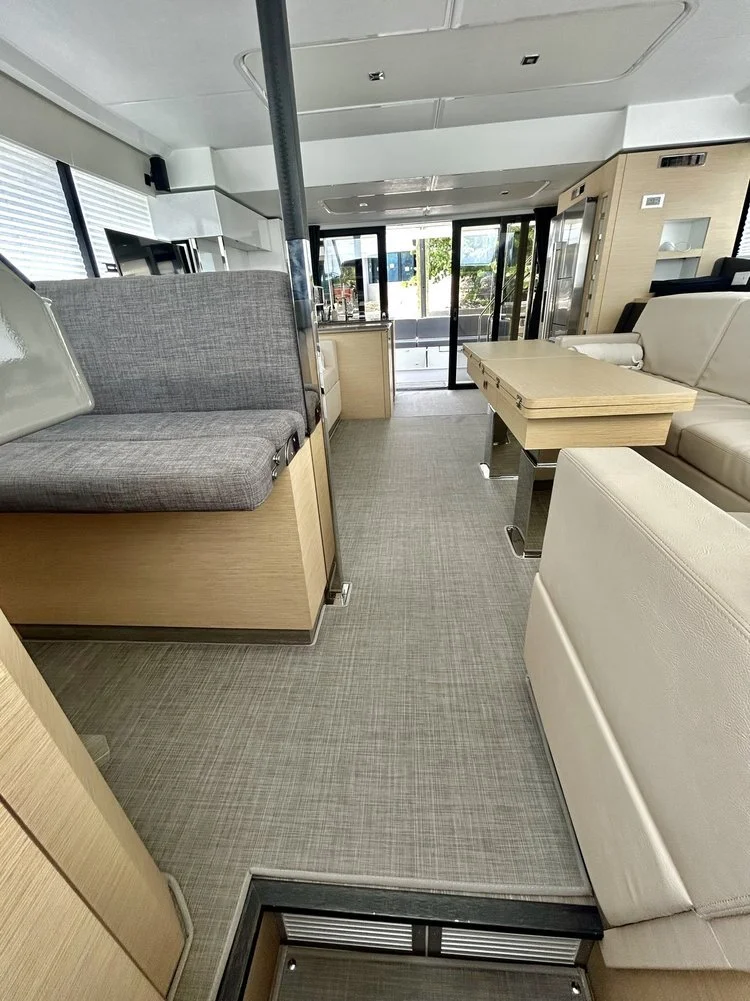
Synthetic teak delamination is one of the most common flooring project calls American Marine receives, and the conversation almost always goes the same way. The owner had the synthetic teak installed two or three years ago — nice product, good appearance — and it held fine through the first season. Then a South Florida summer, with its combination of direct sun, 90-degree deck temperatures, and the thermal cycling of the adhesive bond between a hot day and a cooler night, and the panels started lifting at the perimeter seams. By the third season, sections of the cockpit sole are coming up at the edges.
The product was not the problem. Synthetic teak installed correctly over a properly prepared substrate does not delaminate in South Florida heat — it holds for fifteen to twenty-five years. The problem was substrate preparation: the fiberglass surface was not properly sanded and cleaned before adhesive application, or the adhesive was applied over existing adhesive residue from a previous covering. The thermal expansion cycle of a South Florida summer stressed a bond that was borderline at installation until it failed.
This guide covers every flooring option for South Florida yachts, with specific attention to the installation quality variables that determine whether the result holds. In South Florida, the difference between well-installed flooring and poorly installed flooring is usually visible within two seasons.
Marine flooring for South Florida yachts covers four primary options — synthetic teak, marine carpet, EVA foam, and marine LVP and vinyl — each with specific appropriate applications and specific performance requirements in South Florida heat, UV, and humidity. Installation quality — particularly substrate preparation for adhesive products — is the primary variable that determines service life in this market.
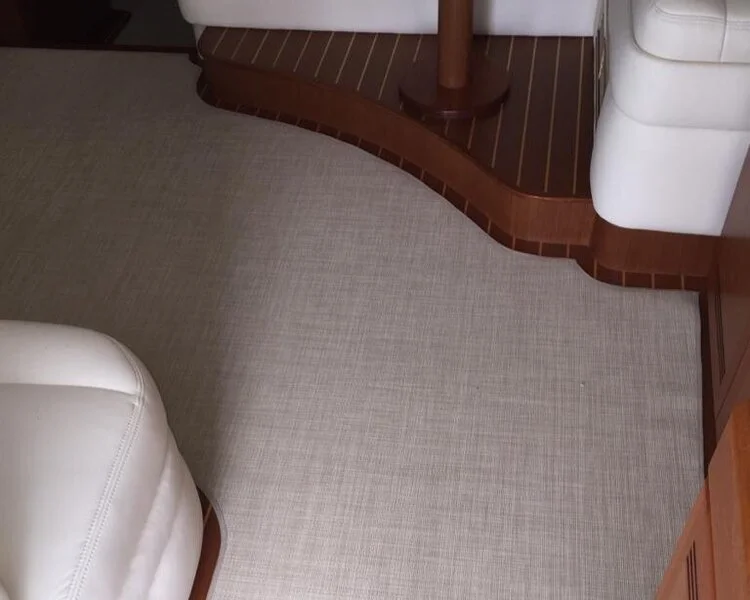
Choosing the Right Flooring for the Right Space
A yacht has multiple flooring zones, and applying the wrong material in the wrong zone is the second most common flooring mistake after poor installation quality. The cockpit sole of a Broward County sportfisher that gets washed down with salt water three times a week and sees direct July sun for eight hours a day needs a completely different material specification than the salon floor of the same vessel.
The outdoor zones — cockpit sole, flybridge, helm station, and swim platform — require UV-stable, non-slip, waterproof surfaces that can be washed down and that hold up to direct South Florida sun without fading or degrading. Synthetic teak composite and EVA foam are the correct specification choices here. Marine carpet and LVP are not appropriate for these outdoor applications.
The interior zones — salon floor, cabin sole, steps, and head — can prioritize aesthetics alongside durability. UV exposure is limited, traffic is the primary wear mechanism, and the appearance standard is higher than on working deck surfaces. Marine LVP, marine carpet, and synthetic flooring are all appropriate here depending on the owner's preference.
Getting the zone assignments right before specifying materials is step one. Every other decision follows from it.
Synthetic Teak: The South Florida Outdoor Standard
Why Synthetic Teak Dominates South Florida Decks
Traditional teak decking in South Florida continuous wet-slip service is a maintenance commitment that most owners eventually decide they do not want. The oil and sealer schedule required to maintain traditional teak in South Florida UV is more demanding than in northern markets, and UV exposure degrades the wood surface faster than most owners expect. Silver-grey teak is structurally weakening and aesthetically undesirable. Once the seam compound begins to crack and lift, water penetration accelerates the deterioration.
Synthetic teak — high-density polyethylene or polypropylene composite in a teak-profile panel format — provides the teak aesthetic without the maintenance burden and without the UV vulnerability. South Florida's sportfishing fleet based at Bahia Mar, Pier 66, and the Marina Mile has largely transitioned to synthetic teak on cockpit soles and helm stations over the past fifteen years. The combination of UV stability, pressure-washer-appropriate cleaning, and non-slip wet performance is the correct specification for South Florida outdoor deck surfaces.
Installation Quality: The Decisive Variable
Properly installed synthetic teak does not delaminate in South Florida heat. This is a factually verifiable statement — there are synthetic teak installations at Fort Lauderdale marinas that are fifteen-plus years old, still bonded, still flat, still performing correctly. The delaminating synthetic teak that South Florida owners call us about regularly is not a material failure. It is a substrate preparation failure.
The adhesive bond between synthetic teak panels and fiberglass substrate requires clean, dry, properly sanded fiberglass with no residue from previous adhesives, no contamination from bottom paint overspray, and no moisture history in the substrate below. Two-part polyurethane or epoxy adhesive applied to a contaminated or wet substrate creates an installation that holds at ambient temperature and fails at South Florida summer deck temperature — when the deck reaches 120 to 130 degrees Fahrenheit in direct sun and the adhesive bond reaches its thermal stress limit.
American Marine's substrate assessment at measurement is not an optional courtesy — it is the step that determines whether the installation we produce will hold. If existing adhesive residue is present, if the fiberglass has a surface contamination profile from years of marina exposure, or if moisture is detected in the substrate below the current surface, we scope and quote the preparation work before fabrication begins. We do not install over a substrate that will fail.
Synthetic Teak Pricing in South Florida
Cockpit sole (measure, fabricate, install): $2,500–$6,000 on a mid-size sportfisher depending on area and complexity
Helm station platforms: $800–$2,500
Flybridge sole: $1,500–$4,500
Swim platform coverage: $600–$1,800
Full vessel exterior deck coverage: $8,000–$25,000+ on larger motoryachts
Synthetic teak installed correctly — substrate assessment included, not optional.
american-marine.com/carpet-and-flooring | Request a flooring consultation
Marine Carpet: Where It Belongs and Where It Doesn't
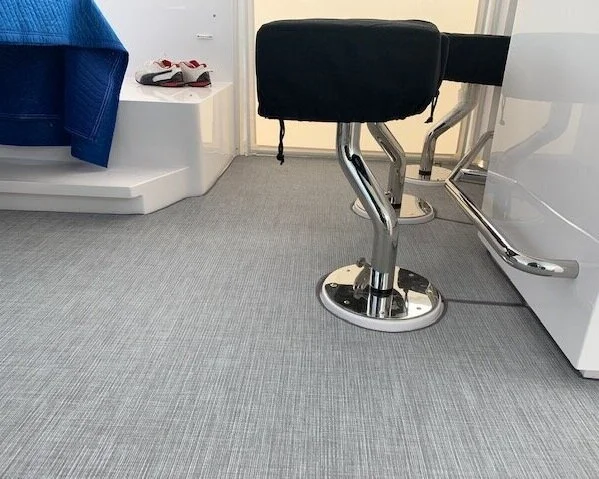
Marine carpet has a specific and appropriate role on South Florida yachts — and several inappropriate ones that are worth being explicit about.
The appropriate applications: salon floors, cabin soles, steps, and pilothouse interiors where UV exposure is limited, foot traffic is the primary wear mechanism, and the owner values the noise dampening and comfort that carpet provides over hard flooring. In these applications, marine carpet from polypropylene or solution-dyed nylon fiber with a marine-grade rubber or vinyl backing is a functional, durable, and aesthetically flexible choice.
The inappropriate applications: cockpit soles, flybridge decks, helm stations, swim platforms, and any outdoor surface with direct UV exposure and regular water contact. Marine carpet in these applications in South Florida develops mildew from retained moisture, fades from UV, and loses its backing adhesion in the wet-dry cycling conditions of a South Florida outdoor deck. This is not a speculation — it is a predictable outcome.
South Florida interior marine carpet projects require pre-installation substrate assessment for moisture history — particularly on older vessels with any history of deck hardware leaks or hull condensation. Marine carpet installed over a substrate that retains moisture will develop mildew regardless of the fiber specification. The substrate must be dry and sealed before carpet goes down.
Marine carpet replacement in South Florida salon and cabin spaces typically runs $6 to $15 per square foot installed, depending on carpet specification, substrate preparation, and the complexity of the space. A full salon carpet replacement on a 40-foot vessel runs $1,500 to $4,000.
EVA Foam: The Safety and Comfort Specification
Ethylene-vinyl acetate foam — sold under brand names including SeaDek and produced by several South Florida-familiar suppliers — is the non-slip, shock-absorbing surface product used on swim platforms, helm station pads, cockpit soles on sportfishers, and ladder and step surfaces. It is not a teak substitute in appearance; it has a distinct mat-like texture in grey, black, charcoal, or carbon fiber patterns. Its value proposition is performance, not aesthetics.
South Florida sportfisher captains who have used EVA foam on helm stations for multi-day offshore trips describe the fatigue difference concretely. At the end of an eight-hour offshore run, the captain on EVA foam has absorbed less vibration load than the captain on fiberglass or hard composite deck. It is a real and measurable difference, and it is why tournament-level sportfishers in the Broward County offshore fleet routinely specify EVA foam on helm stations and cockpit soles.
Swim platform coverage with EVA foam is a safety specification as much as a comfort one. A wet fiberglass swim platform on a South Florida sportfisher at the end of a long day offshore is a fall risk. EVA foam provides secure non-slip grip when wet that fiberglass and synthetic teak cannot match. For South Florida vessels that are boarded and disembarked from the swim platform regularly, EVA foam is the appropriate surface.
EVA foam installation is adhesive-bonded to the substrate — the same substrate preparation principles that apply to synthetic teak apply here. Properly prepared substrate, correct adhesive, and correct pressure during cure produce an installation that holds. EVA foam swim platform coverage runs $400 to $1,200; helm station pads run $200 to $600; cockpit coverage runs $800 to $2,500.
Marine LVP and Vinyl Flooring
Marine luxury vinyl plank (LVP) has become the most common replacement for traditional teak-and-holly cabin sole on South Florida yachts. It provides a hardwood or stone appearance with complete water resistance, is click-lock or glue-down installable, and requires minimal maintenance relative to traditional wood sole. The ease of cleaning — no fiber to trap mold, no grout to stain — makes it particularly appropriate for South Florida's humid conditions.
Marine LVP is an interior application only. It is not UV-rated for cockpit or flybridge exposure and will degrade in direct South Florida sun faster than outdoor-rated composite products. In protected, shaded interior spaces — salon, cabin, pilothouse — marine LVP performs well and provides aesthetic flexibility that traditional cabin sole and marine carpet do not.
Marine sheet vinyl and vinyl tile are used in utility and wet spaces on vessels — heads, engine room walkways, bait prep areas, fish boxes — where easy cleaning, water resistance, and traction are the priorities. Sheet vinyl can be fabricated into custom shapes for irregular spaces and bonded directly to the substrate.
Project Timing and Haul-Out Coordination
Marine flooring work — particularly synthetic teak and EVA foam installation — is most efficiently done during a scheduled haul-out. The vessel on the hard provides full access to the outdoor deck surfaces without the complications of working over water, and the cure time for adhesive products is most easily managed when the vessel is not in the water. If a haul-out is being scheduled for bottom paint or hull work, coordinating synthetic teak or EVA foam installation in the same yard period reduces both total cost and total disruption.
Interior flooring — marine carpet and LVP — can be done in the water in most cases. Access to salon and cabin spaces does not require haul-out, and the substrates involved are not affected by the vessel being afloat.
We coordinate with boatyards and captains on project sequencing during haul-outs. For vessels planning a refit that includes multiple trades, we can schedule flooring work to follow or precede canvas, electrical, or mechanical work as the sequence requires.
How to Choose and What to Verify
Match the material to the zone. Outdoor UV-exposed surfaces need synthetic teak or EVA foam. Interior surfaces can use carpet or LVP. Do not install marine carpet outdoors on a South Florida vessel.
Insist on a substrate assessment for adhesive products. Synthetic teak and EVA foam adhesive installations are only as good as the substrate preparation. A shop that skips the substrate assessment is skipping the step that determines whether the installation lasts.
Verify adhesive specification. Two-part polyurethane or epoxy adhesive is the correct specification for South Florida deck temperatures. Pressure-sensitive adhesive-only installations are not appropriate for the thermal cycling of a South Florida outdoor deck.
View material samples on the vessel before committing. Flooring colors that look correct in the shop look different in direct South Florida sun on the water at noon. Request samples and evaluate them in the actual environment before finalizing color selection on a large project.
Ask about substrate warranty versus material warranty. Many synthetic teak products carry manufacturer material warranties. The installation warranty — which covers adhesive bond failure — is a separate question. Confirm both before committing.
Frequently Asked Questions
Why did my synthetic teak delaminate after only two seasons?
Almost all premature synthetic teak delamination in South Florida is substrate preparation failure — the fiberglass surface was not properly cleaned, sanded, and dried before adhesive application, or adhesive was applied over existing residue from a previous covering. Thermal cycling in South Florida summer conditions stresses marginal adhesive bonds to failure. Properly prepared substrate bonds do not delaminate.
Can synthetic teak be installed over existing marine carpet or old adhesive?
No. Existing carpet, adhesive residue, and surface contamination must be removed and the substrate properly prepared before synthetic teak installation. Installing over existing adhesive residue creates a bond-to-residue situation rather than a bond-to-fiberglass situation, and the residue bond fails under South Florida thermal cycling.
What is the correct cleaning method for synthetic teak?
Fresh water rinse after use removes salt loading. For deeper cleaning, mild soap solution and a medium-bristle brush. Do not use hard-bristle brushes or abrasive cleaners that scratch the woodgrain surface texture. Do not use solvents. A fresh-water rinse after offshore trips is the single most effective maintenance step for extending adhesive bond life at the perimeter seams.
Is marine carpet appropriate for the pilothouse or enclosed helm area?
Yes, in an enclosed helm with limited UV exposure and climate control. In a helm station with direct UV exposure through the windshield or from above — typical on many South Florida express sportfisher designs — marine carpet will show UV degradation faster than in a fully protected space. EVA foam or synthetic teak is the more durable choice for helm stations with any significant UV exposure.
How do I know if my fiberglass substrate is ready for synthetic teak installation?
Proper substrate for synthetic teak installation is dry (no elevated moisture reading), clean (no oil, wax, or adhesive residue from previous coverings), and sanded (scuffed to 80 grit for adhesive grip). We test substrate moisture and assess surface condition at the measurement visit and advise whether preparation work is needed before installation proceeds.
Marine flooring installed correctly — substrate assessed, adhesive specified, built to hold in South Florida conditions.