Custom Marine Canvas & Yacht Covers: The 2026 South Florida Owner's Guide
The fastest way to understand the South Florida marine canvas market is to compare what a quality canvas shop says when you ask about materials versus what a budget shop says. The quality shop names the products: Sunbrella, Strataglass, Tenara. The budget shop describes categories: 'marine-grade canvas,' 'quality vinyl,' 'heavy-duty thread.' The categories are marketing language. The products are performance specifications with verifiable characteristics, manufacturer warranties, and documented service-life data. That distinction explains nearly everything you need to know before you commit a canvas project to anyone.
This guide covers the full scope of custom marine canvas work for South Florida vessels — what types of work exist, what materials actually mean for service life in this environment, what custom fabrication costs and what drives that cost, and how to evaluate a South Florida canvas shop before you sign the quote. The owner who reads this before the first phone call makes better decisions than the owner who reads it after the first disappointment.
Custom marine canvas for South Florida vessels means Sunbrella solution-dyed acrylic for UV performance, Strataglass for enclosure windows, Tenara PTFE thread at every seam, and pattern work taken from the vessel rather than approximated from a catalog. This is not the premium tier of the South Florida canvas market — it is the correct specification for a market where UV intensity, salt loading, and hurricane season create performance demands that generic materials cannot meet over a multi-year service life.
What 'Custom' Actually Means — and Why It Matters
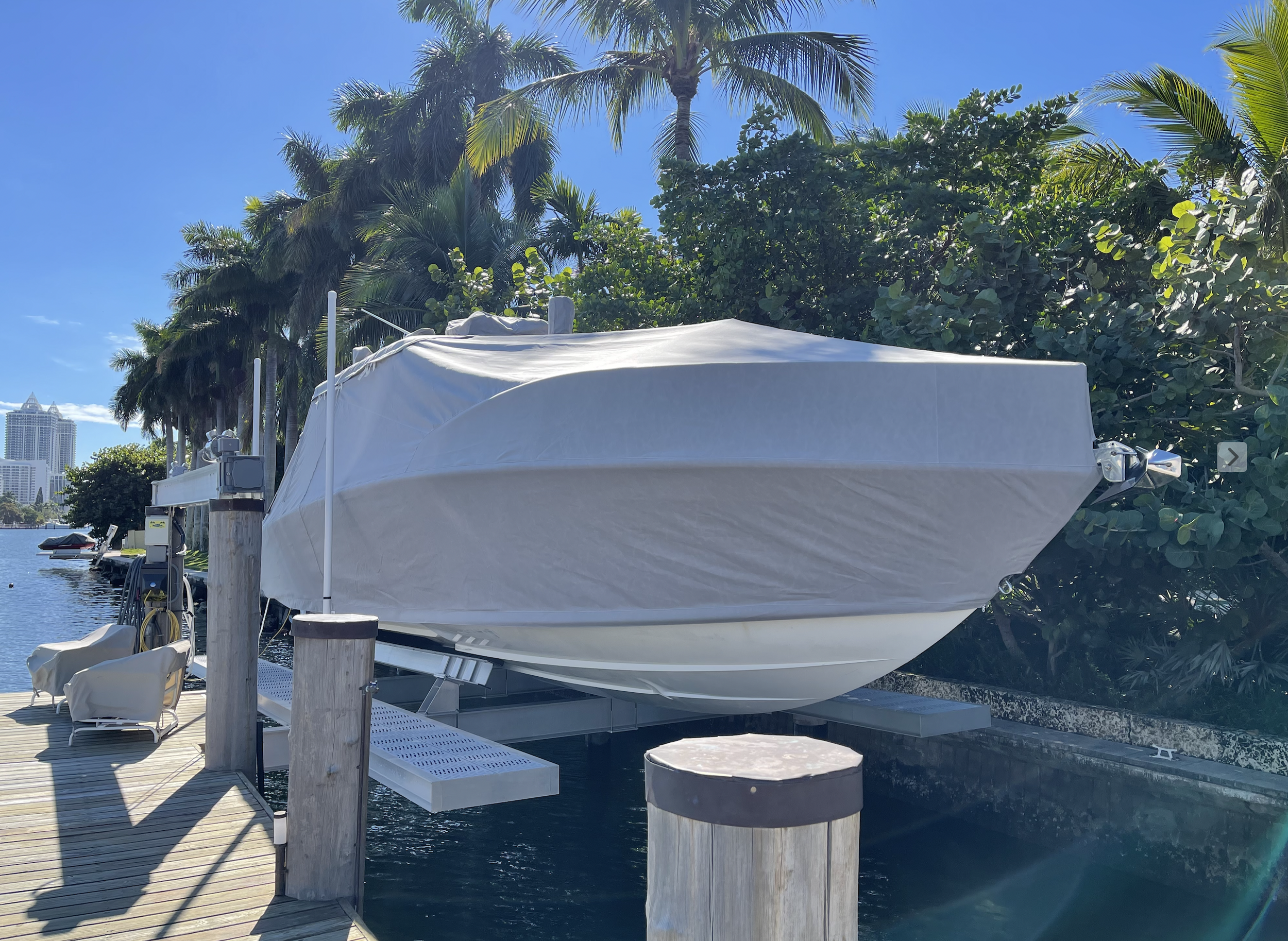
The word 'custom' is overused in marine canvas marketing. At its genuine meaning, a custom canvas project means patterns taken from the specific vessel at its specific geometry — the actual dimensions, the actual snap or track placement, the actual clearance requirements around the radar arch, electronics, cleats, and hatches of that specific boat. The result fits the vessel. A catalog cover in a model-specific size fits the model spec, not the vessel.
No two boats — even same make, model, and year — have identical configurations of deck hardware, electronics, and clearance requirements. A custom cover is patterned from the boat it will go on. A catalog cover is approximated from the boat it is supposed to fit. The difference shows up as fit: a custom cover is flat, tensioned correctly, and does not have stress wrinkles or loose areas where water pools and creates mildew conditions. A catalog cover on the same vessel will have both.
For a South Florida vessel in wet-slip storage year-round, a cover with poor fit is not a cosmetic issue — it is a functional failure that creates UV penetration at loose areas, water accumulation at low points, and wind vulnerability at loose edges that a properly fitted cover would not have.
Custom fabrication from vessel-taken patterns — the right fit for your specific boat.
american-marine.com/boat-covers | american-marine.com/marine-upholstery
Types of Marine Canvas Work
Bimini Tops
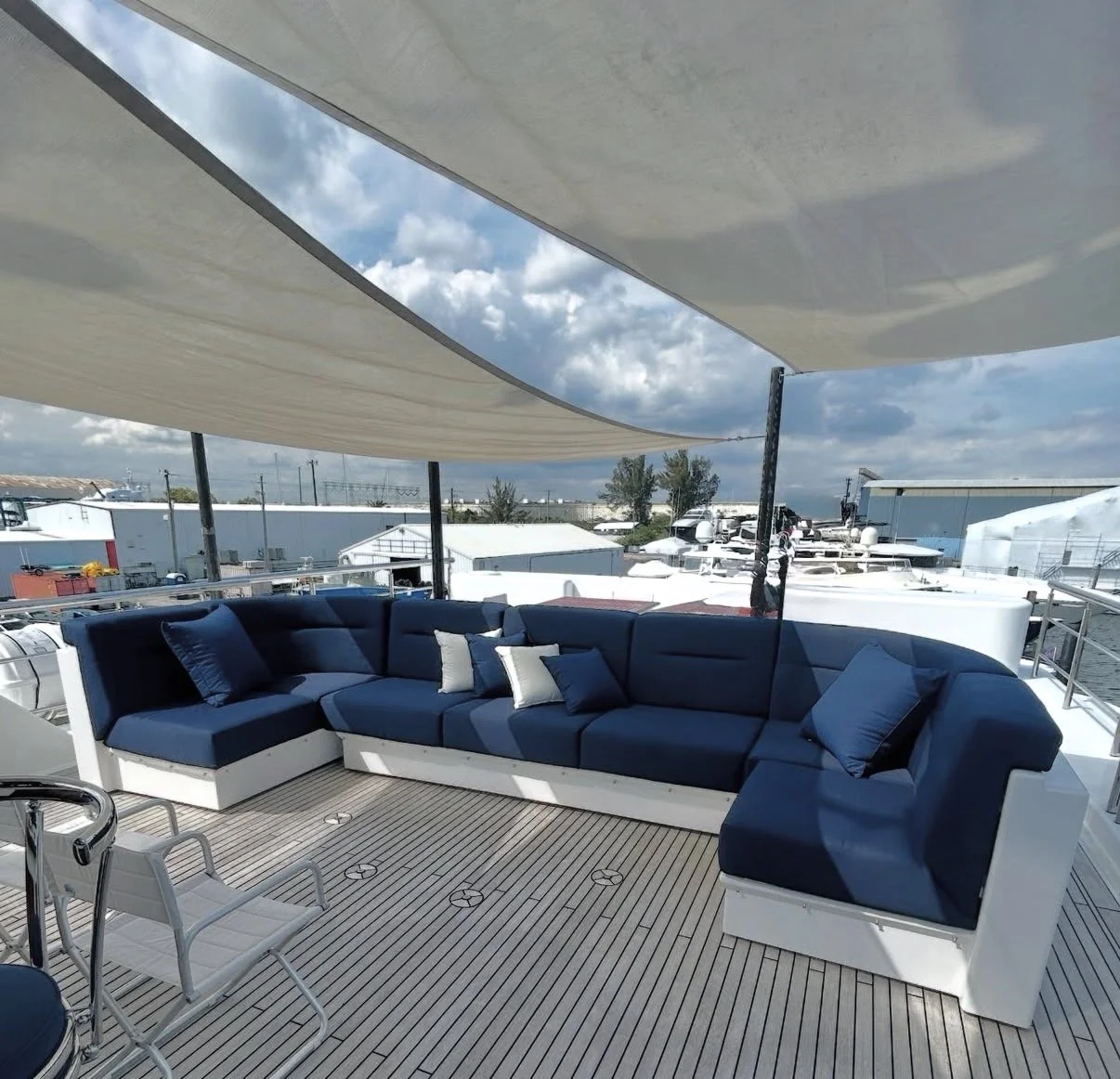
The bimini top is the most common canvas project on South Florida powerboats. It provides overhead shade and rain protection for the helm and cockpit while maintaining airflow — essential in South Florida heat. A bimini consists of a stainless steel frame (7/8-inch or 1-inch diameter tubing) and the canvas fabric top stretched over it.
Custom bimini work ranges from fabric-only replacement on existing frames to full builds with new frames. Frame replacement is warranted when corrosion at the fitting connections has compromised structural integrity, when the frame has been bent from storm or impact damage, or when the shade coverage is simply inadequate for the vessel and operator's needs.
South Florida bimini specification: Sunbrella fabric, Tenara PTFE thread, YKK or Riri marine-grade zippers, 316 stainless hardware on frame fittings. A replacement bimini top on existing frames for a center console or sportfisher runs $600 to $1,500 depending on size and complexity. A full new bimini build — frame and fabric — runs $1,200 to $3,500.
Cockpit and Flybridge Enclosures
Enclosures are the most complex and highest-value canvas project for South Florida vessels. A well-designed and correctly installed enclosure transforms the cockpit from an open outdoor space into a year-round usable environment — protected from South Florida's afternoon thunderstorms, shaded from the July sun, and sealed against the driving rain that can accompany a squall line moving through Broward County.
An enclosure system includes canvas panels (Sunbrella) forming the structural frame of the system, Strataglass clear vinyl panels providing visibility and weather protection simultaneously, and marine-grade zipper systems for access and ventilation. The engineering variable that determines whether a South Florida enclosure performs correctly over its service life is the Strataglass tensioning. Each clear panel must be installed under exactly the right tension — accounting for South Florida's thermal expansion cycle between a January installation temperature and a July service temperature — to remain flat, clear, and stress-crack-free over years of service.
Full cockpit enclosures on mid-size South Florida sportfishers and motoryachts run $3,500 to $8,000 or more. Full flybridge enclosure systems run comparably or higher depending on the flybridge configuration and panel count.
Mooring and Trailering Covers
The mooring cover is the vessel's primary protection at the slip — covering the cockpit, often extending to the helm, protecting upholstery, electronics, and interior surfaces from UV, rain, and salt air. For vessels on South Florida wet slips, the mooring cover is in service for the majority of the vessel's life when not underway.
The UV loading on a South Florida wet-slip boat cover is roughly equivalent to five to six years of sun exposure in a mid-Atlantic or Great Lakes market per calendar year. This is the single most important data point in any South Florida canvas materials decision. A polyester blend cover that would last ten years in Connecticut lasts three to four years on a Broward County wet-slip vessel. Sunbrella — which holds its UV resistance over the full service life of the fabric — lasts eight to twelve years in the same conditions. The per-season cost math is not as different as the upfront price difference suggests.
Trailering covers are a different application — protecting the vessel during road transport and short-term storage rather than sustained UV exposure in a slip. For this application, a catalog cover in a model-specific size is an acceptable choice if the vessel is not in wet-slip storage.
Sail Covers and Running Rigging Canvas
South Florida's sailing community — Fort Lauderdale to Biscayne Bay includes active cruising and offshore racing fleets based at Bahia Mar and the nearby sailing facilities — requires sail covers and running rigging canvas specified to the same UV standard as canvas on powerboats. A sail cover protects the mainsail from UV degradation when furled on the boom; a stack pack provides a dedicated drop-in cover that the sail falls into directly at the end of a sail, eliminating the manual bagging step. South Florida sailboat owners in wet-slip storage should treat sail covers as consumables that need to meet the same Sunbrella standard as any other canvas on the vessel — unprotected sails in direct South Florida sun have measurably shortened service lives.
Hatch Covers, Winch Covers, and Accessory Canvas
South Florida vessels accumulate canvas beyond the primary projects — hatch and companionway covers, windlass covers, winch covers, dinghy covers, helm station covers, and custom fit covers for specific equipment. For large motoryachts, the canvas scope can extend to tender covers, PWC covers, and flybridge soft furnishing systems. These are smaller projects individually but add up to meaningful UV protection for surfaces that would otherwise degrade faster.
The Materials That Determine Service Life
Canvas Fabrics
Understanding the materials difference is not a specialty topic — it is the foundation of any rational South Florida canvas purchasing decision.
Sunbrella (Glen Raven, solution-dyed acrylic): Solution-dyed means color is locked into the acrylic fiber during the dyeing process, not applied to the surface of the finished fabric. The UV stability that results is not a coating that degrades — it is an inherent property of the fiber. Glen Raven backs Sunbrella with a 10-year fade and weathering warranty. In South Florida, where fabric undergoes the equivalent of 50 to 60 years of northern US UV exposure over a 10-year service life, this is the correct base specification.
Stamoid (Serge Ferrari, PVC-coated polyester): Higher water resistance than Sunbrella, less breathability. The correct specification for applications where water resistance is the primary requirement — cockpit cover tops where water stands, dodgers in direct spray, enclosure canvas panels where waterproofing matters more than breathability. Stamoid is a premium material appropriate for specific South Florida applications.
Polyester blends and olefin fabrics: The materials used in most catalog products and in budget canvas fabrication. They look like Sunbrella when delivered and diverge visibly within two South Florida summers. UV fading, loss of water repellency, brittleness at fold lines — all predictable consequences of inadequate UV resistance in a high-UV environment. American Marine does not use them.
Clear Vinyl Enclosure Materials
Strataglass: Optical-grade clear vinyl with UV inhibitors formulated into the material rather than applied as a surface treatment. The South Florida standard for enclosure windows because optical clarity and UV performance are the two performance requirements the application demands, and Strataglass delivers both. Correct tensioning during installation is critical — Strataglass installed under tension mismatched to the thermal expansion cycle of a South Florida service year will develop stress cracks from the edge attachments inward.
Standard marine vinyl (generic Eisenglass): Adequate for limited UV exposure applications — vessels in covered storage, northern markets, or short-season use. In South Florida direct sun, standard vinyl begins hazing within two to three years and typically requires replacement within five to seven years. For enclosures expected to be in service for a decade, standard vinyl is not cost-effective even at its lower price point.
Thread — the Detail Most Owners Miss
Thread specification is the marine canvas variable that most owners never think to ask about. It is also a significant determinant of service life in South Florida conditions, because polyester thread — the thread used in most marine canvas fabrication at all price points — is UV-degradable.
In South Florida UV loading, polyester thread in canvas seams can fail before the fabric has reached end of life. The seam opens on canvas that still has years of UV resistance remaining. Replacing canvas because of seam failure — not because the fabric is worn out — is an entirely avoidable cost.
Tenara PTFE thread (W.L. Gore, polytetrafluoroethylene) is completely impervious to UV radiation and salt water. It does not degrade in the conditions that cause polyester thread to fail. A canvas piece sewn with Tenara has the same expected seam life as the fabric it holds together. American Marine specifies Tenara throughout all canvas work because the alternative creates a predictable failure mode that is entirely avoidable.
Custom vs. Catalog: The Cost-Per-Season Analysis
The upfront price difference between custom Sunbrella fabrication and catalog alternatives is real — typically 30 to 60 percent more for custom work. The cost-per-season calculation over the service life of the product in South Florida conditions changes that picture significantly.
A custom Sunbrella mooring cover on a 38-foot center console runs approximately $1,500 to $2,500. A catalog cover for the same vessel runs approximately $400 to $800. The catalog cover in South Florida wet-slip service lasts three to five years. The custom cover lasts eight to twelve. At five-year service life for the catalog cover and ten-year service life for the custom cover, the annual cost of the catalog cover is roughly $80 to $160 per year, and the annual cost of the custom cover is roughly $150 to $250 per year. The difference per season is not as large as the upfront number suggests — and the custom cover fits correctly, the catalog cover does not.
For enclosures, the math is more dramatic because replacement is more expensive. A $5,000 custom Strataglass enclosure that serves correctly for ten years costs $500 per year. A $3,000 budget enclosure that requires replacement in four years — because the standard vinyl has hazed and the seams are opening from polyester thread failure — costs $750 per year and requires the disruption of an additional project.
Common Mistakes South Florida Canvas Buyers Make
Accepting a quote without specifying materials. The cheapest quote and the correct-materials quote are different documents. Request the fabric brand, thread specification, and clear vinyl specification in writing before accepting any quote.
Deferring replacement until failure. Canvas approaching end of UV resistance life does not fail dramatically — it degrades gradually, providing decreasing protection until a storm or season-end inspection makes the replacement unavoidable. Replacing at the right time — not at the latest possible time — protects the surfaces the canvas is supposed to be protecting.
Choosing catalog for a wet-slip vessel. The catalog service-life assumption is built for northern market conditions. In South Florida wet-slip UV exposure, catalog products reach end-of-life roughly two to three times faster than in their target market. For a South Florida wet-slip vessel, custom Sunbrella fabrication is the correct long-term decision.
Not attending the measurement visit. The measurement visit is where the project is actually scoped and where the client can confirm exactly what is being built. Owners who attend the measurement session understand their project better and have fewer surprises at installation.
Pricing Framework for South Florida Canvas Work
Replacement bimini top, fabric on existing frames: $600–$1,500
New bimini build, frame and Sunbrella canvas: $1,200–$3,500
Mooring cover, cockpit area: $800–$2,500
Full mooring cover, cockpit forward to bow: $1,500–$4,000
Cockpit enclosure with Strataglass windows: $3,500–$8,000+
Full cockpit and flybridge enclosure system: $6,000–$15,000+ depending on vessel configuration
Sail cover, mainsail: $400–$900
These are market reference ranges. Every project is quoted specifically from the vessel. Request a quote for accurate pricing on your scope.
Frequently Asked Questions
How do I know if my existing canvas is Sunbrella?
Ask the original installer for the Sunbrella color code, which should appear on the purchase documentation. If documentation is unavailable, a Sunbrella dealer or canvas shop can assess the fabric — Sunbrella has a distinct texture and the color should be consistent through the cross-section of the fiber, not just on the surface.
How much does South Florida UV accelerate canvas degradation vs. northern markets?
South Florida UV from March through October produces UV exposure roughly equivalent to three to four times the annual UV loading of a northeastern US location. Canvas that would reach end of fade life at twelve to fifteen years in New England typically reaches it at seven to ten years in South Florida continuous service, with lower-grade fabrics degrading proportionally faster.
Can I reuse existing frames if only the canvas needs replacement?
Yes, if the frames are structurally sound. Frame assessment is part of the measurement visit — we check for corrosion at fitting connections, bent or cracked tube sections, and misaligned bow pockets. A fabric-only replacement on a good frame is significantly less expensive than a full rebuild. A fabric replacement on a compromised frame produces the same fit problems as a poorly patterned piece.
Should I have canvas work done before or after hurricane season?
Before, ideally in April or May. Canvas that is borderline serviceable at the start of June is a risk through a hurricane season that runs six months. If the cover, bimini, or enclosure is showing UV degradation, hardware failure, or seam separation, address it before June 1, not after the first storm.
Custom marine canvas for South Florida conditions — built from the correct materials for this market.
american-marine.com/boat-covers | Request a consultation for your canvas project