
How Custom Marine Canvas Solutions Are Specified for Motor Yachts and Superyachts
Why Custom Marine Canvas Solutions Are Essential for Motor Yacht and Superyacht Protection
Custom marine canvas solutions are precision-fabricated covers, enclosures, shade structures, and upholstery systems designed specifically for a vessel's exact dimensions, deck geometry, and operational requirements. Unlike generic alternatives, correctly specified and fabricated solutions deliver:
- Precision fit — eliminates wind flap, water pooling, and the chafe damage that generic covers produce at hardware contact points
- Superior protection — guards against UV degradation, saltwater corrosion, and South Florida's storm season
- Functional integration — adds usable protected living space through enclosures, shade systems, and upholstery that coordinate with the vessel's design
- Asset preservation — protects finishes, electronics, and upholstery from the cumulative UV damage that South Florida's sun produces on unprotected surfaces
- Vessel value — a well-protected motor yacht or superyacht presents better at survey and sale than one with inadequate cover protection
For motor yachts and superyachts operating in South Florida — where UV intensity, salt air, and hurricane season are sustained operational realities — custom marine canvas is a fundamental component of vessel maintenance, not an optional upgrade. Generic covers create more problems than they solve: flapping fabric generates chafe against gelcoat, pooling water promotes mildew, and loose attachment systems fail in South Florida's wind conditions.
I'm Jeremy Bottau, owner of American Marine. I've spent years working with luxury yacht and superyacht owners, captains, and refit managers throughout South Florida to specify and fabricate custom marine canvas solutions using 3D digital patterning, elite marine-grade materials, and professional fabrication standards. This guide covers the full range of products available, the materials that define professional-grade performance, and the fabrication process that produces results consistent with the standards of South Florida's major yards.
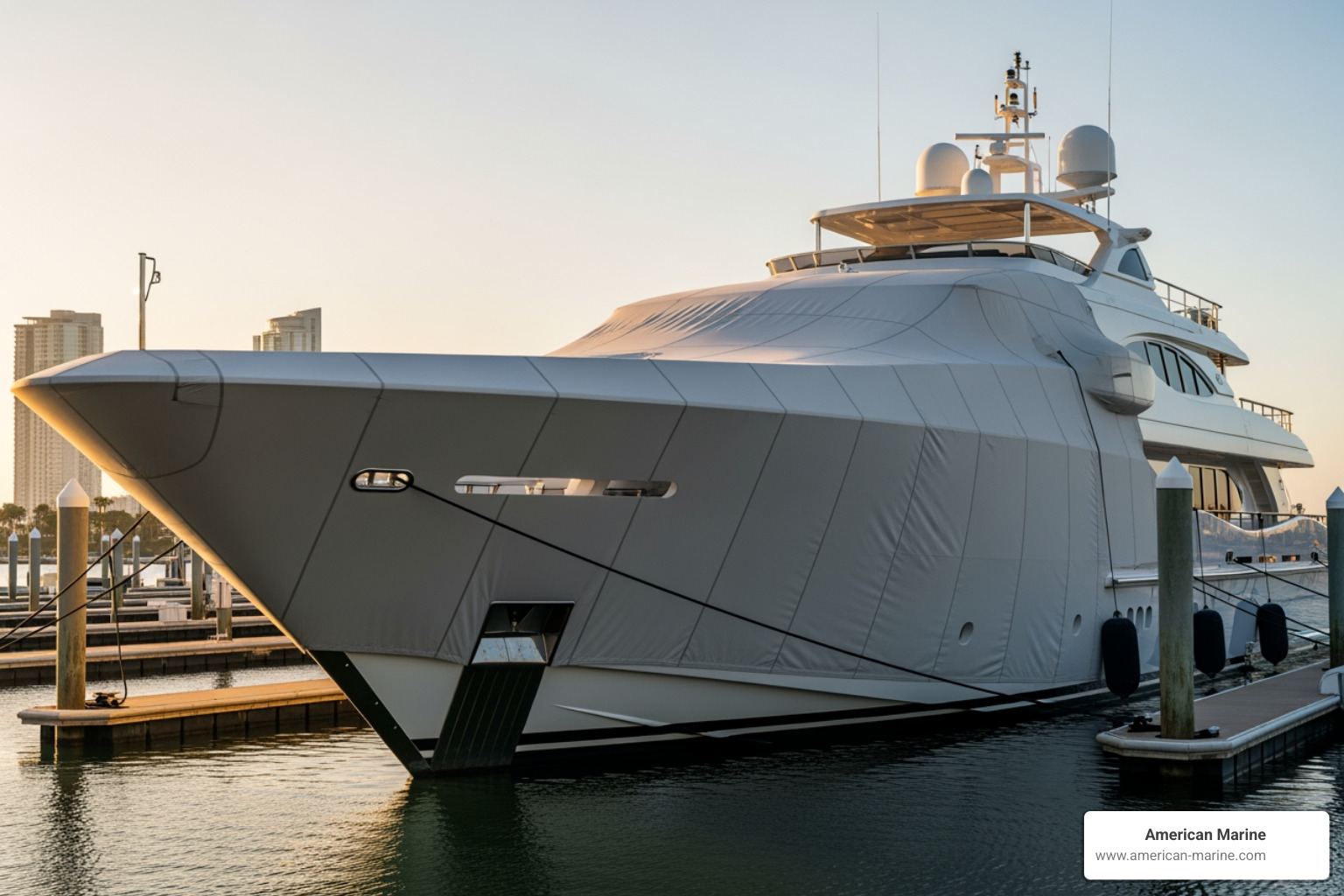
Why Custom Canvas Is the Correct Specification for Large Vessels
The Primary Benefits of Custom Marine Canvas on Motor Yachts and Superyachts
The operational case for custom marine canvas on large vessels is well-established. UV protection is the primary function — South Florida's UV intensity fades upholstery, degrades gel coats, cracks dashboards, and accelerates corrosion of any unprotected surface. A correctly specified custom cover acts as a sacrificial UV barrier, absorbing this load and protecting the surfaces beneath it. Saltwater resistance is equally important — prolonged exposure to salt air degrades fabric, corrodes metal components, and accelerates the deterioration of any material not specifically engineered for marine conditions. For further context on how custom canvas contributes to vessel preservation, see our article More Than a Cover: The Role of Custom Canvas in Yacht Preservation.
Beyond protection, custom enclosures and shade systems extend usable deck space — converting open flybridge areas into climate-controlled environments and providing weather protection that extends the vessel's operational season in South Florida's afternoon storm conditions. These functional additions are only possible with canvas fabricated to the vessel's exact geometry — generic products cannot achieve the fit precision required for structural enclosure systems on large vessels.
Why Generic Covers Fail on Large Yachts
Generic and semi-custom covers produce consistent, predictable failure modes on motor yachts and superyachts. Poor fit produces wind flap that generates continuous mechanical stress on seams and attachment points. Excess material sags and pools rainwater, creating mildew growth conditions on the vessel's surfaces and upholstery beneath the cover. Chafe against hardware — cleats, stanchions, antenna bases — produces localized abrasion that requires cosmetic remediation. These are not edge cases — they are the expected outcome of applying a standard pattern to a vessel with specific deck equipment and superstructure configurations. For a detailed cost analysis, see our article The Hidden Costs of Generic Covers: Why Custom-Fit Saves Money Long-Term.
Custom Marine Canvas Products for Motor Yachts and Superyachts
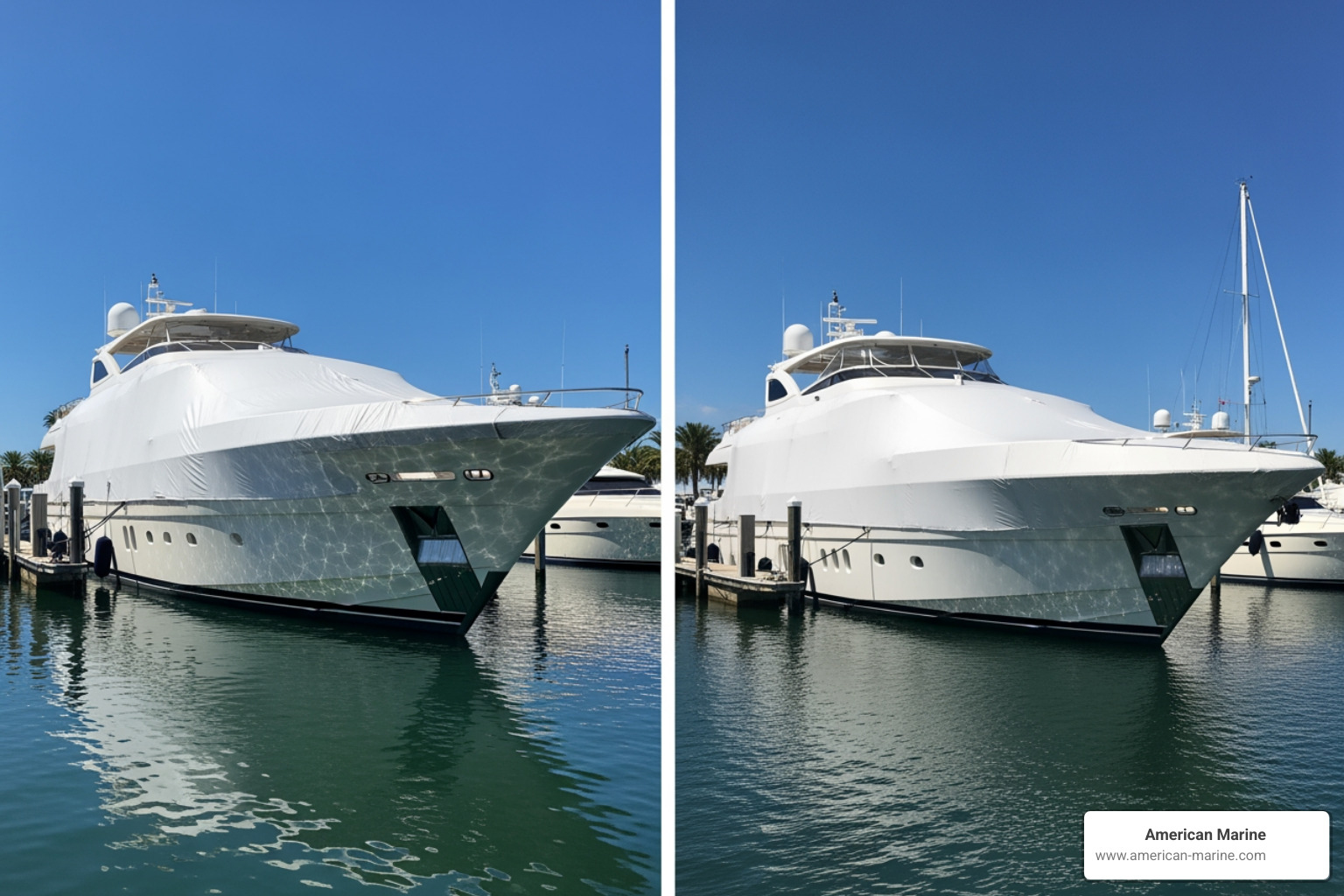
Protective Covers
Vessel covers are the primary asset protection layer for any motor yacht or superyacht during dockside periods. American Marine fabricates:
- Full mooring covers: Precision-patterned to encase the entire vessel during dockside storage — engineered for South Florida's UV load and tropical rain season
- Cockpit covers: Protecting seating areas and helm stations when the vessel is not in active use
- Helm covers: Custom-fitted protection for electronics and navigation systems — critical in South Florida's salt air environment
- Tender covers: Precision-patterned for tenders on davits or deck — custom fit prevents flapping under way and ensures complete protection during storage
- Sail covers: UV protection for sails during dockside periods on sailing vessels
Every cover is engineered for correct water shedding, reinforced at hardware contact points, and fabricated with PTFE thread and marine-grade hardware throughout. For a detailed guide on cover specification for large vessels, see our article Durable Yacht Covers for Motor Yachts and Superyachts.
Shade and Shelter Systems
Shade system specification on large vessels requires the same engineering precision as structural covers:
- Bimini shade systems: Custom shade panels for flybridge, T-top, and hardtop configurations — wind-load rated, fabricated in Sunbrella Marine, Sattler Yacht, or Serge Ferrari depending on application. Frames in 1" or 1¼" double-walled stainless steel for large vessel wind-load requirements.
- Flybridge shade panels: Custom-patterned extensions for motor yacht and superyacht flybridge decks — engineered to the vessel's specific superstructure geometry
- Awnings and sunshades: Bespoke shade systems for larger yachts and superyachts — deployable for aft deck and flybridge entertaining areas
For a full overview of shade system products and the specification process, see our Bimini and Shade Systems page.
Enclosures and Upholstery
Enclosure systems and upholstery are the most complex fabrication work in the custom marine canvas category — requiring 3D digital patterning, precise hardware integration, and material specification that accounts for both weather performance and aesthetic requirements.
Enclosures:
- Full flybridge enclosures — creating climate-controlled environments on motor yacht and superyacht flybridge decks
- Cockpit enclosures — protecting helm and seating areas during South Florida's afternoon storm season
- Pilothouse systems — integrated canvas and clear panel systems for motor yachts with pilothouses
We specify Strataglass flexible vinyl panels and Makrolon AR rigid polycarbonate based on the application's visibility and durability requirements. For a detailed guide on enclosure specification, see our article Custom Enclosure Systems for Motor Yachts and Superyachts.
Marine Upholstery:
- Helm seating — ergonomic rebuilds using multi-density foam for long-range comfort
- Cockpit and deck cushions — closed-cell or Dryfast foam specification for South Florida's exterior moisture conditions
- Salon and interior upholstery — custom seating, settee cushions, and panel work coordinated with the vessel's interior design scheme
- Custom mattresses and cabin cushions — precision-fitted to the vessel's specific berth geometry
For a detailed guide on upholstery specification, see our article Custom Yacht Upholstery for Motor Yachts and Superyachts.
The Fabrication Process: From Vessel Assessment to Dockside Installation
Step 1: On-Vessel Consultation and Assessment
Every custom marine canvas project begins with a thorough on-vessel consultation — not a showroom meeting. We assess the vessel's specific protection, shade, and enclosure requirements, evaluate existing canvas condition where applicable, and document the hardware and superstructure conditions relevant to each fabrication component. This assessment drives all material specification and design decisions — it is not a sales visit.
Step 2: 3D Digital Measurement and CAD Design
We use 3D digital measuring technology to capture the precise contours and dimensions of the vessel — creating a digital blueprint that accounts for every curve, hardware attachment point, and structural constraint. This data is processed through CAD software where each panel and component is designed with the exact geometry of the vessel. The result is a custom-patterned canvas system that fits the vessel precisely — eliminating the flapping, water pooling, and chafe that result from manual measurement approaches on complex large vessel geometry. Digital templates are archived in cloud storage, enabling replacement fabrication from any location without remeasuring the vessel.
Step 3: Fabrication and Dockside Installation
With design finalized and precise digital patterns complete, fabrication is executed in our South Florida facility. CNC-guided cutting tables ensure every piece is cut to exact specification — minimizing waste and guaranteeing fit accuracy. Experienced marine fabricators assemble each system using UV-resistant PTFE thread (SolarFix® or Tenara) and marine-grade YKK zippers and stainless steel fasteners throughout. The final step is professional dockside installation — at your slip, marina, or yard — where our team installs each component, verifies fit and tension, confirms hardware alignment, and makes on-site adjustments before handover.
Materials: The Foundation of Professional-Grade Performance
High-Performance Marine Fabrics
We specify professional-grade marine fabrics with documented performance credentials for South Florida's conditions:
| Feature | Solution-Dyed Acrylic (Sunbrella) | Vinyl-Coated Polyester (Stamoid) |
|---|---|---|
| UV Resistance | Excellent — color embedded in fiber | Very Good — UV stabilizers in coating |
| Water Resistance | Very Good — highly water-repellent, breathable | Excellent — fully waterproof coating |
| Breathability | High — prevents condensation and mildew | Low — requires integrated ventilation |
| Best Applications | Biminis, enclosures, mooring covers, upholstery | Full vessel covers, cockpit enclosures, storm preparation |
| Service Life | 10+ years with maintenance | 10+ years with maintenance |
For a detailed comparison of these two primary specifications, see our article Sunbrella vs Stamoid: Which Marine Fabric Reigns Supreme for Superyacht Covers?
Thread, Zippers, and Hardware
- PTFE thread (Tenara / SolarFix®): UV-stable and impervious to salt and chemicals — ensures seams outlast the fabric, not the other way around. Standard polyester thread degrades under South Florida's sustained UV exposure.
- Marine-grade YKK zippers: Designed specifically for saltwater environments — resist corrosion and salt binding that seizes standard zippers within a season.
- 316 stainless steel fasteners: All snaps, screws, and mounting hardware specified in 316 stainless — prevents the rust bleeding and corrosion failure that non-marine hardware produces in South Florida's salt air.
Frequently Asked Questions
What is the typical service life of custom marine canvas in South Florida?
With correct material specification and consistent maintenance, custom marine canvas typically delivers 7–15 years of service life in South Florida's conditions. The primary variables are material specification — premium solution-dyed acrylics and PTFE thread consistently deliver the upper end of this range — and maintenance consistency. Regular fresh water rinsing to remove salt accumulation before crystallization, pH-neutral cleaning products, and complete drying before storage are the foundational maintenance actions that determine where in the 7–15 year range a system lands.
How does canvas specification differ by vessel type and size?
Every vessel requires canvas specified to its specific operational profile. Motor yachts at large scale — 60ft and above — require enclosure and shade systems engineered for significant wind loads, complex superstructure geometry, and the coordination requirements of refit schedules at professional yards. Superyachts involve coordination with naval architects and interior designers to ensure canvas systems integrate with broader design specifications. The fabrication process — 3D digital patterning, CNC cutting, professional dockside installation — is consistent across vessel sizes, but the design complexity and material load increase significantly with vessel scale.
How does upholstery fit into custom marine canvas services?
Upholstery is a core service that complements canvas work on any large vessel refit. Interior and exterior cushions, helm seating, salon upholstery, and custom mattresses and bedding are all specified and fabricated using the same marine-grade material standards — Sunbrella, marine-grade vinyl, PTFE thread — applied to the upholstery application's specific requirements. The integration of canvas and upholstery work under a single fabricator ensures material and color coordination across the vessel's full soft goods system, rather than managing two separate contractors with potentially inconsistent material standards.
Conclusion
Custom marine canvas solutions — covers, enclosures, shade systems, and upholstery — are a fundamental component of asset protection and operational readiness for motor yachts and superyachts in South Florida. Correct specification, professional fabrication, and consistent maintenance produce systems that perform for 7–15 years and preserve the vessel's condition and value through South Florida's demanding operating environment.
American Marine fabricates custom marine canvas solutions for motor yachts and superyachts across Fort Lauderdale, West Palm Beach, and Miami. For a vessel assessment and specification recommendation, schedule a dockside assessment with our team.