
From T-Tops to Towers: A Guide to Custom Marine Fabrication
What Custom Marine Fabrication Means for Yacht Owners and Builders
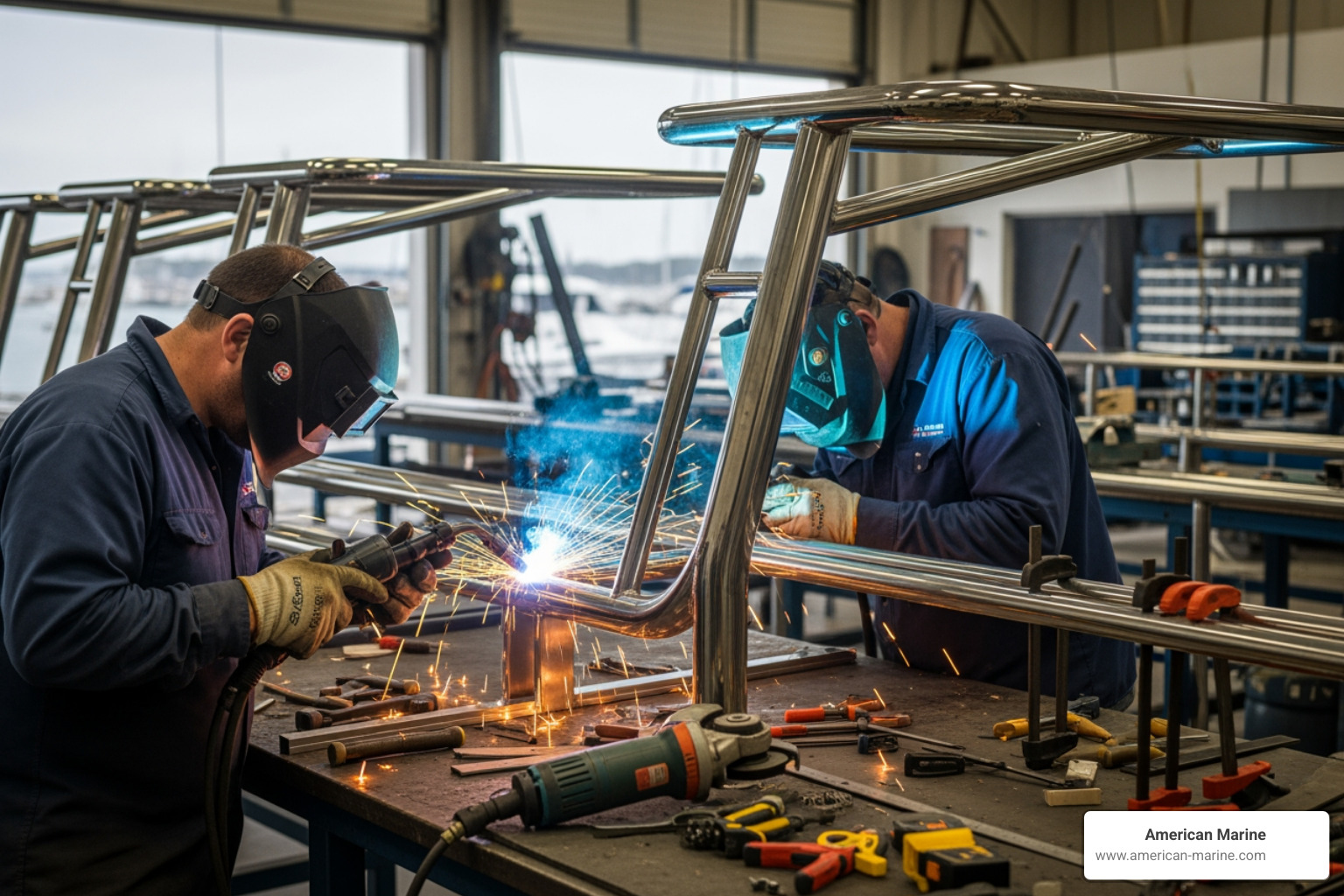
Custom marine fabrication is the process of designing, engineering, and building precision metal components and structural systems specifically for marine vessels. Unlike off-the-shelf parts, custom fabrication delivers exact-fit solutions tailored to your yacht's dimensions, performance requirements, and aesthetic standards.
Core Custom Marine Fabrication Services:
- Structural components – radar arches, dinghy davits, solar towers, tuna towers, t-tops
- Metal systems – stainless steel railings, swim platforms, exhaust guards, mounting hardware
- Performance systems – exhaust headers, water-jacketed tubes, engine component fabrication
- Precision engineering – 3D scanning, CAD design, CNC cutting, laser fabrication
- Material options – 316L stainless steel, 6061-T6 aluminum, powder-coated finishes
Common applications: Large yachts and superyachts requiring durable, corrosion-resistant metalwork that integrates seamlessly with vessel architecture.
For builders, captains, and refit managers working on vessels 60 feet and larger, custom marine fabrication isn't just about adding hardware. It's about structural integrity, repeatable quality, and precision fitment that holds up in harsh saltwater environments.
The difference between generic fabrication and professional-grade work shows up in the details: weld quality, material selection, load distribution, and how components integrate with existing systems. When you're managing a refit schedule or building to spec, fit accuracy and fabrication consistency determine whether a project stays on timeline or requires expensive rework.
I'm Jeremy Bottau, owner of American Marine in South Florida, where we've built our reputation on combining advanced 3D patterning technology with elite marine-grade materials to deliver custom marine fabrication solutions for luxury yachts and superyachts. Our approach centers on precision measurement, shipyard-grade processes, and close collaboration with builders and captains who need reliable, on-schedule fabrication work.
This guide walks through the materials, processes, and engineering standards that separate professional marine fabrication from small-boat metalwork—and what to look for when choosing a fabrication partner for large-vessel projects.
Core Materials and Durability in Custom Marine Fabrication
For vessels operating in the high-salinity environments of South Florida and the Caribbean, material selection is the first line of defense against structural failure. In custom marine fabrication, we prioritize materials that offer a balance of mechanical strength and chemical resistance.
The primary materials used in professional-grade fabrication include 316L stainless steel and 6061-T6 aluminum. While 304 stainless steel or lower-grade alloys might suffice for inland freshwater applications, they quickly succumb to pitting and crevice corrosion in maritime settings.
To ensure longevity, we employ several finishing processes:
- Electropolishing: An electrochemical process that removes surface impurities and creates a chromium-rich surface layer.
- Passivation: A chemical treatment that enhances the protective oxide layer on stainless steel.
- Powder Coating: Often used for aluminum components, providing a durable, UV-resistant barrier that can be color-matched to the vessel's hull or superstructure.
The Role of Stainless Steel in Marine Environments
Stainless steel remains the gold standard for high-visibility hardware and heavy-load structural components. For large yachts and superyachts, the industry standard is 316L (low carbon) stainless steel. The addition of molybdenum in the 316 series provides significantly better resistance to chlorides compared to the 304 series.
In our custom marine fabrication shop, we focus on:
- Mirror Polishing: Achieving a high-luster finish that not only looks professional but also reduces surface area where salt crystals can lodge.
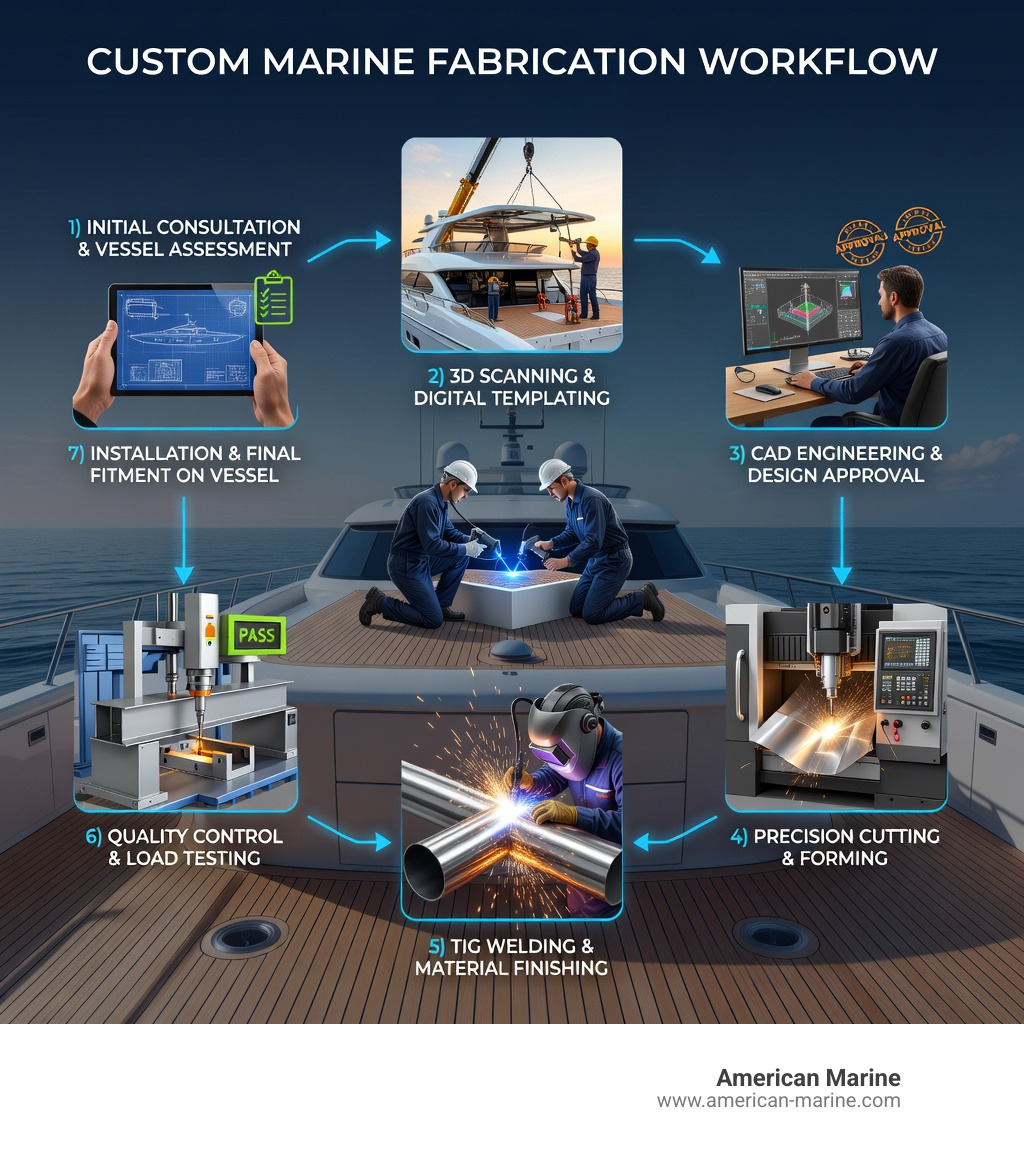
- TIG Welding: Tungsten Inert Gas welding is utilized for its precision and clean aesthetics, essential for visible yacht railings and hardware reproductions.
- Tensile Strength: Ensuring that components like stanchions and cleats can withstand the immense loads generated by large vessels during docking or heavy seas.
Aluminum Fabrication for Performance and Weight
When weight is a critical factor—such as in the fabrication of T-tops, tuna towers, or flybridge structures—6061-T6 aluminum is the preferred alloy. It offers an exceptional weight-to-strength ratio, allowing for expansive structural additions without significantly raising the vessel's center of gravity.
For professional marine operations, aluminum components are typically anodized or powder-coated to prevent the "white rust" oxidation common in untreated aluminum. In South Florida’s heat, these finishes also help manage surface temperatures on handrails and towers.
Essential Components: From Structural Arches to Exhaust Systems
The scope of custom marine fabrication extends from the waterline to the highest point of the mast. Each component must be engineered to withstand both the static loads of the equipment they carry and the dynamic loads of a vessel in motion.
Integrating Solar and Power Systems via Custom Marine Fabrication
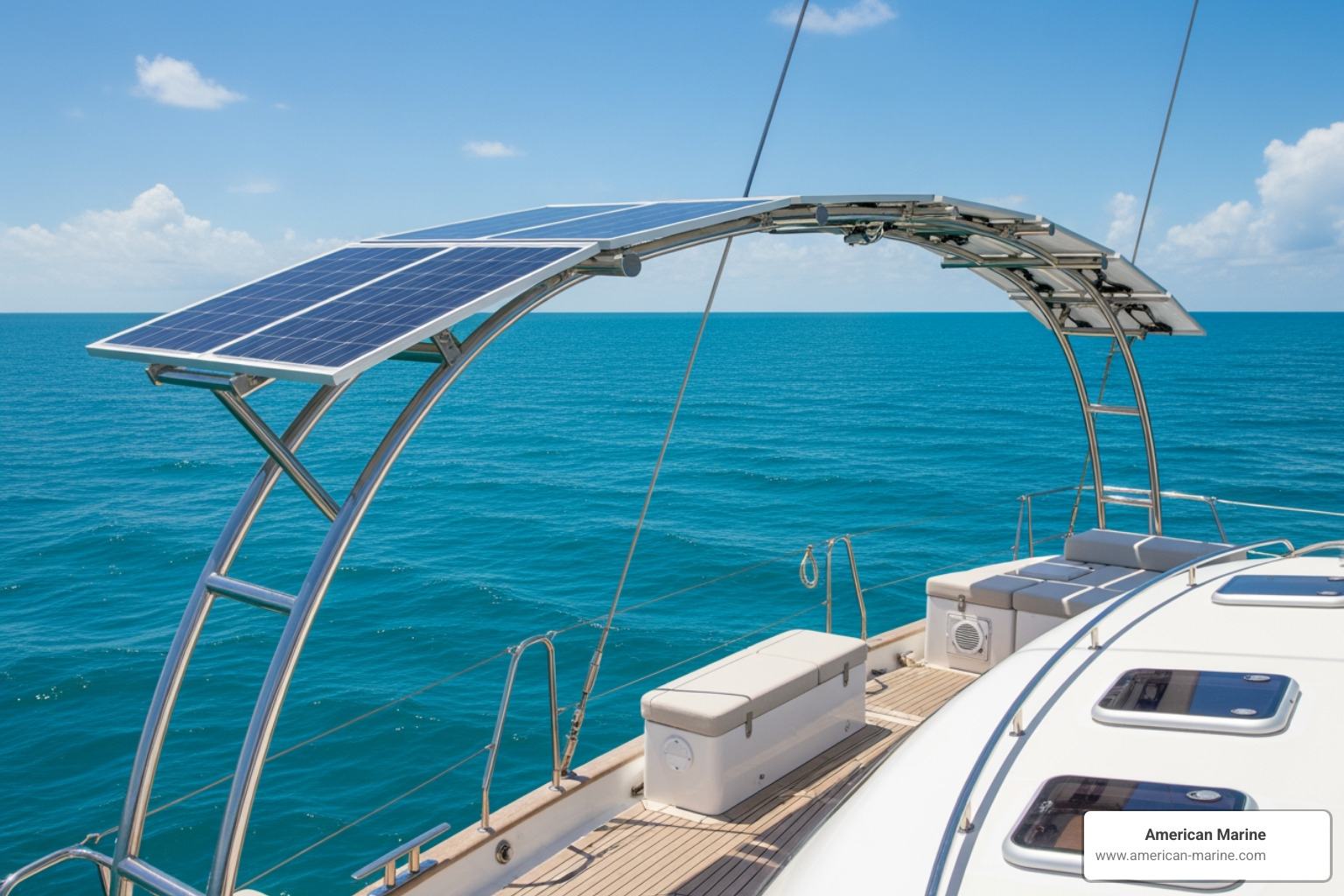
As off-grid power requirements for large yachts increase, we have seen a surge in demand for custom solar and davit arches. Unlike standard canvas biminis, which cannot safely support the weight or wind load of rigid glass solar panels, a custom-engineered arch provides a stable platform for high-output arrays.
Key considerations for solar integration include:
- Rigid Panel Mounting: Secure frames that prevent panel vibration and micro-cracking.
- CAD Engineering: Designing for specific wind speeds and ensuring the arch does not interfere with the boom or rigging.
- Vibration Dampening: Utilizing specialized mounting hardware to prevent resonant frequencies from traveling through the hull.
High-Performance Exhaust and Engine Components
Marine fabrication isn't limited to what you see on deck. Below deck, custom-fabricated exhaust systems are vital for engine longevity and performance. High-performance headers and water-jacketed tubes are engineered to manage extreme temperatures while preventing salt-water backflow into the engine.
For professional marine projects, we also fabricate "surf pipes" and exhaust guards. These systems direct exhaust gases into the propeller wash, reducing noise and keeping the swim platform clear of fumes—a critical feature for yachts used for water sports or frequent guest boarding.
Precision Engineering and 3D Measurement Processes
The days of manual tape measurements and cardboard templates are fading in the professional shipyard environment. For vessels 60ft+, the margin for error is non-existent. We utilize 3D scanning and digital templating to ensure that every fabricated part fits perfectly the first time.
| Feature | Manual Templating | 3D Digital Measurement (ProLiner) |
|---|---|---|
| Accuracy | +/- 1/4 inch | +/- 1 millimeter |
| Speed | Several hours/days | Minutes per section |
| Repeatability | Low (requires new template) | High (digital file stored) |
| Complexity | Difficult for compound curves | Seamlessly captures 3D geometry |
| Integration | Manual translation to CAD | Direct digital output for CNC |
Advancements in Custom Marine Fabrication Technology
By integrating ProLiner technology with CNC (Computer Numerical Control) machinery, we can achieve levels of precision that were previously impossible. This technology allows for:
- Laser Cutting: Ensuring clean edges and perfect dimensions for switch panels and mounting plates.
- CNC Bending: Producing identical curves for sets of railings or T-top frames.
- Polyurethane Molding: Creating custom gaskets and seals that match the fabricated metal components exactly.
Quality Control and Safety Standards in Custom Marine Fabrication
Safety is the baseline of our fabrication process. For military applications and large commercial vessels, adhering to Coast Guard certifications and ISO standards is mandatory.
Our quality assurance protocol includes:
- Weld Penetration Analysis: Ensuring that TIG and MIG welds are structural, not just aesthetic.
- Load Testing: Verifying that davits and arches can support their rated weight plus a significant safety margin.
- Material Traceability: Maintaining records of material grades to ensure no sub-par alloys enter the production line.
Selecting a Fabrication Partner for Luxury Vessels
Choosing a vendor for custom marine fabrication in South Florida requires looking beyond the price tag. For a 100ft superyacht, the cost of a delayed refit or a component that doesn't fit far outweighs the initial fabrication quote.
When vetting a partner, consider:
- Shipyard Logistics: Can the fabricator work within the constraints of major yards in Fort Lauderdale or West Palm Beach?
- Project Management: Do they provide clear timelines and CAD drawings for approval before cutting metal?
- Repeatability: If a railing is damaged, can they pull the digital file and ship a replacement that fits perfectly without a second site visit?
At American Marine, we serve captains and management companies across Broward and Palm Beach counties, providing a seamless transition from 3D scan to final installation.
Frequently Asked Questions about Marine Fabrication
Why is 316L stainless steel the industry standard for custom fabrication?
316L contains molybdenum, which provides superior resistance to pitting and corrosion in saltwater. The "L" stands for low carbon, which makes the metal easier to weld without compromising its corrosion resistance at the weld joints.
Can standard canvas biminis support rigid solar panel arrays?
Generally, no. Standard bimini frames are designed to support the weight of the fabric and moderate wind loads. Rigid solar panels add significant weight and create "lift" in high winds, which can buckle standard tubing. A custom-fabricated arch is required for safe solar integration.
What are the benefits of 3D scanning for yacht refit projects?
3D scanning captures the exact "as-built" dimensions of a vessel. This is crucial because even sister ships often have slight variances. Digital scanning ensures that a new Custom Boat Bimini or radar tower fits the existing mounting points perfectly, reducing labor costs during installation.
Conclusion
Custom marine fabrication is an essential discipline for maintaining the standard of luxury and safety expected on modern yachts. Whether it is a structural radar arch, a high-performance exhaust system, or precision-fit hardware, the quality of the fabrication defines the vessel's longevity and value.
At American Marine, we combine decades of yachting industry experience with the latest in 3D measurement and CNC technology. We understand that for builders and captains, reliability and precision are the only metrics that matter. From our facility in Miami, we provide the South Florida yachting community with Custom Projects and Marine Upholstery solutions that meet the highest naval standards.
If you are managing a refit or overseeing a new build and require precision-engineered metalwork or canvas, we invite you to discuss your project with our team.