Yacht Carpet for Motor Yachts and Superyachts: Materials, Installation, and Maintenance
Carpet selection for a motor yacht or superyacht is a functional specification decision — not just an aesthetic one. In South Florida's saltwater environment, the wrong material fades, molds, or fails structurally within a single season. The right material, correctly installed with professional-grade templates and marine adhesives, performs reliably for 7–10 years with consistent maintenance. This guide covers the primary material options for yacht carpet on vessels 40ft and above, installation considerations specific to large vessel geometry, and a practical maintenance framework for South Florida's high-UV, high-humidity conditions.
Yacht Carpet Trends for 2026: What's New and What Matters
The yacht carpet market continues to evolve with improvements in material science, sustainability, and fabrication technology. Understanding what's current helps captains and vessel managers make informed specification decisions.
Innovations in Marine Carpet Materials
Recycled PET fibers — produced from repurposed plastic — are gaining ground against traditional nylon in the professional marine carpet market. These materials deliver enhanced UV resistance and colorfastness alongside a credible sustainability profile, making them an increasingly common specification on luxury vessel interiors. Anti-microbial treatments and rapid-dry backing technologies are now standard features in professional-grade marine carpet, addressing the mold and mildew risk that South Florida's humidity creates on any vessel with enclosed interior spaces.
| Feature | Nylon | Marine-Grade PET |
|---|---|---|
| Durability | High | High |
| UV Resistance | Moderate | Excellent |
| Eco-Friendly | No | Yes |
| Fade-Proof | Moderate | Excellent |
| Water Resistance | Good | Excellent |
Custom Design and Vessel Identity
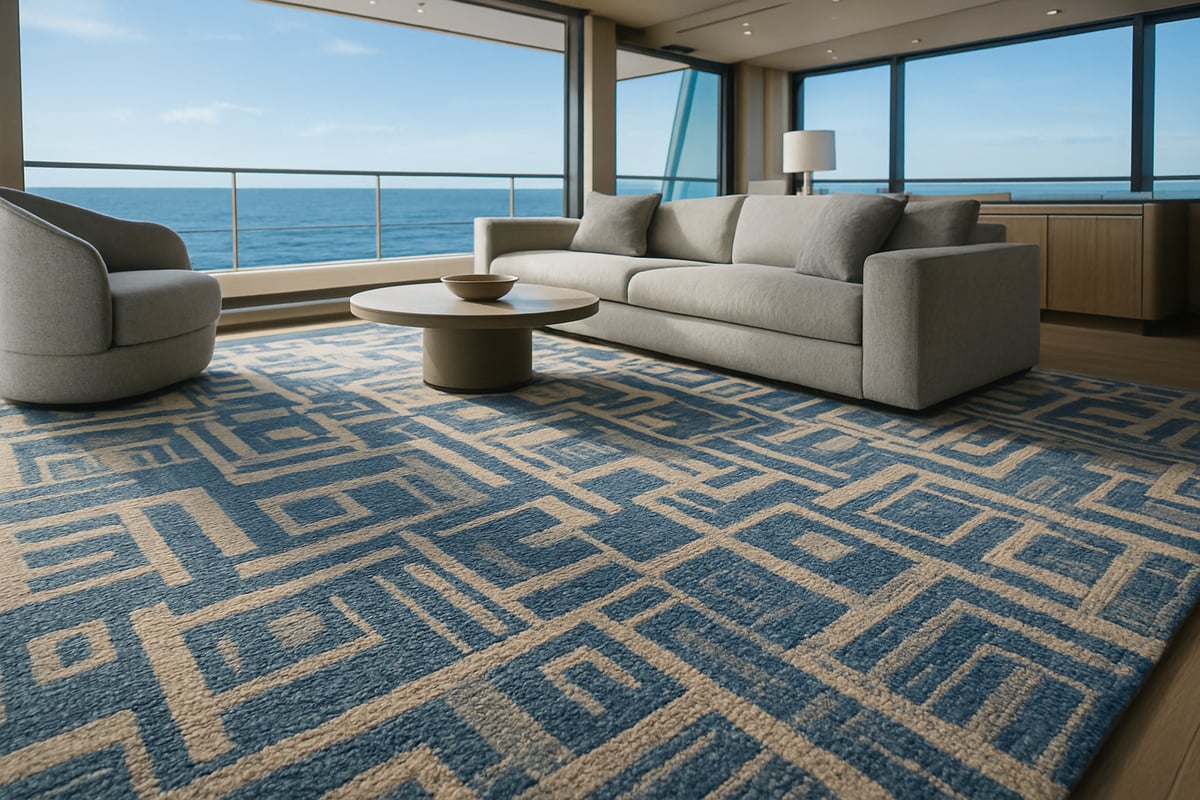
Custom patterning — monograms, vessel name integration, geometric motifs — has become a standard expectation on motor yachts and superyachts where the interior is an extension of the vessel's identity. Digital fabrication technology makes bespoke carpet design more accessible than it was five years ago, with lead times that fit realistic refit schedules. Color specification has shifted toward muted navies, warm neutrals, and tonal greys that hold their appearance longer under UV exposure and high foot traffic.
Sustainability Credentials
Recycled content certifications and low-VOC adhesive systems are increasingly requested by vessel managers and owners making environmental commitments. Manufacturers have responded with documented recycled fiber content, bio-based backing options, and take-back programs for end-of-life carpet. These credentials are now relevant selection criteria on superyacht-level specifications alongside the traditional performance metrics.
Digital Fabrication and Precision Templates
3D digital patterning technology is changing how yacht carpet is fitted on large vessels. At American Marine, we template every project directly on the vessel — capturing exact geometry across hatches, hardware, curved bulkheads, and irregular deck profiles. Digital templates are archived in cloud storage, enabling precise replacement fabrication from any location without remeasuring the vessel. This is a practical operational advantage for motor yachts and superyachts that move between ports and yards across South Florida and beyond.
Choosing the Right Yacht Carpet: Materials, Durability, and Specification
Material selection is the most consequential specification decision in any yacht carpet project. Each fiber type performs differently against South Florida's UV intensity, saltwater exposure, and humidity — and each involves trade-offs between durability, comfort, and maintenance commitment.
Primary Material Options
| Material | Pros | Cons |
|---|---|---|
| Nylon | Highly durable, easy to clean | Prone to fading under sustained UV exposure |
| Polypropylene | Water resistant, lightweight | Less plush underfoot, lower perceived luxury |
| Wool Blends | Luxurious feel, natural insulation | Higher maintenance requirement |
| Marine-Grade PET (Recycled) | Strong UV resistance, eco credentials | Slightly less resilient than nylon under heavy traffic |
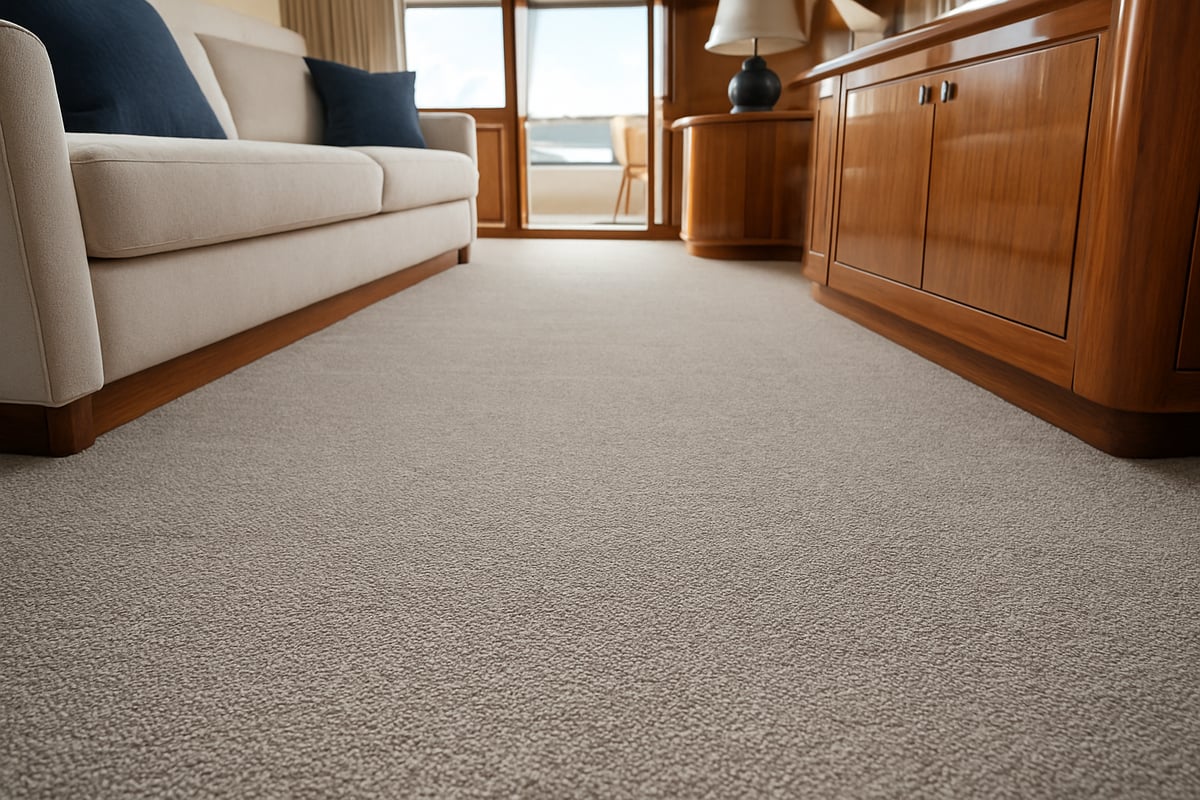
Nylon remains the standard specification for high-traffic areas on motor yachts — salons, companionways, crew quarters — where durability under repeated foot traffic is the priority. Marine-grade PET is gaining traction in guest-facing areas where UV resistance and environmental credentials are valued. Wool blends are specified on superyachts where tactile luxury in guest cabins and formal salons justifies the additional maintenance requirement. For interior spaces on motor yachts and superyachts across South Florida, the correct specification depends on the specific area, usage pattern, and exposure level.
Structural Considerations: Pile, Density, and Backing
Pile height and density directly affect both the tactile experience and the practical performance of yacht carpet in a marine environment. Plush cut-pile delivers the luxury finish expected in guest areas but requires more active maintenance to preserve appearance. Looped weaves handle high-traffic wear better and are more practical for crew areas and companionways. Non-slip backing is non-negotiable on any vessel where motion underway creates a safety consideration. Sound-dampening underlays are a worthwhile specification on motor yachts with significant engine noise — they reduce ambient sound levels in salons and cabins meaningfully.
Durability in South Florida's Marine Environment
Saltwater, UV exposure, and humidity are the primary failure mechanisms for yacht carpet in South Florida. UV-resistant fibers and fade-proof coatings are essential specifications — not optional upgrades — for any area with direct or indirect sun exposure. Anti-microbial treatment is important in any enclosed space where ventilation is limited. For high-traffic zones, reinforced fiber density extends service life significantly.
Expected service life by material in South Florida conditions:
- Nylon: 5–7 years
- Polypropylene: 4–6 years
- Wool blends: 6–8 years with consistent maintenance
- Marine-grade PET: 5–7 years
Matching Specification to Vessel Use
A motor yacht used for private family cruising has different carpet requirements than a charter vessel with high guest turnover, or a superyacht where the interior represents a significant design investment. Private use allows for higher-maintenance luxury specifications — wool blends, bespoke patterns, premium finishes — because the owner controls how the vessel is used. Charter operations require quick-dry, stain-resistant specifications that can be cleaned rapidly between guest changeovers. Superyacht interiors often involve coordination with a naval architect or interior designer — the carpet specification is part of a larger design system rather than a standalone decision.
Lifecycle Cost
| Specification | Initial Cost | Maintenance Level |
|---|---|---|
| Off-the-shelf marine carpet | Lower | Moderate — generic fit requires more frequent replacement |
| Custom professionally fitted carpet | Higher upfront | Lower over time — precise fit reduces edge wear and adhesive failure |
Professional Installation: What the Process Looks Like on a Large Vessel
Installation quality determines whether a correctly specified carpet system performs at its rated lifespan or fails prematurely at seams, edges, and adhesive points. On motor yachts and superyachts, the geometry of large interior spaces — long runs, curved bulkheads, multiple hatches, custom furniture surrounds — makes professional installation significantly more consequential than on smaller vessels.
Digital Measurement and Layout Planning
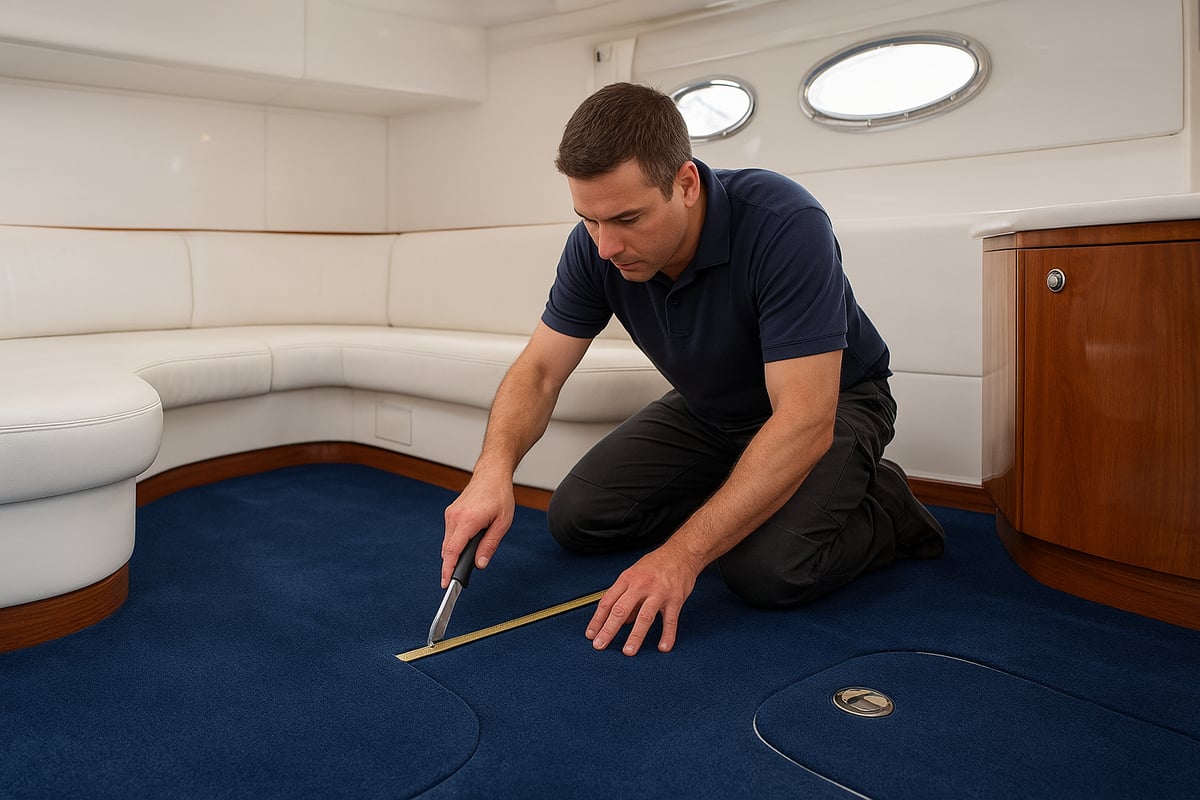
Professional installation begins with precise measurement — not approximation. On large vessels, 3D digital patterning captures exact geometry across all surfaces, accounting for curves, steps, hatch positions, and hardware penetrations. Seam and join placement is planned before cutting begins — on a 100ft motor yacht, a misplaced seam in the main salon is a costly error. Adhesives and fasteners are specified for marine-grade performance: waterproof, solvent-free, and flexible enough to accommodate the vessel's movement in a seaway.
Substrate Preparation
The substrate condition directly determines installation longevity. Any existing moisture, rot, or surface irregularity must be addressed before new carpet is fitted — a correctly specified carpet system installed over a compromised substrate will fail prematurely regardless of material quality. Moisture barriers are applied in high-risk zones — galleys, heads, areas adjacent to the waterline. A dry, level, structurally sound substrate is the foundation of a professional result.
Cutting, Fitting, and Securing
Each panel is cut to specification from digital templates — not measured and cut on-site. This approach eliminates the margin of error that produces visible seams, edge gaps, and uneven pile direction. Adhesive is spread evenly with a notched trowel and sections are pressed into position sequentially. In areas requiring future access — over hatches, around removable hardware — mechanical fastening systems allow panel removal without adhesive damage. Final edges are bound or serged for a finished appearance that resists fraying at wear points.
Quality Verification
After installation, the entire area is inspected for adhesive voids, seam alignment, pile direction consistency, and edge finish quality. Adhesives are allowed to cure fully before the vessel returns to service — premature use before full cure causes shifting and delamination at seam points.
Maintenance: Keeping Yacht Carpet in Condition in South Florida
South Florida's saltwater environment accelerates degradation of any material that isn't actively maintained. A consistent care routine is the primary variable that separates a carpet system that lasts five years from one that lasts ten.
Routine Maintenance Protocol
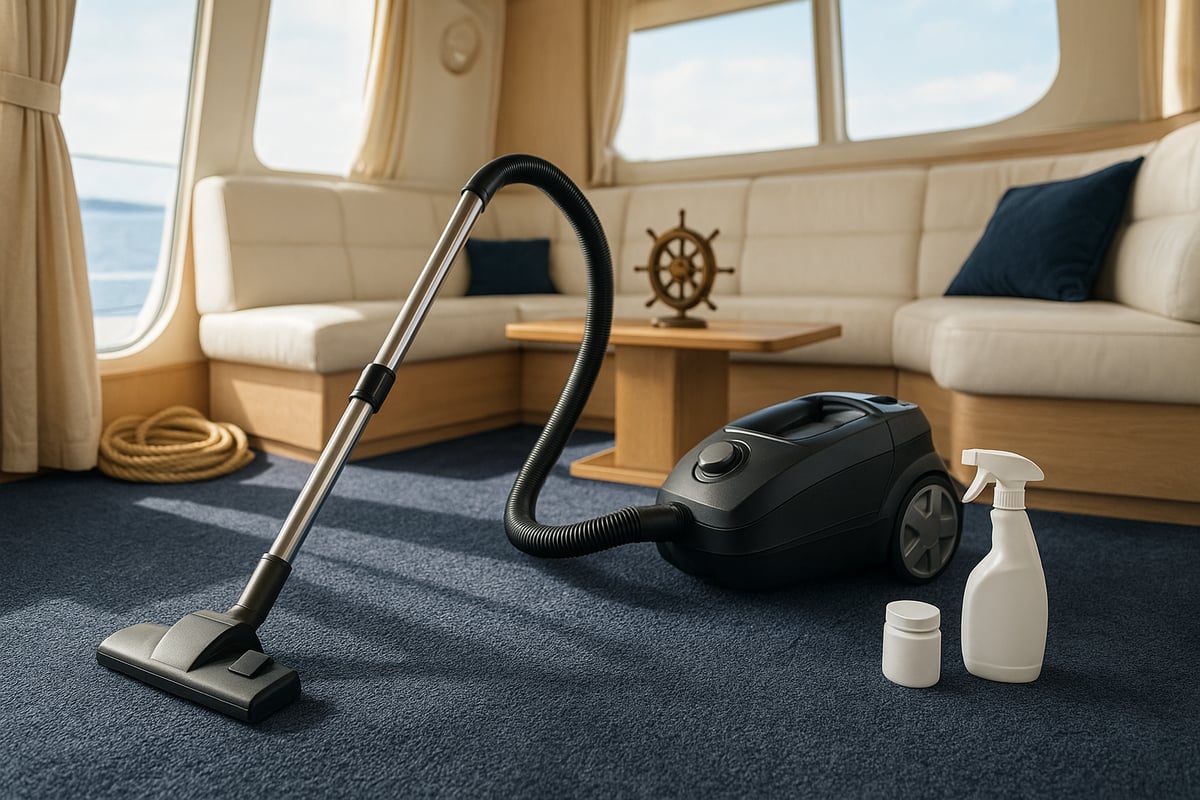
Vacuuming at least twice weekly in high-traffic zones — companionways, salons, crew areas — removes salt crystals and abrasive particles before they work into the fiber structure and accelerate wear. Spills should be blotted immediately with a clean absorbent cloth — rubbing drives the contaminant deeper into the pile. Marine-approved, pH-neutral cleaning products are the correct specification for spot treatment — harsh chemicals and bleach-based products break down fiber coatings and accelerate fading. Moisture management in enclosed spaces is critical in South Florida's humidity: dehumidifiers and moisture-absorbing mats at entry points reduce the mold and mildew risk significantly.
Seasonal Deep Cleaning
A thorough deep clean at the end of each season — or every 3–6 months on vessels in continuous use — removes embedded salt, organic residue, and contaminants that routine vacuuming doesn't reach. Steam cleaning is effective for most professional-grade marine carpet materials — verify compatibility with the specific product specification before use. The carpet must dry completely before the vessel is closed — mold growth in a damp, enclosed space requires remediation that exceeds the cost of preventive maintenance significantly. Annual maintenance checklist:
- Inspect for mold or mildew monthly
- Deep clean every 3–6 months depending on usage intensity
- Apply anti-microbial treatment as needed in enclosed spaces
- Inspect substrate and underlay for hidden moisture annually
Stain Management
| Stain Type | Cleaning Approach | Response Window |
|---|---|---|
| Sunscreen | Mild detergent, warm water, blot — do not rub | Immediate |
| Wine | Club soda, blot, marine spot cleaner | As soon as possible |
| Fish residue | Enzyme-based marine cleaner | Within 1 hour |
| Saltwater | Damp cloth, air dry completely | Promptly — salt crystals accelerate fiber wear |
Wear Management and Replacement Indicators
Rotating area rugs and runners in high-traffic zones distributes wear evenly and extends the primary carpet's service life. UV-protective sprays applied to sun-exposed areas slow fading measurably. A shoes-off policy on board is the single most effective practice for preserving carpet appearance and reducing the introduction of abrasive particles. When thinning spots, persistent odor despite cleaning, frayed edges, or delaminating backing appear — these are indicators that the system has reached end of service life. Small isolated damage can often be patched professionally; widespread deterioration warrants full replacement to avoid compounding the substrate moisture risk.
Customization on Motor Yachts and Superyachts
Bespoke Design and Vessel Identity
Custom monograms, vessel name integration, and bespoke geometric patterns are standard requests on motor yachts and superyachts where the interior reflects the owner's identity. Digital fabrication makes one-off designs practical at a professional level — a sculpted crest in the main salon, color-matched pile direction changes between zones, or vessel-specific insignia woven into the fiber structure. These details require coordination between the carpet fabricator, the vessel's interior designer, and the captain to ensure the design intention survives the practical constraints of installation.
Premium Material Specifications
| Material | Texture | Application | Maintenance |
|---|---|---|---|
| Silk Blend | Ultra-soft | Owner's cabin, formal salon | Moderate — specialist cleaning |
| High-Pile Nylon | Plush | Guest cabins, salons | Low to moderate |
| Hand-Tufted Wool | Textured, premium | Superyacht interiors, owner's suite | Moderate — professional care recommended |
Performance Upgrades Worth Specifying
- Heated zones in owner's suite or formal salon areas on vessels operating in cooler conditions
- Sound-dampening underlays in salons and cabins on motor yachts with significant engine noise transfer
- Non-slip luxury pads in companionways and areas where motion underway creates a safety consideration
Coordination with Interior Design Specifications
On motor yachts and superyachts, carpet color and texture selection is part of a larger interior design system. The carpet specification needs to coordinate with upholstery, joinery, window treatments, and hardware finishes. Experienced vessel managers involve the carpet fabricator early in the refit planning process — changes to carpet specification mid-project are significantly more costly than decisions made before fabrication begins.
Common Specification and Installation Errors
Material Misspecification
Selecting a carpet based on appearance rather than performance profile for the specific application is the most common error. A beautiful wool blend in a companionway that receives heavy crew traffic will deteriorate quickly — the correct specification for that zone is a durable, easy-to-clean nylon or PET. Performance requirements by zone should drive material selection, with aesthetic preference applied within those performance constraints.
Substrate Neglect
Installing new carpet over a compromised substrate — moisture damage, rot, surface irregularities — produces premature failure regardless of material quality. Substrate inspection and remediation is not optional preparatory work — it's the foundation of a professional result.
Lifecycle Cost Errors
Selecting a lower-cost specification to reduce upfront cost frequently produces higher total ownership cost through accelerated replacement cycles and additional installation labor. The correct analysis is total lifecycle cost over a 7–10 year horizon — not initial price. For most professional applications on vessels 40ft and above, a correctly specified and professionally installed carpet system delivers lower total cost than repeated replacement of lower-grade alternatives. For professional guidance on marine carpet and flooring options for motor yachts and superyachts, the correct starting point is a vessel assessment — not a material catalog.
American Marine installs custom yacht carpet on motor yachts and superyachts across Fort Lauderdale, West Palm Beach, and Miami. If you're planning a carpet replacement or refit project on a vessel 40ft or above, schedule a dockside assessment and we'll evaluate your vessel's specific requirements and recommend the correct specification for each area.