
Beyond the Bimini: Everything You Need to Know About Custom Boat Enclosures
Why Custom Boat Enclosures Matter for Yacht Owners
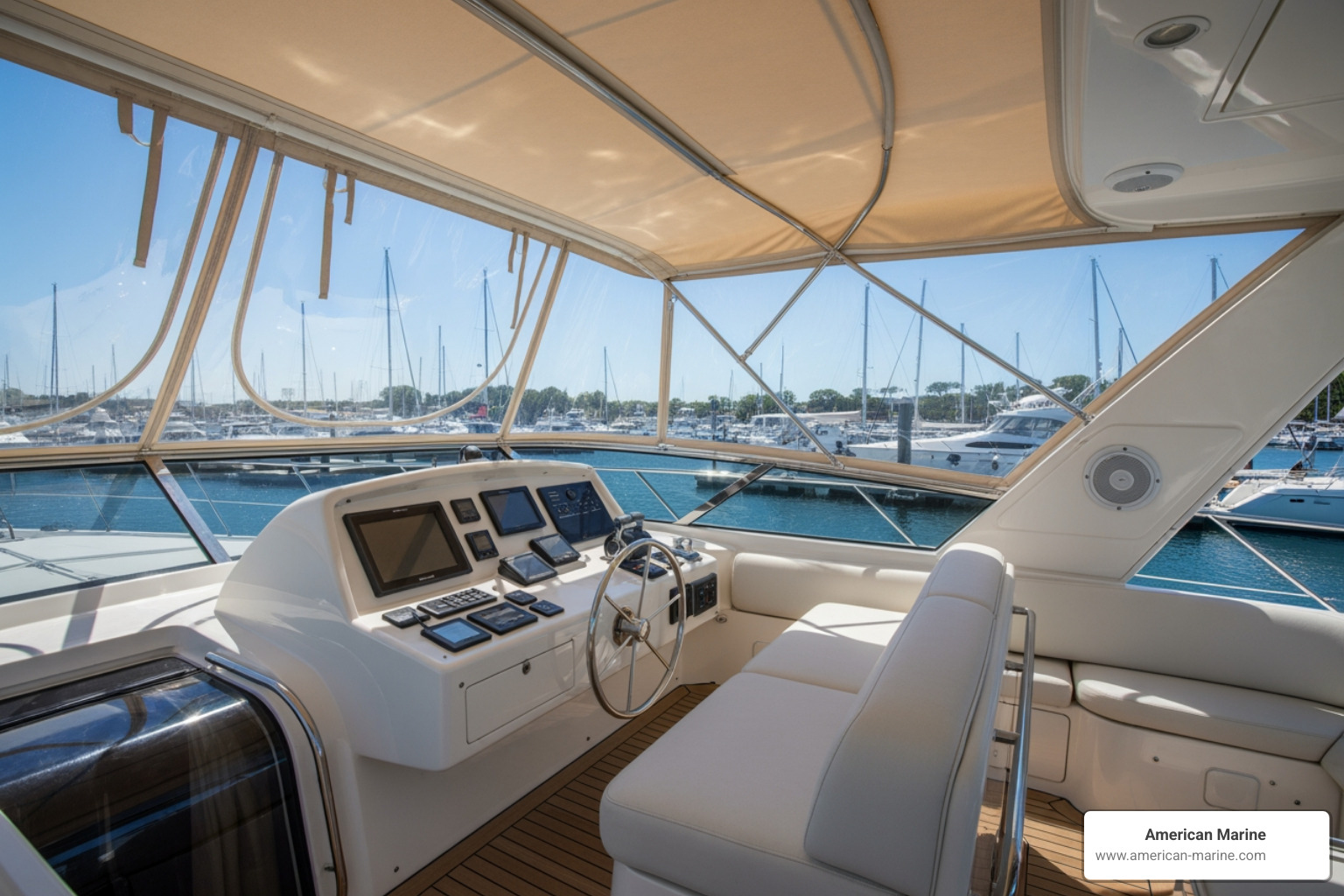
Custom boat enclosures are engineered canvas and clear vinyl systems designed to protect cockpits, flybridges, and helm stations from weather while maintaining visibility and operational access. Unlike off-the-shelf solutions, custom enclosures are digitally templated to match your vessel's exact geometry—accounting for hardtops, radar arches, seating configurations, and electronics.
Key Benefits of Custom Boat Enclosures:
- Weather Protection – Shield crew and guests from wind, rain, spray, and UV exposure
- Extended Season – Use your vessel comfortably year-round, not just fair-weather months
- Asset Preservation – Protect electronics, upholstery, and teak from saltwater and sun damage
- Resale Value – Well-maintained enclosures signal proper care to buyers and brokers
- Operational Flexibility – Removable panels, zippered sections, and ventilation options adapt to conditions
Common Custom Boat Enclosure Configurations:
| Type | Best For | Features |
|---|---|---|
| Full Cockpit | Express cruisers, sportfish | Bow-to-stern protection, zippered entry |
| Flybridge | Dual-helm yachts | Upper deck coverage, helm visibility |
| 3-Wing or 5-Wing | Center consoles | Spray curtains, convertible side panels |
| Aft Deck | Motor yachts | Partial enclosure, entertainment area protection |
A well-engineered custom enclosure is not decorative canvas work. It's a precision-fabricated system built from marine-grade fabrics, optical-clarity vinyl, and corrosion-resistant hardware—designed to withstand years of saltwater exposure while maintaining structural integrity and appearance.
For large yachts and superyachts, the difference between a generic fit and a custom solution becomes obvious within the first season. Gaps, wrinkles, and sagging panels signal poor templating. Professional enclosures fit taut, operate smoothly, and integrate seamlessly with your vessel's lines and hardware.
As Jeremy Bottau, owner of American Marine in South Florida, I've built my career around delivering precision-engineered custom boat enclosures for luxury yachts using 3D patterning and CNC fabrication. My background in yacht brokerage and marine operations gives me the perspective to understand what owners, captains, and builders expect—and what actually performs in harsh marine environments.
Engineering Precision: The Custom Boat Enclosures Fabrication Process
For the modern yacht owner or captain, the fabrication of custom boat enclosures has evolved from manual labor to a high-tech engineering discipline. At American Marine, we approach every project as a technical refit rather than a simple upholstery job. The process begins with advanced 3D scanning and ProLiner technology, which allows us to capture the exact dimensions of a vessel's superstructure with sub-millimeter accuracy.
This digital data is essential for Custom Enclosure Design. By mapping the radar arch, hardtop, and coaming lines digitally, we eliminate the margin for error inherent in traditional hand-patterning. Once the digital "twin" of the boat's enclosure area is created, our designers use CAD software to plot seam lines, zipper placements, and window orientations that follow the yacht’s aesthetic lines while ensuring structural stability.
Digital Templating vs. Manual Patterning
The industry transition from manual patterning to digital templating is a defining factor in Premium Custom Marine Canvas Engineering. Manual patterning involves draping physical plastic or paper over the boat, which can stretch, shift in the wind, or sag, leading to a loose fit.
Digital templating offers several critical advantages:
- Accuracy: Captures every curve, fastener location, and obstruction without physical distortion.
- Repeatability: If a panel is damaged three years later, we can pull the digital file and CNC-cut an identical replacement without needing to revisit the boat.
- Refit Efficiency: Minimizes the time the vessel must spend at the dock for measuring and fitting.
- CNC Precision: Our CNC cutting tables ensure that every piece of fabric and vinyl is cut exactly to the digital spec, resulting in a drum-tight fit that reduces wind noise and vibration.
Structural Integrity and Hardware
A custom enclosure is only as strong as its foundation. For yachts in South Florida, where afternoon squalls and high-speed cruising are the norm, the hardware must be robust. We typically utilize 1" or 1 ¼” stainless steel double-walled tubing for frames to ensure maximum rigidity.
Mounting fittings and screws must be high-grade stainless steel to resist the corrosive Broward and Palm Beach County salt air. For tensioning, we often employ 1” nylon webbing straps or upgraded stainless steel struts. These components work together to ensure the enclosure does not "bellow" or flap when the vessel is underway at 30+ knots.
Material Selection for High-Performance Marine Environments
Choosing the right materials for custom boat enclosures is a balance between optical clarity, UV resistance, and structural stability. In the intense sun of Miami and Fort Lauderdale, inferior materials degrade rapidly. High-performance textiles like Sattler Marine Grade are engineered to block up to 97.5% of harmful UV rays, protecting both the passengers and the vessel’s interior.
Fabric shrinkage is another technical hurdle. Materials like Stamoid are favored for superyacht applications because they boast almost zero fabric shrinkage, ensuring the enclosure remains easy to zip and unzip regardless of temperature fluctuations. For more detailed data, owners can review Technical specifications for marine-grade textiles to understand how different weaves handle tension and moisture.
Understanding the Marine Canvas Material options is the first step in planning a long-term investment for your yacht.
Comparing Clear Vinyl and Rigid Polycarbonate
The "glass" of your enclosure is often the most scrutinized component. There are two primary schools of thought: flexible vinyl and rigid polycarbonate.
| Feature | Flexible Vinyl (Isinglass/Strataglass) | Rigid Polycarbonate (Makrolon/EZ2CY) |
|---|---|---|
| Visibility | Excellent (when new) | Superior (glass-like clarity) |
| Flexibility | Can be rolled or folded | Semi-rigid to rigid; usually pinned to hardtop |
| Durability | 3–5 years | 5–7+ years |
| Impact Resistance | Moderate | High |
| Maintenance | High (scratch-sensitive) | Moderate (chemical-sensitive) |
Strataglass is a popular choice for flexible enclosures because it features a scratch-resistant coating that significantly extends the life of the vinyl compared to standard clear sheets. On larger yachts, 40-gauge Strataglass is the standard for its balance of clarity and weight. For those seeking the ultimate in clarity, 60-gauge Makrolon AR (Abrasion Resistant) polycarbonate provides a nearly indestructible, glass-like window that does not yellow or craze under the Florida sun.
Elite Fabrics for Custom Boat Enclosures
The choice between Sunbrella vs. Stamoid often comes down to the specific application and the owner's preference for aesthetics versus purely industrial performance.
- Sunbrella (Solution-Dyed Acrylic): Known for its "soft" fabric feel and breathability. It is highly resistant to fading and mildew, making it a staple for biminis and cockpit enclosures where a classic look is desired.
- Stamoid (Vinyl-Coated Polyester): This is the go-to for many superyacht captains. It is completely waterproof, incredibly strong, and easy to clean. Because it is a coated fabric, it does not stretch or shrink, which is vital for large-scale panels that must maintain a precise fit over several years.
Primary Configurations for Yachts and Superyachts
Custom boat enclosures are not one-size-fits-all. The design must complement the vessel's primary use case, whether it is long-range cruising, sportfishing, or dockside entertaining.
A Yacht Cockpit Enclosure typically covers the aft seating area, connecting the radar arch or hardtop to the transom or coaming. This creates an "outdoor room" that remains dry and climate-controlled if the vessel is equipped with cockpit AC. For multi-deck vessels, a flybridge enclosure is essential for protecting the upper helm and seating, allowing the captain to operate in comfort during inclement weather.
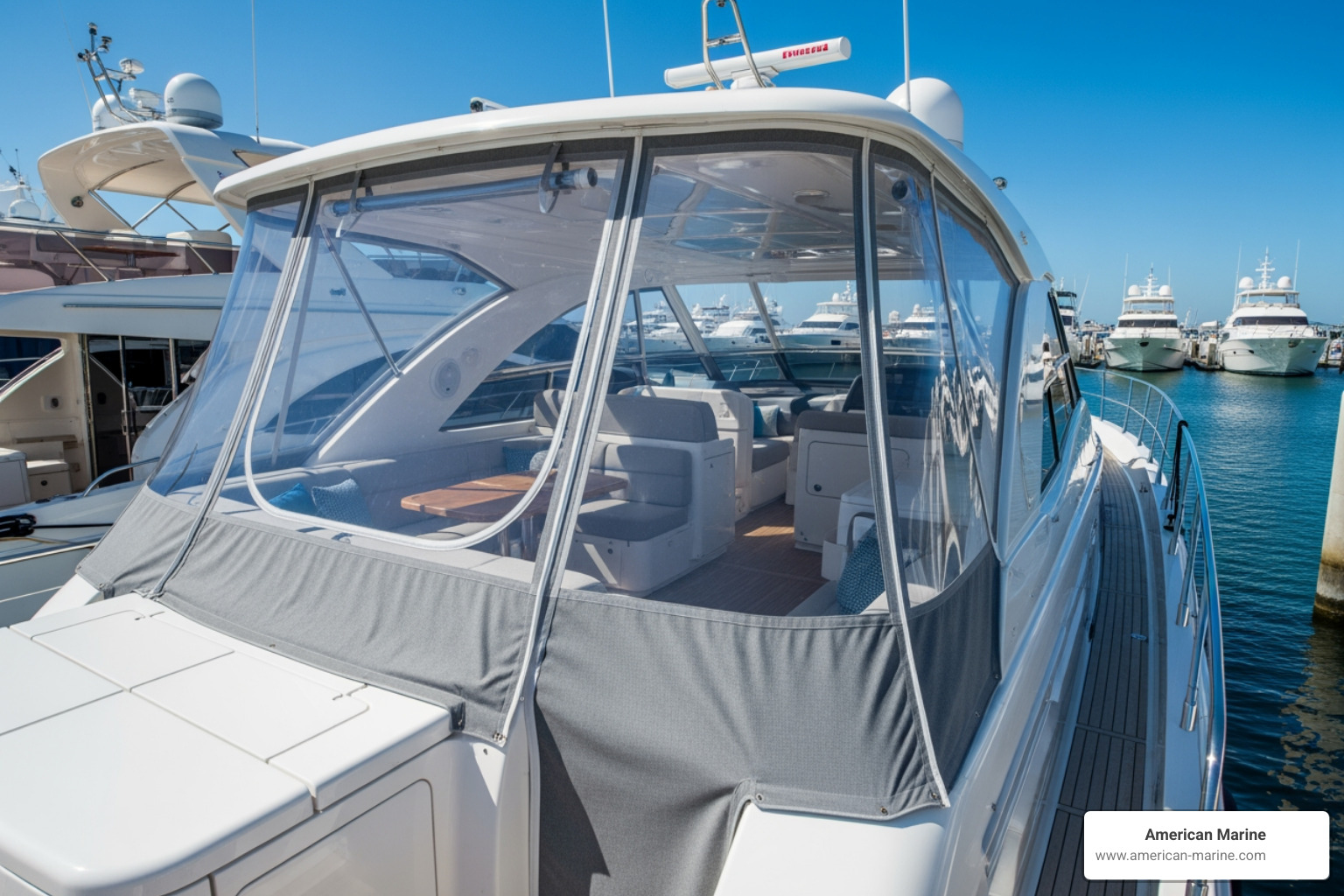
Specialized Custom Boat Enclosures for Sportfish and Center Consoles
For the professional fishing community in Palm Beach and Miami, enclosures serve a more tactical purpose. A Boat Bimini Top with Full Enclosure on a large center console often utilizes "wings."
- 3-Wing Enclosure: Protects the front and sides of the console, leaving the aft open for easy movement during a hookup.
- 5-Wing Enclosure: Extends further aft to provide additional spray protection for passengers seated behind the helm.
- Spray Curtains: These are often lightweight, removable panels designed specifically to deflect "green water" and heavy spray during rough crossings to the Bahamas.
Customization Features and Ventilation
A common mistake in enclosure design is failing to account for airflow. Without proper ventilation, an enclosure can become a "greenhouse." We integrate several features to combat this:
- U-Zips: Large, U-shaped zippered sections within a clear panel that can be rolled up and secured with straps, allowing for immediate airflow.
- Smile Windows: Smaller, semi-circular zippered openings at the bottom of a panel that let in a breeze while keeping the main panel closed.
- Heavy-Duty Zippers: We exclusively use oversized YKK or similar marine-grade zippers designed for thousands of cycles in salt environments.
- Screen Integration: For those evenings at anchor, we can swap clear panels for fine mesh screens to keep out insects while allowing the breeze to pass through.
Longevity and Maintenance of Professional Canvas Systems
A high-end custom boat enclosure represents a significant investment. While a well-maintained system can last 7-10 years, South Florida’s environment is unforgiving. UV degradation is the primary enemy of clear vinyl, while salt crystallization can seize zippers and abrade Waterproof Marine Vinyl Fabric.
Maximizing Service Life
To ensure your enclosure reaches its full 10-year potential, a rigorous maintenance schedule is required.
- Routine Rinsing: After every trip, rinse the entire enclosure with fresh water to remove salt crystals.
- Specialized Cleaners: Never use Windex or ammonia-based cleaners on clear vinyl; they will strip the protective coatings and cause yellowing. Use only manufacturer-approved cleaners and polishes.
- Zipper Lubrication: Apply a PTFE-based lubricant to zippers every few months to prevent corrosion and ensure smooth operation.
- Proper Storage: If panels are removed, they should be cleaned, dried, and rolled with acid-free paper or soft microfiber blankets between them. Never fold clear vinyl, as it will create permanent creases.
Repair and Panel Replacement
Even the best enclosures may eventually need a "refresh." Because we use digital templating, we can provide a Boat Enclosure Kit or individual replacement panels without the need for a total redesign. Common repairs include:
- Zipper Replacement: Swapping out worn sliders or teeth.
- Re-patterning: Adjusting a fit if the vessel's hardware has been moved or upgraded.
- Modification: Adding new features like u-zips or screens to an existing system.
Frequently Asked Questions about Marine Enclosures
How does a custom enclosure affect vessel resale value?
A professional, taut, and clear enclosure is a major selling point. It indicates to a prospective buyer that the owner has invested in the vessel's protection. Conversely, a cloudy, poorly fitted enclosure can detract from the boat's "curb appeal" and lead to lower offers, as the buyer will immediately calculate the cost of a full replacement.
What is the expected lifespan of polycarbonate vs. Isinglass?
With proper care in the South Florida climate, flexible Isinglass (like Strataglass) typically lasts 3–5 years before clarity begins to diminish. Rigid polycarbonate (like Makrolon) is more durable, often lasting 5–7 years or more. Factors such as whether the boat is kept in a covered slip or under a full boat cover will significantly extend these timelines.
Can individual panels be replaced without a full redesign?
Yes, provided the original enclosure was fabricated using digital templating or high-accuracy manual patterns. At American Marine, our CNC-driven process allows us to reproduce a single panel with the confidence that it will zip perfectly into the existing structure, saving the owner the cost of a full system replacement.
Conclusion
Investing in custom boat enclosures is about more than just staying dry; it is about extending the utility and preserving the value of your luxury yacht. For vessels operating in Miami, Fort Lauderdale, and West Palm Beach, the combination of 3D precision engineering and elite marine-grade materials is the only way to ensure long-term performance.
At American Marine, we specialize in the scale and complexity required for superyachts and large cruisers. Our process is designed for captains and builders who value technical accuracy and reliable delivery schedules.
If you are looking to upgrade your vessel's protection or integrate a new enclosure system into a refit project, we invite you to Plan an Offseason Canvas Project with our fabrication team. Let us show you how precision engineering can transform your time on the water.