
Beyond the Boom: Choosing the Right Bimini Top for Your Sailboat
Why the Right Bimini Top for Your Sailboat Is More Complex Than It Looks
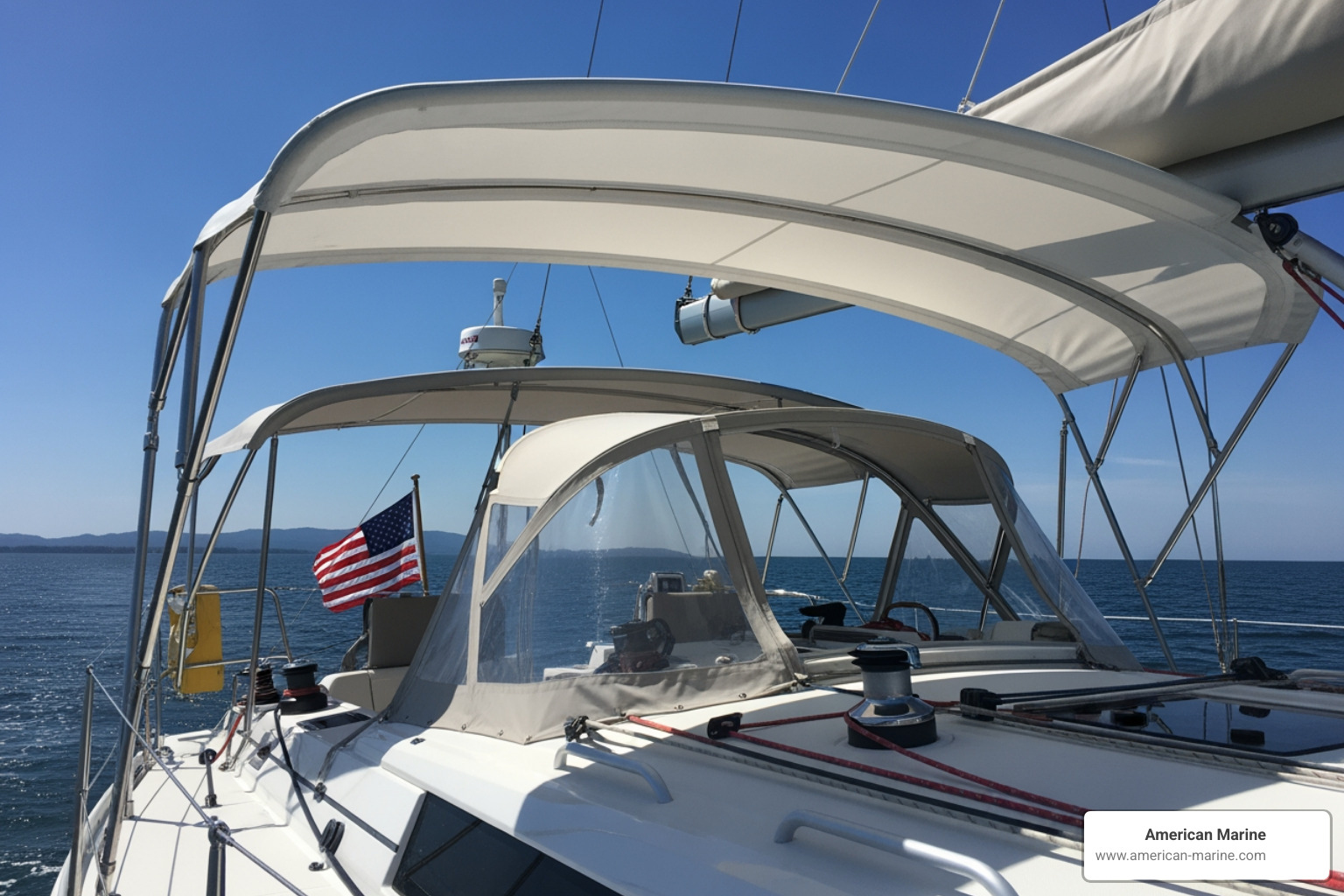
A bimini top for sailboat use is not a simple shade purchase — it is a precision engineering decision shaped by rigging geometry, cockpit ergonomics, and the demands of open-water sailing.
Quick answer: What to look for in a sailboat bimini top
| Factor | What to Consider |
|---|---|
| Frame material | 316L stainless steel for saltwater; anodized aluminum for freshwater/weight savings |
| Bow configuration | 2-bow (compact), 3-bow (mid-range coverage), 4-bow (up to ~10'6" coverage) |
| Rigging clearance | Boom height under sail, backstay passage, traveler clearance |
| Mounting style | Deck mount, rail mount, or split mount around winches |
| Fabric | Sunbrella Plus or equivalent solution-dyed acrylic, UPF 50+ minimum |
| Fit type | Custom-fabricated for large yachts; semi-custom or retail for smaller vessels |
| Support system | Tension straps, solid support poles, or self-supporting design |
Sailboats introduce constraints that powerboats simply don't have. A boom that drops under sail, a backstay running through your intended canvas zone, a traveler crossing the cockpit — each of these can compromise a bimini that wasn't specifically designed around them. On a yacht 40 feet or larger, the stakes are even higher. A poorly fitted bimini creates chafe damage, limits sail trim visibility, and can interfere with crew movement during a tack.
The details matter far more than most owners realize before they start the process.
I'm Jeremy Bottau, owner of American Marine, a South Florida precision marine canvas firm specializing in custom bimini top for sailboat projects on luxury yachts and superyachts. With experience spanning custom fabrication, 3D patterning, and high-end vessel refit, I've seen what separates a bimini that performs at sea from one that creates problems the moment you raise the main.
Engineering the Ideal Bimini Top for Sailing Yacht Performance
For large yachts and superyachts operating in the intense UV environments of South Florida, a bimini is a structural necessity. Unlike temporary umbrellas, a fixed bimini top for sailboat use must withstand 40-knot apparent winds while maintaining the vessel's aesthetic profile.
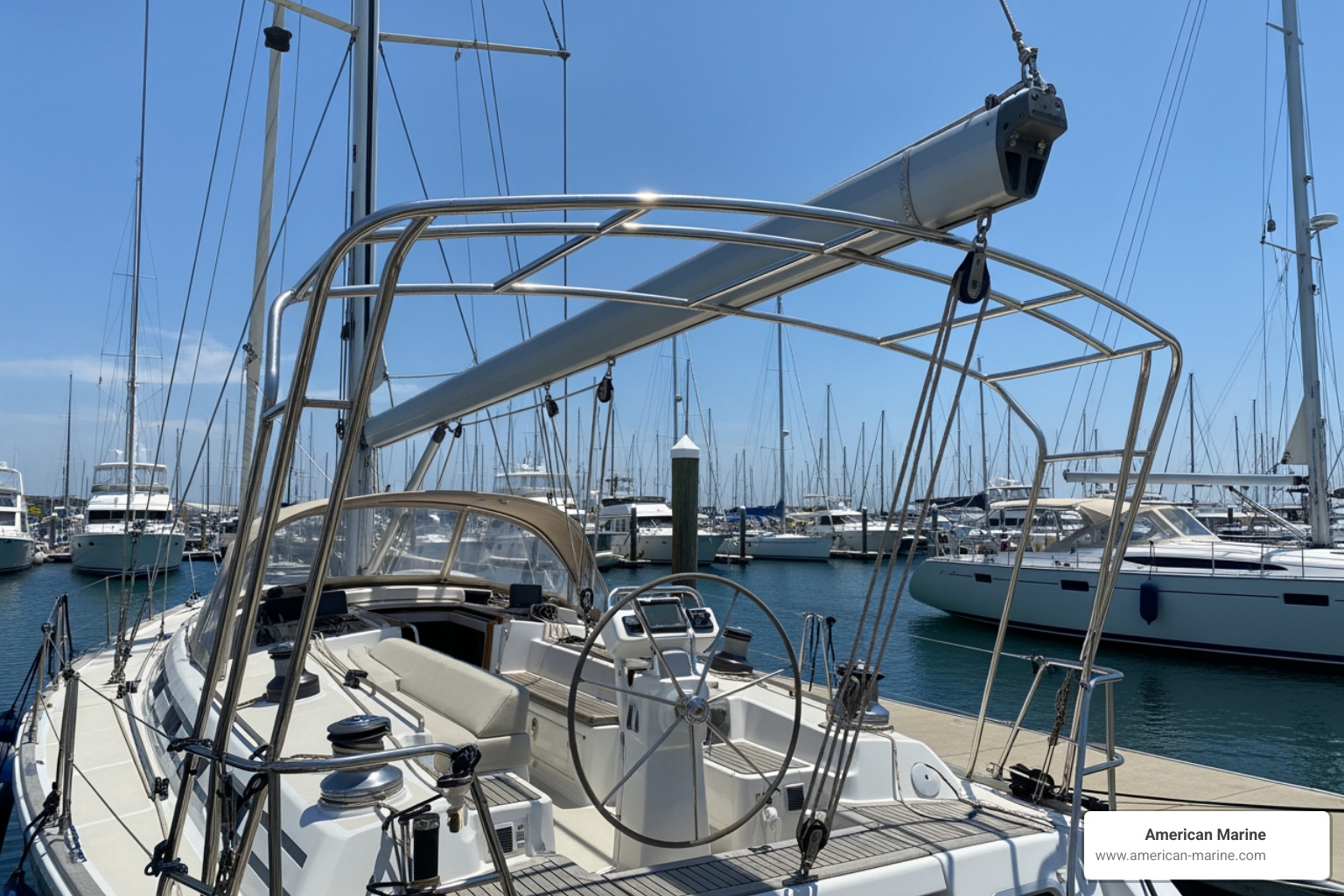
Beyond simple shade, these structures manage cockpit ergonomics and safety. A well-engineered top reflects UV radiation—which is intensified by water reflection—reducing crew fatigue during long passages. However, we must always account for windage. On a 60ft+ vessel, a massive canvas area acts as a sail; therefore, structural integrity is paramount. We focus on bimini boat tops that integrate into the yacht’s lines without compromising sailing performance or visibility.
Structural Bow Configurations
The "bows" are the primary ribs of the frame. Their number dictates the length of coverage and the stability of the fabric:
- 2-Bow Frames: Generally reserved for small cockpits or limited shade areas, providing approximately 5 feet of length.
- 3-Bow Frames: The industry standard for mid-sized cruising yachts, offering 5 to 6 feet of coverage.
- 4-Bow Frames: Essential for large cockpits, covering up to 10'6" in length. For these larger spans, maintaining a maximum distance of 42 inches between bows is critical to prevent water puddling. If you are refurbishing an existing frame, we often provide 4-bow bimini top replacement canvas cut to precise digital patterns.
Speed Ratings and Stability
Professional marine operations require gear that doesn't need to be stowed every time the throttle or wind picks up. High-performance frames are engineered to travel comfortably at 40 knots. To achieve this, we utilize:
- Double-walled main bows: Providing extra rigidity at the primary pivot point.
- Vibration dampening: Precision fittings that eliminate the "chatter" common in retail-grade kits.
- Heavy-wall tubing: Ø1″ or larger 316L stainless steel to resist deflection under load.
Technical Specifications: Frame Configurations and Mounting Strategies
The choice of materials and mounting hardware determines the lifespan of the installation in the corrosive environments of Broward and Palm Beach County.
Frame Materials: Stainless Steel vs. Aluminum
For projects requiring precision and scale, we exclusively recommend 316L stainless steel.
| Feature | 316L Stainless Steel | Anodized Aluminum |
|---|---|---|
| Corrosion Resistance | Exceptional (Best for Saltwater) | Moderate (Better for Freshwater) |
| Strength | Very High (Heavy-duty) | Moderate |
| Weight | Heavier | Lightweight |
| Aesthetics | Polished/High-Lustre | Matte/Satin |
| Customization | Highly Malleable for Custom Curves | Limited |
Mounting for Yacht Cockpits
Mounting a bimini top for sailboat use requires navigating deck hardware. While powerboats often have clear gunwales, sailboats have winches, tracks, and cleats.
- Mid-point Mounting: The standard approach where the frame mounts halfway along the canvas length.
- Split Mounts: Used when a winch or stay sits exactly where a deck hinge should be. This allows the frame to "split" its support to clear the obstruction.
- Rail Mounts: Attaching the frame to the pushpit or side rails using 1-inch stainless steel knuckles, preserving deck space.
For captains managing complex refits, our custom boat bimini ultimate guide provides deeper insights into these hardware configurations.
Support Systems and Self-Supporting Designs
Traditional biminis use nylon or stainless steel tension straps to stay open. However, on luxury yachts, straps can interfere with movement.
- Support Poles: Replacing straps with solid stainless steel poles increases stability and allows the bimini to stand in a "booted" position when the canvas is retracted.
- Self-Supporting Designs: These utilize horizontal "stiffener" poles. While they offer the cleanest look and best mobility, they put significant strain on the deck hinges. For open ocean sailing, we often reinforce these with stanchion attachments to ensure structural safety.
Precision Measurement and Rigging Constraints for Large Vessels
The most common failure in sailboat canvas is a lack of "boom awareness." A bimini that fits perfectly at the dock may be struck by the boom the moment the mainsheet is eased.
At American Marine, we utilize 3D-measured, precision-cut solutions. We don't just measure the cockpit; we scan the boom's arc and the backstay's angle. This ensures that every custom bimini meets the exacting standards of superyacht captains and builders. This level of detail is also why our sailboat cockpit cushions fit with such surgical precision.
Customizing a Bimini Top for Sailing Yacht Rigging
Rigging interference is the primary differentiator between a generic top and a professional installation.
- Backstay Passage: If the backstay intersects the canvas, we incorporate zippered sleeves or "slits" with reinforced collars. This allows the stay to pass through while maintaining a weather-tight seal.
- Traveler Clearance: If the traveler is located on the cockpit floor or a bridge deck, the bimini frame must be high enough to allow full traveler travel without snagging the lines.
- Mast Clearance: For mid-boom sheeting, the forward edge of the bimini must be calculated to avoid interference with the mainsheet. If damage does occur from poor planning, bimini canvas repair is often required to reinforce these high-wear zones.
Headroom and Ergonomic Planning
We aim for "standing headroom" wherever possible, but this is governed by the boom height.
- The "Under Sail" Measurement: We always measure the boom at its lowest point while under sail. This measurement is the "ceiling" for the entire project.
- Companionway Coverage: The bimini should ideally overlap with the dodger to protect the companionway from rain.
- Viewing Windows: Essential for checking sail trim. These clear vinyl windows should be positioned directly above the helm and include a fabric cover to prevent sun damage to the vinyl when not in use. Some owners prefer a boat bimini extension to bridge the gap between the helm and the companionway.
Material Selection for High-Performance Marine Environments
For vessels 60ft+, standard retail fabrics are insufficient. We utilize elite marine-grade materials designed for the high-UV, high-salt environment of South Florida.
Advanced Fabric Features
We primarily specify Sunbrella Plus or ATLAS GOLDEN RANGE fabrics. These solution-dyed acrylics offer:
- Weight: 10.4 oz/yd² for superior durability.
- UV Protection: UPF 50+ (often measured as high as UPF 80), providing better protection than clothing.
- Breathability: Preventing mildew growth on the underside of the canvas.
- Chafe Patches: We add leather or heavy-duty vinyl reinforcements where the canvas might contact the boom or rigging.
- PTFE Thread: We use Gore-Tex or similar lifetime PTFE threads that will not rot or degrade in the sun, ensuring the bimini top covers stay intact for a decade or more.
Hardware and Fittings
A frame is only as strong as its weakest hinge. Our builds feature:
- 316 Stainless Steel Fittings: No nylon or plastic components.
- Quick-Release Hinges: Allowing for rapid stowing before a storm.
- Slide Track Assemblies: Enabling the bimini to slide forward or aft to adjust for sun angle or rigging changes.
Integration and Maintenance of Sailboat Canvas Systems
A bimini top for sailboat use rarely stands alone. On luxury yachts, it is part of a larger "canvas suite."
Integration with Dodgers and Enclosures
The most effective setups utilize a "connector" piece—a strip of fabric that zips between the dodger and the bimini. This creates a continuous shaded area from the helm to the cabin. For those seeking total protection, a boat bimini top with full enclosure adds side panels with clear isinglass, effectively doubling the usable living space of the yacht in inclement weather.
Maintaining Your Bimini Top for Sailboat Longevity
To protect your investment, follow these professional protocols:
- Cleaning: Use a soft brush and lukewarm water with mild soap. Avoid harsh detergents that strip the fabric's water-repellent coating.
- Storage: When not in use, the canvas should be zipped into a storage boot. This prevents the fabric from "whipping" in the wind, which causes microscopic tears.
- Folding: Ensure the canvas is dry before folding to prevent mold. Most of our frames are designed to fold aft against the backstay for a clean, low-profile look when stowed.
Frequently Asked Questions about Sailboat Biminis
How do I accurately measure boom clearance for a bimini?
The most common mistake is measuring at the dock. You must raise your mainsail and ease the sheet to find the boom’s lowest working position. This "under sail" height is the maximum height your bimini can reach. We recommend leaving at least 2–3 inches of clearance to account for boom bounce.
Can a sailboat bimini remain deployed while under sail?
Yes, if it is a custom-fabricated 316L stainless steel structure. Retail-grade aluminum frames often lack the rigidity to handle the vibration and wind loads of active sailing. A properly designed top will have viewing windows so the helmsman can still see the sail tell-tales.
What are the benefits of a 3D-measured custom bimini over retail options?
Retail biminis are "one size fits most," which in the yachting world means "fits nothing perfectly." A 3D-measured solution accounts for your specific winch placements, backstay angles, and boom height. This eliminates chafe, prevents water pooling, and ensures the structure enhances rather than detracts from the vessel's value.
Conclusion
Choosing a bimini top for sailboat applications on a luxury vessel is a technical undertaking that requires an understanding of naval architecture and high-performance materials. For builders, captains, and refit managers, the focus must remain on precision, structural integrity, and long-term durability. When timelines and fit matter, a 3D-scanned, CNC-fabricated solution is the only way to ensure the final product meets the rigors of professional marine operations.
If you are planning an offseason canvas project in South Florida, we invite you to discuss your requirements with our team.