
Marine Grade Vinyl Upholstery for Yachts: Materials, Specifications, and Selection
Why Marine-Grade Materials Matter for Large Yacht Projects
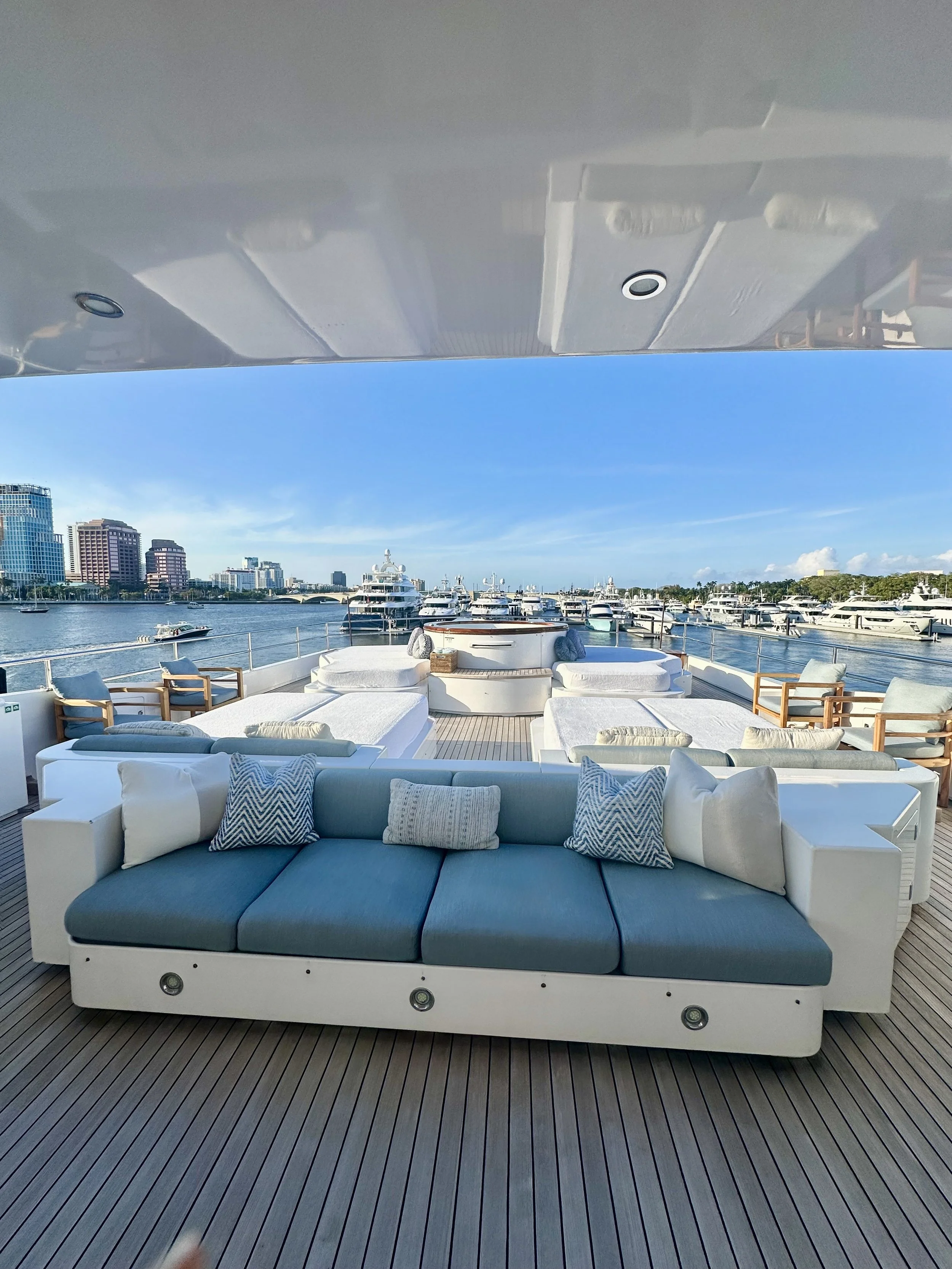
Marine grade vinyl upholstery is a specially engineered material designed to withstand the harsh conditions of saltwater environments, extreme UV exposure, and constant moisture. It differs from standard vinyl through three critical properties:
- UV Stabilization: Rated for 1,000+ hours of UV resistance to prevent fading and brittleness
- Mildew Resistance: Treated to resist fungal and bacterial growth in humid marine conditions
- Cold Crack Limits: Engineered to remain flexible at temperatures as low as -10°F without cracking
- Abrasion Resistance: Exceeds 20,000–30,000 Wyzenbeek double rubs for high-traffic seating applications
For vessels 40 feet and larger, material selection is not about aesthetics alone — it's about engineering performance. Saltwater accelerates degradation. UV rays break down plasticizers in untreated vinyl, causing brittleness and cracking within months. Temperature swings from below-deck storage to sun-exposed decks demand materials that maintain dimensional stability and flexibility. Standard automotive or residential vinyl fails quickly in these conditions — not gradually, but catastrophically.
Marine-grade vinyl addresses these stressors through specialized formulations. PVC-based vinyls offer superior abrasion resistance and cost efficiency for high-traffic areas. PU-based vinyls provide improved temperature regulation and a softer hand for interior applications. Protective topcoats — ranging from stain-resistant finishes to antimicrobial treatments — extend service life and reduce maintenance intervals.
For captains and vessel managers overseeing refit schedules, the wrong material choice creates cascading problems: premature replacement, increased labor costs, and disrupted timelines. The right material, specified correctly and fabricated with precision, becomes invisible — it simply performs.
I'm Jeremy Bottau, and I've spent years working with builders, captains, and refit managers to specify and fabricate marine-grade vinyl upholstery for large yachts and superyachts across South Florida. Through that work, I've learned that material selection is where most projects succeed or fail — long before the first stitch is made.
Defining Marine-Grade Materials: Specifications for Professional Marine Use
When we discuss marine grade vinyl upholstery, we are referring to a category of materials engineered specifically for the conditions found on motor yachts and superyachts operating in South Florida. This is distinct from general-purpose outdoor vinyl, which — while durable in residential applications — lacks the specialized properties required for vessels where the material is exposed to sustained saltwater, UV, and mechanical stress simultaneously.
Marine-grade materials are not just water-resistant but waterproof or highly water-repellent under sustained exposure — preventing moisture ingress into foam cushions, which leads to mold, mildew, and structural degradation of the seating system.
The core properties that define a professionally-specified marine-grade material:
- Mildew Resistance: Treated to inhibit mold and mildew growth in South Florida's high-humidity marine environment — a condition that destroys standard vinyl within months of dockside use.
- UV Stabilization: Engineered with UV inhibitors rated at 1,000 hours or more — preventing the fading, cracking, and embrittlement that South Florida's tropical sun produces on unprotected materials.
- Cold Crack Limits: Formulated to remain flexible at -10°F — ensuring durability in air-conditioned interiors and cooler operational conditions.
Material Composition: PVC vs. PU Vinyl in Marine Applications
The specification decision between Polyvinyl Chloride (PVC) and Polyurethane (PU) vinyl determines the performance profile of the finished upholstery system on a motor yacht or superyacht.
- PVC (Polyvinyl Chloride) Vinyl: The standard professional specification for exterior seating, helm chairs, coaming bolsters, and high-traffic areas on large vessels. PVC delivers superior abrasion resistance, structural durability under sustained UV and saltwater exposure, and consistent performance across South Florida's operational conditions. It is the correct specification for any application where the primary requirement is long-term durability under mechanical and environmental stress.
- PU (Polyurethane) Vinyl: Preferred for interior applications — owner's cabins, formal salons, and guest-facing areas — where tactile comfort and a premium hand-feel are priorities. PU vinyl offers a softer surface that responds to body heat and mimics the feel of high-grade leather. It requires more careful specification in exterior applications, where sustained UV and mechanical stress can cause surface stretching and performance degradation over time.
Beyond the face material, the backing specification is equally critical. Reinforced woven or knit backings provide dimensional stability, tear strength, and structural integrity through the fabrication process. The backing choice influences the material's stretch, drape, and long-term performance — factors we specify for each vessel project based on the application zone and use pattern.
The Role of Specialized Coatings and Finishes
Modern marine grade vinyl upholstery performance is significantly determined by the protective coatings and finishes applied to the face material. These treatments extend service life and reduce maintenance burden on crew and vessel managers.
- Protective Topcoats: Create a barrier against common marine contaminants — sunscreen, food oils, salt residue — that would otherwise penetrate and degrade unprotected vinyl surfaces. Advanced topcoats allow crew to remove these substances with a cloth and mild cleaner rather than specialized solvents.
- Antimicrobial Treatments: Silver ion antimicrobial agents and fungal inhibitors prevent the bacterial and mildew growth that South Florida's humidity produces on any surface with organic contamination. This is a non-negotiable specification for any vessel where the upholstery is not protected from humidity between uses.
- UV-Resistant Formulations: Coating-level UV protection supplements the UV stabilization built into the vinyl substrate — extending colorfastness and preventing surface cracking under sustained tropical sun exposure.
- Cleanability Coatings: A smoother, less porous surface allows crew to maintain upholstery appearance with minimal effort — critical on large vessels where upholstery maintenance competes with other operational priorities.
Our material selection for motor yachts and superyachts across Fort Lauderdale, West Palm Beach, and Miami incorporates these advanced finishes from professional-grade manufacturers — ensuring the materials we specify perform at their rated service life in South Florida's conditions.
Key Performance Metrics for Yacht-Scale Upholstery
For captains, builders, and refit managers specifying upholstery on large vessels, understanding the quantifiable performance metrics behind marine-grade vinyl separates a correct specification from a costly mistake.
- Wyzenbeek Double Rubs (Abrasion Resistance): The standard measure of surface wear resistance. Residential vinyl rates at 15,000–25,000 double rubs. For high-traffic areas on a motor yacht or superyacht — exterior deck seating, helm chairs, crew areas — we specify materials exceeding 20,000 cycles, with premium options reaching 30,000+ double rubs.
- UV Resistance Hours: Marine-grade vinyl is engineered for 1,000+ hours of UV resistance — the threshold required to prevent plasticizer breakdown and surface cracking under South Florida's sustained UV intensity. Materials below this rating fail visibly within a single season in direct sun exposure.
- Cold Crack Limits: -10°F is the professional standard for marine-grade vinyl — ensuring the material remains flexible and intact in air-conditioned vessel interiors and cooler operational conditions.
- Seam Strength: The material's ability to hold a stitch under sustained load is as critical as surface durability. Our fabrication process specifies thread weight, stitch density, and seam construction based on the application zone and the stress the seam will bear in service.
Vinyl Thickness and Weight for Professional Projects
Upholstery vinyl is measured in ounces per linear yard rather than gauge. A standard professional specification for durable yacht upholstery is approximately 28 oz. per linear yard.
- Durability Correlation: Heavier vinyl provides greater resistance to punctures, tears, and wear in high-traffic seating areas. For exterior deck seating on a large vessel, heavier weight is the correct specification.
- Hand-Feel and Application Fit: Heavier vinyl can be stiffer — appropriate for structural applications but less suitable for interior cushions requiring a softer finish. Medium-weight vinyl balances durability with the pliability needed for comfort-focused interior applications.
- Fabrication Precision: On motor yachts and superyachts, upholstery involves complex curves, tight radii, and multi-section assemblies. Medium-weight vinyls are more consistently workable for these geometries — allowing clean contours without excessive stretching or puckering at seam points. Our 3D-measured, precision-cut process depends on materials that perform consistently through cutting and assembly.
For further context on how material specification connects to fabrication quality, see our article The Art of Marine Upholstery: Where Form Meets Function on the Water.
Marine Grade Vinyl for Exterior Yacht Applications
Exterior spaces on a motor yacht or superyacht — helm chairs, sun pads, coaming bolsters, deck seating — face the most aggressive environmental conditions of any application zone. Material specification for these areas must prioritize:
- UV Resistance: South Florida's UV intensity demands vinyl with premium UV stabilization. Colorfastness and structural integrity in direct sun exposure are non-negotiable for any exterior application that will remain on the vessel through a full season.
- Saltwater and Moisture Resistance: Sustained salt spray and humidity require vinyl that resists water absorption and prevents the mildew growth that develops on any surface with trapped moisture.
- Abrasion Resistance: High-traffic exterior areas — step pads, boarding areas, frequently used deck seating — require 30,000+ double rub ratings to withstand constant friction without visible wear.
- Dimensional Stability: Exterior vinyl must maintain tension and shape across South Florida's temperature range — from direct sun exposure to air-conditioned storage — without sagging or stretching that compromises appearance and fit.
- Crew Cleanability: Sunscreen, food, and beverage contamination are constant on deck. Stain-resistant topcoats that allow crew to clean effectively with standard marine cleaning products are a practical operational requirement, not a luxury.
For context on how exterior upholstery connects to the broader vessel interior system, see our article From Deck Chairs to Sun Lounges: Elevating Comfort with Marine Upholstery.
Marine Grade Vinyl vs. Canvas: Application-Specific Selection
The selection between marine grade vinyl upholstery and marine canvas is an application decision, not a quality decision. Each material is engineered for distinct functions on a motor yacht or superyacht — specifying the wrong material for the application produces premature failure regardless of material quality.
- Vinyl for Seating and Cushions: Vinyl's stretch and recovery, smooth non-porous surface, and form-fitting properties make it the correct specification for any upholstered seating application. It contours to foam geometry, withstands the mechanical stress of repeated use, and cleans effectively from spills.
- Canvas for Enclosures and Covers: Marine canvas — solution-dyed acrylic, coated polyester, vinyl-coated polyester — is specified for structural protective applications: enclosures, covers, bimini systems, dodgers. Canvas prioritizes dimensional stability, breathability, and resistance to wind load and sustained weather exposure. It is not the correct material for seating applications where comfort and cleanability are the primary requirements.
Vinyl for Seating and Cushions on Large Vessels
For the seating and cushioning requirements on large motor yachts and superyachts, marine grade vinyl upholstery delivers the combination of comfort, resilience, and aesthetic consistency that professional vessel management requires:
- Comfort and Ergonomic Support: Modern marine vinyls engineered for a soft hand provide comfortable seating surfaces that contour around foam to deliver ergonomic support across extended use.
- Crew Cleanability: The non-porous surface allows effective cleaning of spills, sunscreen, and marine contaminants with standard cleaning products — minimizing crew maintenance time and protecting the upholstery's appearance between guest visits.
- Aesthetic Range: Professional-grade marine vinyl is available in a wide range of colors, textures, and finishes — from smooth leather-like surfaces to embossed patterns — allowing specification that coordinates with the vessel's interior design scheme without compromising performance.
Canvas for Covers and Enclosures
For custom covers and enclosures on motor yachts and superyachts, marine canvas delivers performance properties that vinyl cannot — structural integrity under wind load, breathability that manages condensation in enclosed spaces, and UV protection for the vessel components and interior surfaces the canvas is protecting.
- Structural Integrity: High-tenacity woven polyester canvas provides tensile and tear strength that protects vessel surfaces through South Florida's summer storm season and offshore conditions.
- Breathability: Unlike vinyl, breathable marine canvas prevents condensation buildup under covers — reducing the mildew risk on the interior surfaces and upholstery the canvas is protecting.
- UV Shielding: Canvas covers extend the service life of the upholstery, electronics, and finishes beneath them by preventing direct UV exposure during extended dockside periods.
Whether fabricating a new bimini system, cockpit enclosure, or full vessel cover, our canvas specification follows the same application-driven logic as our vinyl specification — the material is chosen for what the application requires, not for convenience or familiarity.
Maintenance and Care Protocols for Marine Grade Vinyl
Even correctly specified marine grade vinyl upholstery requires consistent maintenance to perform at its rated service life. South Florida's saltwater environment accelerates surface degradation on any material that isn't actively maintained — the difference between 5 years and 10 years of service life is largely determined by maintenance consistency.
Professional maintenance protocol for marine vinyl:
- Mild Detergents Only: Harsh chemicals and abrasive cleaners permanently damage the protective topcoat — reducing stain resistance and accelerating UV degradation. Vinyl-safe cleaning solutions are the correct specification for routine cleaning.
- Immediate Spill Response: Blot liquid spills immediately — rubbing drives contaminants deeper into the surface texture. The non-porous surface of marine vinyl makes prompt cleanup straightforward.
- Conditioning Every Six Months: Vinyl conditioner restores plasticizers, maintains flexibility, and provides an additional UV protection layer. Without conditioning, vinyl stiffens and becomes prone to cracking at high-flex points — seams, corners, and edges.
- Storage Discipline: Removable cushions stored away from direct sun and excessive heat during extended dockside periods preserve colorfastness and surface integrity significantly longer than cushions left in direct exposure.
Detailed Maintenance Protocols
- Seam-to-Seam Cleaning: When treating a stain, clean the entire surface from seam to seam — not just the affected area. Spot-cleaning without cleaning the full surface produces visible water rings and uneven appearance.
- Mold and Mildew Management: Marine vinyl resists mildew growth, but mildew will develop on accumulated organic material on the surface. For established mold or mildew staining, a solution of 1 cup bleach and ¼ cup mild soap per gallon of water — applied, allowed to soak for 15 minutes, then rinsed thoroughly — is an effective treatment. Ensure complete rinsing and air drying before the vessel is closed.
- Conditioner Application Schedule: Every six months minimum — more frequently on vessels in continuous use or with significant exterior exposure. Conditioner application is the single highest-leverage maintenance action for extending vinyl service life.
End-of-Life Indicators and Refurbishment Planning
Proactive refurbishment planning — rather than waiting for material failure — allows vessel managers to schedule downtime, coordinate with fabricators, and avoid unplanned operational disruption. End-of-life indicators for marine grade vinyl:
- Persistent Fading: Color degradation that cleaning cannot address indicates UV breakdown of the face material.
- Loss of Suppleness: Vinyl that has stiffened and lost flexibility is at risk of cracking at high-flex points under normal use.
- Surface Cracking or Pitting: Visible surface damage, particularly at seams and edges, indicates the material has reached end of service life.
- Backing Delamination: Separation of the face material from its backing is a structural failure that cannot be reversed with maintenance.
When these indicators appear, the correct response is to plan reupholstery as a scheduled maintenance event — not to defer it until the material fails completely and creates operational or aesthetic problems on a vessel with a scheduled charter or owner commitment.
Conclusion
Material selection is the foundation of a yacht upholstery project that performs correctly over its intended service life. For motor yachts and superyachts operating in South Florida, the specification decisions — PVC vs PU, coating selection, weight and backing, application zone matching — determine whether the investment in upholstery delivers 5 years or 10 years of reliable service. Getting those decisions right requires understanding the technical performance requirements of each application zone, not selecting materials based on appearance or cost alone.
American Marine specifies and fabricates marine grade vinyl upholstery for motor yachts and superyachts across Fort Lauderdale, West Palm Beach, and Miami. If you're planning a refit or replacement project on a vessel 40ft or above, schedule a dockside assessment and we'll evaluate your vessel's specific requirements and recommend the correct material specification for each application zone.