
Superyacht Style: A Deep Dive into Interior Design and Marine Fabrics
Why Superyacht Interior Design Demands a Different Approach
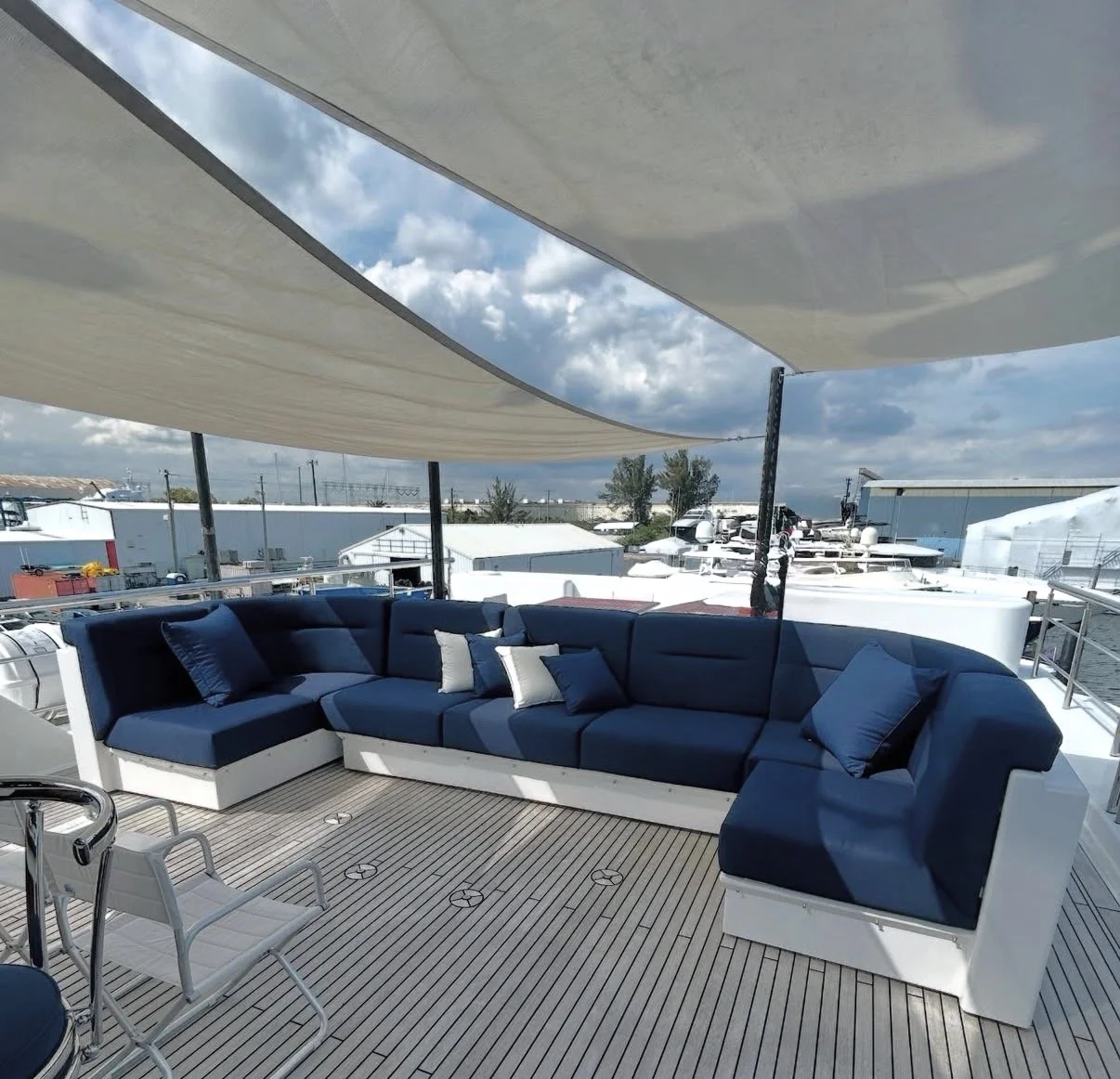
Superyacht interior design is the pinnacle of marine craftsmanship, where luxury meets extreme engineering. Unlike land-based residential interiors, every element must perform flawlessly while withstanding constant motion, saltwater corrosion, and strict weight limitations that directly impact a vessel's stability and fuel efficiency.
Key Distinctions of Superyacht Interior Design:
- Marine-Grade Materials – All fabrics, woods, and finishes must resist humidity, saltwater, and UV exposure
- Weight Management – Every piece affects vessel performance; most yachts gain 30-100 tons between delivery and owner use
- Regulatory Compliance – Must meet IMO fire safety codes and structural integrity standards
- Precision Fit – 3D-measured, CNC-fabricated components ensure perfect fitment in confined, irregularly shaped spaces
- Structural Integration – Exhaust trunking, AC ducting, and technical systems must become design features, not obstacles
- Technology Integration – Smart systems for climate, lighting, and automation must function unobtrusively in harsh conditions
The industry has witnessed a quiet revolution. A new generation of ultra-high net worth owners—many without traditional boating backgrounds—are demanding interiors that feel like floating country houses rather than formal hotel suites. They're prioritizing personal expression, comfort, and lived-in warmth over conventional yacht aesthetics or charter appeal.
This shift requires designers to balance contradictory demands: create spaces that are both breathtakingly neat and brutally durable, maximizing natural light while maintaining privacy, and incorporating cutting-edge technology that remains invisible during daily use.
The Technical Challenge:
Superyacht interiors must solve problems that never exist on land. The bow's sloping, non-rectangular shape requires creative spatial solutions. Limited head height demands central domes for comfort. Panoramic windows and retractable glass walls must seal against ocean spray while maintaining seamless aesthetics. Every cabinet, chair, and fabric selection must account for constant vibration and the corrosive marine environment.
As one designer noted about the 44.8-meter yacht Logica, the brief was to create "fresh modernism on the high seas"—a directive that captures the industry's current trajectory toward sophisticated, personalized spaces that happen to float.
I'm Jeremy Bottau, owner of American Marine, where we specialize in precision-fabricated marine canvas and upholstery for luxury yachts and superyachts throughout South Florida. Over years of collaborating with builders, captains, and designers on superyacht interior design projects, I've seen how 3D-measured, CNC-cut solutions and elite marine-grade materials create the flawless fit and durability these vessels demand.
The Technical Evolution of Superyacht Interior Design
The marine environment presents a unique set of challenges that fundamentally differentiate superyacht interior design from land-based architecture. Unlike a static building, a superyacht is a dynamic platform constantly exposed to motion, humidity, and corrosive saltwater. These factors necessitate a highly specialized approach to every aspect of the interior.
A primary consideration is weight management. Every component, from structural elements to decorative finishes, contributes to the vessel's overall displacement. A critical statistic reveals that most yachts will increase in weight by between 30 and 100 tons between delivery and owner use, as essential items are added and stowed. This weight directly impacts fuel efficiency, performance, and stability, making lightweight yet durable materials paramount.
Another significant challenge is ensuring seaworthiness and occupant safety. This involves stringent adherence to fire safety regulations (such as IMO codes) and ensuring the structural integrity of all interior elements. Materials must be inherently fire-resistant, and their installation must prevent propagation. Moreover, all components must withstand constant vibrations and movement, requiring robust anchoring and construction. Saltwater resistance and humidity control are also critical, as these elements can quickly degrade non-marine-grade materials, leading to mildew, corrosion, and structural compromise.
| Feature | Land-Based Residential Design | Superyacht Interior Design |
|---|---|---|
| Environment | Static, controlled | Dynamic, exposed to motion, humidity, saltwater |
| Weight | Minimal impact | Critical for stability, performance, fuel efficiency |
| Regulations | Building codes | IMO, flag state, class society rules (fire, safety, structure) |
| Durability | Standard wear and tear | Marine-grade, UV, corrosion, vibration resistant |
| Space | Generally flexible | Finite, irregular shapes, multi-functional |
| Integration | Utilities hidden | Technical systems (exhaust, AC) often integrated as features |
Precision Fit in Superyacht Interior Design
Achieving a flawless interior on a superyacht requires an unparalleled level of precision. Unlike the relatively straightforward rectangular rooms of a house, yacht interiors are characterized by curved hulls, varying deck heights, and a complex interplay of structural and mechanical systems. This is where advanced techniques like 3D scanning and CNC fabrication become indispensable.
Our approach at American Marine, particularly for boat interior renovation projects in South Florida, uses 3D-measured, precision-cut solutions. This process involves digitally mapping every contour and dimension of the yacht's interior, allowing for tolerance management down to millimeters. This digital rendering ensures that every piece of upholstery, every panel, and every custom fixture fits perfectly, even in the most unusually shaped rooms. The repeatability offered by CNC fabrication means consistency across multiple elements and throughout the vessel, a critical factor for large-scale projects.
Regulatory Compliance and Material Standards
The selection of materials for superyacht interior design is not merely an aesthetic choice; it is governed by a complex web of marine regulations. These include IMO (International Maritime Organization) codes, flag state requirements, and class society rules, all of which impose strict standards for fire resistance, structural integrity, and safety. For instance, materials must often meet specific flame spread and smoke emission criteria.
This strict regulatory environment mandates the use of specialized marine-grade materials. For upholstery, this means selecting marine upholstery fabric that is not only visually appealing but also inherently resistant to fire, UV degradation, mildew, and saltwater. Similarly, marine-grade woods and corrosion-resistant metals are chosen for their ability to withstand the harsh marine environment without compromising safety or longevity. Our expertise in South Florida ensures that all materials we use for our projects meet or exceed these rigorous standards, guaranteeing both luxury and compliance.
Space Optimization and Structural Integration
The finite volume of a superyacht presents a unique design paradox: how to create expansive, luxurious spaces within inherent constraints. Every cubic foot must be carefully planned and often serve multiple purposes. This necessitates innovative design solutions that address structural elements like exhaust trunking, AC ducting, and limited head height, changing them into integrated design features rather than intrusive obstacles.
Consider the challenge of exhaust trunking, which typically runs vertically from the engine room up to the mast. This takes up a significant portion of interior volume. Instead of attempting to hide it, designers often integrate it into the interior, making it a feature of a corridor or a structural element around which other design components are built. Similarly, AC ducting requires space between decks, often limiting head height. Creative solutions include using domes in the center of rooms to provide increased central head height, maximizing comfort without impacting the yacht's air draft or stability.
Multi-functional furniture and clever space-saving solutions are critical. The modern approach to superyacht interior design often includes shell doors—openings in the hull that fold down or up—to create expansive 'winter gardens' or complete beach clubs, blurring the lines between interior and exterior spaces.
Intelligent Storage Solutions
On a superyacht, space is always at a premium, and intelligent storage is not just a convenience, but a necessity. Owners often bring aboard a significant amount of personal items and equipment, contributing to the 30-100 ton weight increase observed between delivery and full use. Therefore, optimizing every available nook and cranny is paramount.
Designers employ clever strategies to integrate storage seamlessly into the interior architecture. This includes using push-to-open mechanisms or cut-out handles that allow storage areas to blend flawlessly into cabinetry and wall panels, maintaining a clean and minimalist aesthetic. Corridors, often overlooked, can be transformed into multi-functional spaces with integrated storage. Under-bed storage and concealed walling are common in cabins, providing ample space for personal belongings without cluttering the living areas. Even dedicated storage rooms for watertoys can be designed to double as gyms or entertainment spaces when not in use.
For upholstered elements, our work in marine upholstery for South Florida superyachts focuses on creating bespoke, integrated solutions that offer both comfort and hidden utility. Every piece is designed to maximize storage while complementing the overall aesthetic.
Integrating Structural Features as Design Elements
The structural elements of a superyacht, which would typically be hidden in land-based construction, must be integrated into the interior design. This is not merely about concealment; it's about making these necessities part of the aesthetic. Masts, engine room exhausts, and even lifesaving equipment, while critical for operation and safety, can often be reimagined as design elements.
For instance, the vertical exhaust trunking can be cladded with fine wood or stone, becoming a striking architectural pillar within a saloon. Masts on the sun deck can be designed to provide shaded areas, blending functionality with comfort. Lifesaving equipment, while required to be easily accessible, can be concealed behind panels that match the surrounding décor, ensuring safety without visual disruption.
A particularly striking example of structural integration is the glass-encased elevator. While not commonly found on all superyachts, when present, it often serves as a central design focal point, linking different decks in a visually stunning manner. This transforms a functional necessity into an neat feature, enhancing both accessibility and the overall luxurious ambiance.
Modern Aesthetics and Natural Light
Contemporary superyacht interior design is characterized by a shift towards minimalism and timeless elegance. The industry has increasingly focused on sophisticated, balanced interiors that offer a sense of calmness, often as a counterbalance to the world outside. This often translates into neutral color palettes, clean lines, and a deliberate absence of excessive ornamentation, allowing the quality of materials and the surrounding marine environment to take center stage.
The owner's brief for the 44.8-meter yacht Logica, which sought "fresh modernism on the high seas" with bright colors and clean, modern lines, perfectly encapsulates this trend. Designers like Martin Kemp have brought a residential sensibility to yacht interiors, focusing on creating spaces that feel lived-in and comfortable, rather than overtly formal. This involves thoughtful material selection, emphasizing texture and subtle variations in tone over bold patterns.
Smart Technology in Superyacht Interior Design
Technology plays an increasingly vital role in enhancing comfort and functionality on superyachts, but the modern approach dictates that it should be a "silent partner." This means seamless, intuitive integration that improves the experience without being visually intrusive. Advanced systems for climate control, lighting, entertainment, and even security are now standard, offering personalized experiences at the touch of a button or via voice command.
One of the most exciting trends is the integration of AI-powered wellness spaces, offering customizable sensory experiences. These can include automated lighting scenes, soundscapes, and even climate-controlled environments that mimic natural settings. The challenge lies in housing the necessary servers and wiring discreetly. Even for advanced AV technology, which allows for digital libraries containing terabytes of content, servers still require dedicated cupboard space, necessitating clever concealment.
Our expertise in superyacht interior design means understanding how to integrate complex systems while maintaining refined aesthetics. For more information on the technological advancements in this sector, resources like Superyacht Technology provide valuable insights into the cutting-edge innovations shaping the future of yachting.
Maximizing Natural Light and Views
One of the most coveted features in modern superyacht interior design is the maximization of natural light and panoramic views. The goal is to connect the interior seamlessly with the breathtaking marine environment outside. This is achieved through innovative architectural elements such as floor-to-ceiling windows, panoramic glazing, and even retractable glass walls.
These expansive glass surfaces not only flood the interiors with natural light but also create an illusion of greater space, making smaller areas feel open and airy. High-gloss surfaces and light-colored materials are often used to reflect sunlight, further brightening the interior. Balcony integration, where sections of the hull fold out to create private balconies, has become de rigueur on modern luxury yachts, extending living spaces directly over the water.
Skylights also play a crucial role, particularly in lower deck areas or bathrooms, bringing natural light into spaces that would otherwise be dark. For flooring, careful consideration of carpet and flooring materials is essential, balancing durability with light-reflecting properties. The design of the 45-meter yacht Logica, as highlighted in Interiors inspiration: Martin Kemp on Logica, exemplifies this focus on natural light, with large windows and a light color palette creating an open and inviting main saloon.
Sustainability and Material Durability
Sustainability has emerged as a significant driving force in contemporary superyacht interior design. There is an increasing focus on incorporating eco-friendly materials and energy-efficient solutions without sacrificing luxury. This holistic approach extends beyond material selection to include renewable energy solutions, advanced waste management, and water purification technologies.
Designers are actively seeking sustainable materials, such as reclaimed teak for flooring, which offers both environmental benefits and a rich aesthetic. Compressed paper-based materials are being used for countertops, providing lightweight, durable, and practical surfaces. The use of recycled finishes and innovative alternatives to genuine leather, such as high-quality natural fabrics, is also gaining traction. You can explore more about these initiatives on platforms dedicated to Sustainable Materials.
Beyond sustainability, the durability of materials in the marine environment remains paramount. Every fabric, finish, and piece of furniture must be able to withstand constant movement, vibrations, salt air, humidity, and intense UV exposure. This requires materials with inherent UV protection, fade-resistance, and resistance to corrosion and mildew.
Custom Upholstery and Fabric Longevity
For superyacht interiors, custom upholstery is not merely about aesthetics; it is a critical component of durability, comfort, and safety. Every piece of fabric and cushioning must be engineered to withstand the unique challenges of the marine environment. This involves selecting elite marine-grade materials that are inherently resistant to saltwater, humidity, and UV radiation.
Our focus at American Marine on custom yacht upholstery ensures that all fabrics are not only luxurious but also built for longevity. This includes materials with superior fade-resistance to prevent sun damage, non-slip surfaces for safety during rough seas, and construction methods that prevent moisture retention and mildew growth. Handcrafted woodwork, often paired with bespoke upholstery, ensures precise fit and finish, contributing to the overall structural integrity of the interior. Additionally, safety considerations such as rounded edges on furniture and fixtures are crucial to prevent injuries in a moving environment.
The Role of Brokers and Designers
The journey of creating a superyacht interior is a complex collaborative process involving multiple stakeholders, where the roles of brokers and designers are pivotal. Superyacht brokers, such as the Edmiston superyacht brokers team, often serve as the initial point of contact, guiding clients through the intricate process of yacht design. They begin with a thorough client needs assessment, working closely to understand the client’s lifestyle, preferences, and usage requirements. This crucial step helps shape a clear design brief, which then informs the selection of appropriate yacht design companies. Brokers also play a key role in budget management, ensuring that the client's vision aligns with financial realities while maintaining the highest standards of quality and luxury.
Once the brief is established, interior designers take the lead, translating the client's vision into tangible concepts. They collaborate intimately with the client, often involving them in every step—from reviewing mood boards and testing textures to developing digital renderings that bring their vision to life. This ensures that the final design is a true reflection of the owner's personality and lifestyle. Designers also work closely with shipyards and naval architects from the outset, carefully planning every detail to ensure seamless integration of the interior with the yacht's structure and technical systems. This collaborative approach ensures that the design is not only aesthetically stunning but also functionally robust and compliant with all marine regulations.
Frequently Asked Questions about Superyacht Interiors
How does superyacht design differ from land-based design?
Superyacht interior design fundamentally differs from land-based design due to the marine environment's unique demands. It must account for constant motion, extreme moisture, and strict weight limitations that directly impact fuel efficiency and stability. Unlike a static home, every element on a yacht must be engineered for dynamic conditions, adhering to rigorous safety regulations like IMO codes for fire resistance and structural integrity. Materials must be marine-grade, resistant to salt, humidity, and UV, and all components must be securely fastened to prevent shifting at sea.
How is storage optimized in a confined yacht environment?
Storage optimization in a superyacht is an art form. Designers use 3D-measured, built-in compartments and multi-functional furniture to ensure every square meter serves a practical purpose without compromising aesthetics. Solutions include seamlessly integrated push-to-open cabinets, under-bed storage, concealed walling, and even turning corridors into utility spaces. The goal is to provide ample storage for personal items and equipment, which can add 30-100 tons of weight to a yacht, all while maintaining a clean, uncluttered, and luxurious appearance.
What materials are best for durability in marine environments?
For optimal durability in marine environments, elite marine-grade fabrics, UV-resistant leathers, and corrosion-resistant metals are essential. These materials are specifically chosen for their ability to withstand saltwater, humidity, and intense sun exposure without degrading. Examples include specialized marine upholstery fabrics that resist mildew and fading, reclaimed teak or advanced hardwood systems for flooring, and compressed paper-based materials for countertops. All materials must also meet strict fire resistance and safety regulations to ensure seaworthiness.
Conclusion
Superyacht interior design is a testament to the seamless fusion of art, engineering, and precision. It addresses the unique demands of the marine environment with innovative solutions, changing vessels into luxurious, functional, and deeply personal spaces. From managing critical weight considerations to integrating complex structural elements, every design decision is a delicate balance of aesthetic aspiration and technical necessity.
At American Marine, we are proud to contribute to this specialized field. Our commitment to precision fabrication, utilizing 3D-measured, precision-cut solutions, ensures that every project we undertake in South Florida, including Miami FL, Fort Lauderdale, West Palm Beach, and Broward County, meets the exacting standards required for luxury yachts and superyachts. We work with elite marine-grade materials, delivering top-tier craftsmanship and reliable, timely completion that captains and builders demand.
Our fabrication benefits include:
- Unparalleled precision for perfect fitment in complex yacht interiors
- Use of elite marine-grade materials ensuring durability and longevity
- Efficient production timelines supported by advanced CNC technology
- Consistent quality and repeatability across all custom projects
- Expert collaboration with designers and shipyards throughout South Florida
We invite you to partner with us for your next project.