
Marine Canvas and Upholstery for Motor Yachts and Superyachts: Materials, Fabrication, and Care
Why Marine Canvas and Upholstery Defines the Standard for Serious Vessel Ownership

Marine canvas and upholstery is the system of protective covers, enclosures, and soft interior furnishings engineered specifically to perform in saltwater, UV exposure, and constant environmental stress.
For captains and vessel managers overseeing motor yachts and superyachts, it is not a cosmetic upgrade. It is a structural and functional investment that directly affects vessel preservation, resale value, and onboard livability.
A quick breakdown of what professional marine canvas and upholstery work covers on large vessels:
| Category | Examples |
|---|---|
| Exterior Protection | Bimini tops, mooring covers, flybridge enclosures, cockpit covers |
| Interior Soft Goods | Helm seats, settee cushions, V-berth mattresses, headliners |
| Enclosures & Screens | Strataglass panels, dodgers, full canvas enclosures |
| Flooring | Foam decking, marine carpet, snap-in woven vinyl |
| Custom Bedding | Fitted linens, pilot berth cushions, master stateroom mattresses |
The quality gap between a professionally fabricated solution and a generic replacement is significant — especially on vessels 40 feet and larger, where fit tolerances, material load, and hardware complexity demand precision engineering rather than off-the-shelf approaches.
The difference between a cover that fits correctly and one that pools water, chafes hardware, or fails inside a season comes down to the fabrication process and material specification — not the category of work.
I'm Jeremy Bottau, owner of American Marine and a specialist in precision marine canvas and upholstery for luxury yachts and superyachts throughout South Florida, with a background spanning yacht brokerage, refit management, and large-scale marine fabrication. In the sections ahead, I'll walk through the technical standards, materials, and services that separate professional-grade work from the rest.

Technical Standards for Marine Canvas and Upholstery
In the South Florida marine environment, textiles are subjected to some of the harshest conditions in the professional marine market. Between the high UV index across Broward, Palm Beach, and Miami-Dade counties and the corrosive salt air that accelerates hardware and fabric degradation, standard materials fail within months. Professional marine canvas and upholstery must meet rigorous technical standards to ensure longevity across a full operating season and beyond.
Structural integrity is the primary engineering concern. When a vessel is underway at 25 knots, the wind load on a flybridge enclosure or bimini top is substantial. Every system we fabricate is engineered to withstand these dynamic forces without stretching, tearing, or losing tensioning at the attachment points. This requires high-tensile UV-stable thread, reinforced seams, and hardware specified for marine corrosion resistance — not residential or automotive standards.
Environmental resistance extends beyond waterproof ratings. True marine-grade textiles must be antimicrobial to prevent mold and mildew in South Florida's humid climate. They require colorfastness ratings sufficient to maintain appearance through a full season of direct UV exposure — not just the initial installation. For further context on the standards behind this work, see our article The Art of Marine Upholstery: Where Form Meets Function on the Water.
Custom Marine Canvas and Upholstery for Large Vessels
For vessels exceeding 60 feet, project complexity increases significantly. Large motor yachts and superyachts feature unique deck hardware, custom-molded flybridges, and intricate stainless steel framing that make off-the-shelf solutions physically incompatible. A generic cover on a 100-foot superyacht is not just aesthetically wrong — it creates wind whip, hardware chafe, and water pooling that damage the vessel and fail structurally well before the end of a season.
Precision fit is mandatory at this scale. Our process uses 3D digital patterning to ensure every corner, cutout, and attachment point aligns with the vessel's exact architecture — capturing compound curves, stanchion positions, and hardware penetrations that manual measurement cannot consistently replicate. Refit management is an equally critical component. When a vessel is in the yard in West Palm Beach or Fort Lauderdale for a scheduled refit, timelines are tight and coordination with project managers is essential to ensure canvas and upholstery work integrates cleanly with other mechanical and aesthetic upgrades.
Engineering for South Florida's Marine Environment
The technical specifications of our materials are chosen for their hydrophobic properties and thermal stability. Hydrophobic materials shed water immediately, preventing the pooling effect that leads to structural sagging and fabric stress at seam points. Thermal stability ensures the fabric does not expand or contract significantly through South Florida's temperature range — from direct sun exposure on deck to air-conditioned below-deck storage.
Saltwater resilience is non-negotiable on every component. Every zipper, snap, and grommet is specified in marine-grade stainless steel or high-density polymer to prevent hardware seizure from salt crystallization — a common failure point on vessels maintained to a lower standard.
Essential Fabrication Services for Yacht Refits
A comprehensive refit on a motor yacht or superyacht often requires a complete overhaul of both interior and exterior soft goods. We provide a full suite of fabrication services designed to restore or elevate a vessel's functional and aesthetic condition.
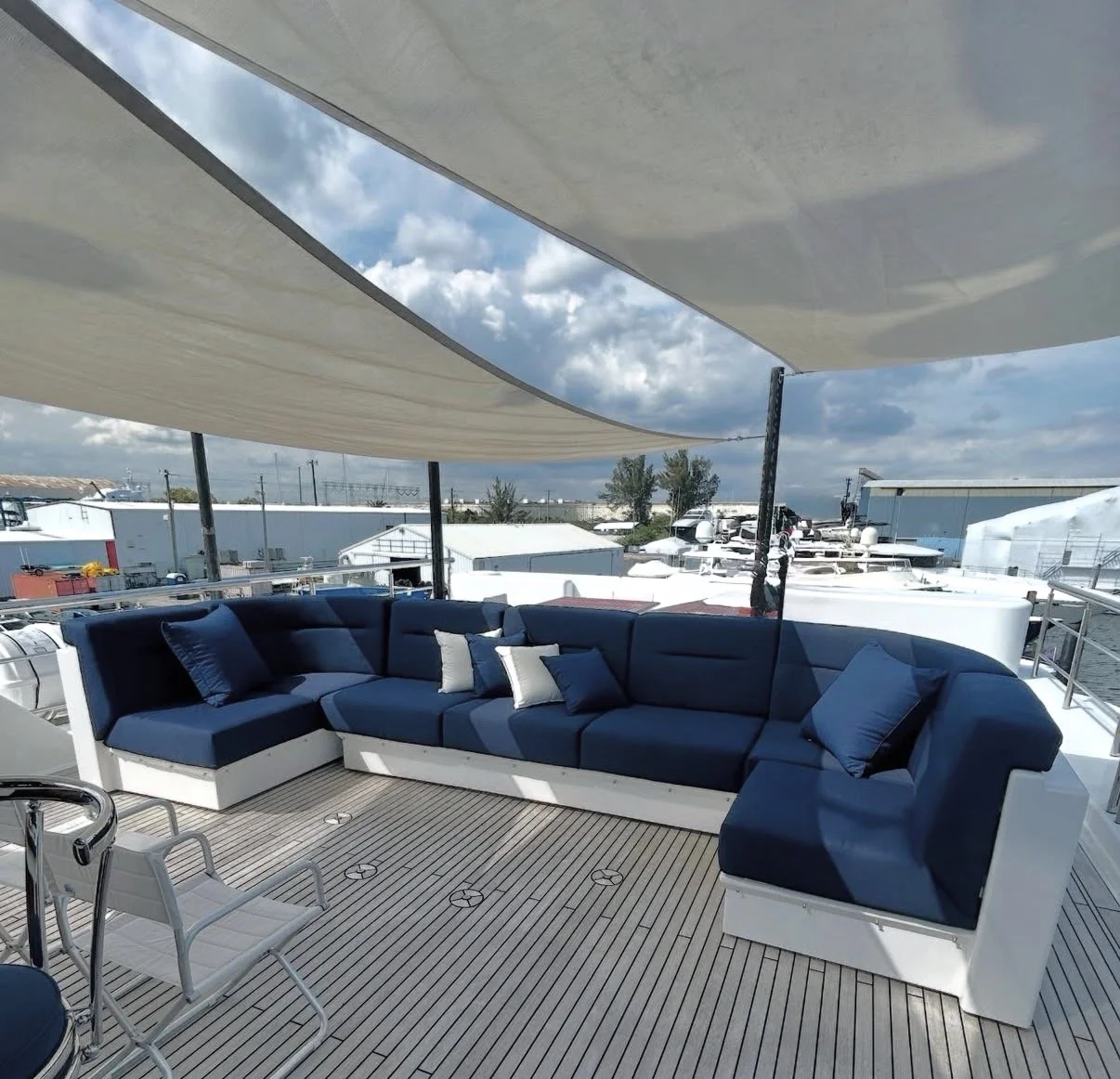
From aft cockpit covers that protect teak decking to flybridge enclosures that extend the usable living space in inclement weather, the goal is consistent: protection and comfort that performs correctly and looks like original equipment. We specialize in Premium Custom Marine Canvas Engineering to ensure additions integrate with the vessel's existing architecture rather than reading as aftermarket additions.
Interior Soft Goods and Bedding
The interior of a motor yacht or superyacht requires the same precision fabrication standard as the exterior. Standard mattresses do not fit the unique contours of a vessel hull — we fabricate custom mattresses using natural latex or memory foam, incorporating Dry Fast technology for breathability in marine cabins where ventilation is a managed concern. Custom headliners serve dual functions: they provide a clean finished appearance to the overhead while acting as sound-deadening panels that reduce engine noise and vibration throughout the cabin — a meaningful quality-of-life improvement on motor yachts with significant propulsion systems.
Exterior Protection and Enclosures
Exterior canvas is a vessel's first line of defense against South Florida's UV intensity, tropical rain events, and salt air exposure during dockside periods. Mooring covers and full vessel covers protect gelcoat, wood accents, and electronics from the sustained UV degradation that accumulates over an extended dockside season.
For vessels in active year-round use, enclosures are a core service. We specify Strataglass panels — offering the optical clarity of glass with the flexibility and reworkability of vinyl — typically paired with mesh underlining to provide ventilation while managing spray and insects. For enclosure systems on superyachts with complex flybridge or pilothouse configurations, we fabricate to the vessel's specific geometry using 3D digital patterning.
High-Performance Materials for the Marine Environment
Material selection is the foundation of any professional marine canvas and upholstery project. We specify only materials with documented performance credentials and manufacturer warranties appropriate to the application.
Current Material Standards in Marine Canvas and Upholstery
Solution-dyed acrylics — Sunbrella being the industry standard — represent the correct specification for the majority of sun-exposed canvas applications. Unlike surface-dyed alternatives, solution-dyed fibers are saturated with UV-stabilized pigments through the fiber core — delivering colorfastness that holds through multiple seasons of direct South Florida sun exposure. Current material innovations include:
- Antimicrobial Treatments: Integrated into the fiber structure to resist mold and mildew in enclosed marine environments.
- Breathable Membranes: Allowing moisture vapor to escape from beneath covers while preventing water ingress — critical for protecting interior surfaces during extended dockside storage.
- Dry Fast Foam: Open-cell foam with a pore structure that does not retain water — the correct specification for cockpit cushions and exterior sunpads in South Florida's rain-intensive summer season.
For a detailed comparison of the primary material options, see our guide to Marine Canvas Materials.
Specifying the Correct Textile by Application Zone
Material specification varies by application zone on a motor yacht or superyacht. For high-traffic seating — exterior deck areas, helm stations, crew areas — abrasion resistance and tensile strength are the primary specification criteria. For interior settees and owner's cabin applications, hand (the tactile quality of the fabric) and aesthetic range become relevant alongside the baseline performance requirements. With over 1,000 products available in the Sunbrella marine upholstery line alone, correct specification requires expertise in how each option performs in the specific conditions of each application zone — not simply selecting from a catalog based on appearance.
Professional Engineering vs. Traditional Fabrication
The gap between a local canvas shop and a professional marine fabrication facility is primarily a process and technology difference — not simply a quality-of-craft difference.
Precision Fabrication for Large-Scale Vessel Projects
We utilize 3D scanning and ProLiner technology to create a digital twin of each vessel. This captures every curve, cleat, and stanchion with sub-millimeter accuracy — producing templates that eliminate the fit errors that manual measurement generates on complex vessel geometry.
| Feature | Manual Patterning | 3D Digital Measurement (American Marine) |
|---|---|---|
| Accuracy | Subject to human error and fabric stretch | Digital precision — no accumulated measurement error |
| Speed | Multiple site visits and fittings required | Single scanning session — one-time fitment |
| Archiving | Physical patterns degrade and are difficult to store | Digital files archived indefinitely — replacement available at any time |
| Repeatability | Difficult to replicate exactly | Identical replacement panels fabricated from archived templates |
This precision eliminates the installation labor associated with fitting covers that don't align correctly. CNC-cut panels fit correctly the first time — reducing yard time and the disruption to a vessel's operational schedule.
Why Yacht Builders and Refit Managers Prioritize Scalable Solutions
Yacht builders and refit managers in South Florida specify our services because our digital workflow delivers consistency across multiple vessels and multiple fabrication cycles. When a builder is producing a series of vessels, canvas and upholstery specifications need to be identical in fit and quality across the fleet — a result that manual fabrication cannot reliably deliver. CNC cutting also optimizes material usage, reducing waste and allowing investment in higher-quality textiles and hardware without increasing total project cost.
Maintenance Protocols for Marine Canvas and Upholstery
Even correctly specified and professionally fabricated marine canvas and upholstery requires a consistent maintenance schedule to reach its full service life. In South Florida's salt-heavy environment, neglect is the fastest way to lose years of service life from a professional installation.
Routine Inspection and Early Repair
Monthly inspection of all soft goods is the correct maintenance cadence for vessels in active South Florida use. Key inspection points:
- Hardware Tension: Verify bimini frames and enclosure tracks are secure — loose hardware creates load concentrations that accelerate fabric stress and tearing.
- Seam Integrity: Identify fraying thread or loose stitching before it progresses to panel failure.
- Zipper Function and Lubrication: Apply marine-grade zipper lubricant to prevent salt crystallization from seizing hardware — zipper failure is the most common and most preventable maintenance issue on marine canvas systems.
Early repair of minor issues — a loose stitch, a small chafe point — prevents progression to full panel replacement. For canvas repair support on enclosures and covers, contact American Marine to schedule a dockside assessment.
Cleaning and Long-Term Protection
Consistent cleaning is the most effective maintenance action for extending marine canvas service life. Most marine-grade fabrics clean effectively with mild soap and lukewarm water — the correct starting point for routine cleaning on any vessel. For established mold or mildew, a diluted bleach solution may be used on solution-dyed acrylics — always verify with the manufacturer's specification for the specific product before applying bleach-based treatments. Protective coatings that enhance water repellency and UV resistance can be applied seasonally to extend the fabric's performance beyond its baseline specification — particularly useful on vessels in continuous South Florida operation without extended lay-up periods.
Frequently Asked Questions
What factors influence the cost of a marine canvas and upholstery project?
Project cost is driven primarily by vessel size and complexity, total material yardage, textile and hardware specification, and whether the project involves interior soft goods, exterior canvas, enclosures, or a combination. Larger vessels require more reinforcement and more complex hardware integration. 3D digital patterning adds a front-end engineering cost that is typically recovered in reduced installation labor and rework — the fit is correct the first time rather than requiring multiple adjustment sessions at the vessel.
How long does professional marine canvas and upholstery last?
Premium materials carry manufacturer warranties of 5–10 years for canvas fabrics like Sunbrella, and Strataglass clear vinyl typically lasts 3–5 years with proper care. Upholstery vinyls range from 3–7 years depending on UV exposure and maintenance consistency. With correct specification, professional fabrication, and consistent maintenance, many vessels see canvas and upholstery systems perform well beyond these baseline figures. Our workmanship is held to a standard where the seams outlast the fabric itself.
Why is 3D scanning the preferred method for large vessel enclosures?
Manual patterning on complex surfaces is prone to cumulative measurement error and fabric creep — the small inaccuracies that compound across a large enclosure and produce a result that doesn't tension correctly, sags in the wrong places, or doesn't align with hardware at the attachment points. 3D scanning eliminates these variables by capturing the exact geometry of the vessel's superstructure digitally. The result is an enclosure that tensions correctly across its full span, fits hardware without adjustment, and looks like it was designed for the vessel — because the template was taken from the vessel.
Conclusion
Marine canvas and upholstery on a motor yacht or superyacht is a technical discipline that determines how well the vessel is protected, how long the interior holds its condition, and how the vessel presents to guests, charter clients, and prospective buyers. The difference between correct specification and fabrication and a generic alternative is measured in years of service life and thousands of dollars in avoided maintenance and replacement cost.
American Marine fabricates custom marine canvas and upholstery for motor yachts and superyachts across Fort Lauderdale, West Palm Beach, and Miami. If you're planning a refit or canvas replacement on a vessel 40ft or above, schedule a dockside assessment and we'll evaluate your vessel's specific requirements and recommend the correct specification for each system.